

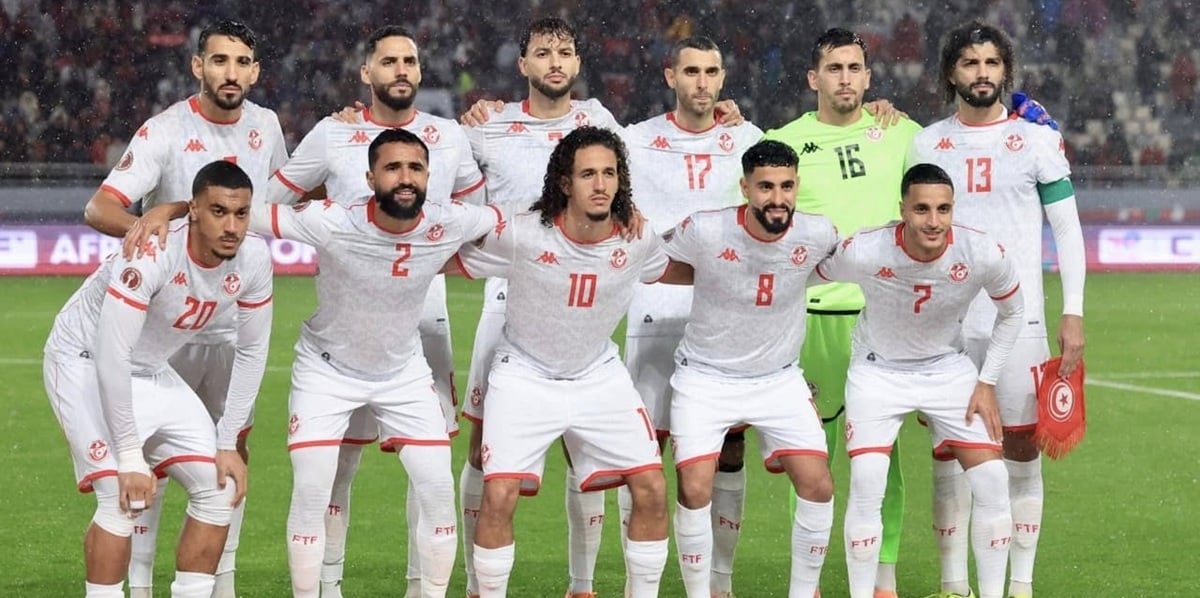
Tunisia launched its African Cup of Nations perfectly by dominating Uganda in Rabat. A solid start on a sporting level, marked by positive historical statistics, but contested in a stadium far from displaying the fervor observed during previous continental and Arab meetings.
The Tunisian selection successfully completed its baptism of fire in the African Cup of Nations by winning with authority against Uganda. This success, the first in an opening match in more than a decade, confirms the rise in power of the Eagles of Carthage. However, it took place in front of sparsely populated stands partly due to pouring rain.
Sparse stands, far from the fervor of Qatar
The Tunisia – Uganda match, played at the Rabat sports complex, was played in front of around 17,000 spectators, a modest attendance considering the capacity of the stadium (60,000) and especially in comparison with the mobilization observed during the Arab Nations Cup in Qatar.
In Doha, Tunisia’s matches attracted between 27,000 and nearly 50,000 supporters, supported by a large Tunisian diaspora living in Qatar (around 60,000).
In Rabat, several factors explain this difference: absence of a massive Tunisian diaspora in Morocco, competition from other tournament posters, weather. Result, a discreet Tunisian presence in the stands, despite the stakes of the match and the quality of the spectacle offered on the field.
An inaugural victory that puts an end to twelve years of waiting
On a sporting level, this victory is of particular importance. By winning in its first CAN match, Tunisia put an end to a negative series which had lasted for twelve years, its last inaugural victory dating back to 2013.
This statistic, long weighing on people’s minds, gives this success a strong symbolic significance. It also reflects better management of entry into competition, which was often difficult for the Eagles of Carthage in previous editions.
Trabelsi faces dilemma in next match against Nigeria
Building on the successful performance against Uganda, coach Sami Trabelsi finds himself faced with a major strategic choice before the clash against Nigeria. The collective mastery displayed argues for continuity in the starting eleven, but the Nigerian opponent imposes a different tactical reading.
Without announcing major changes, the technical staff could make targeted adjustments, particularly in midfield or on the wings, in order to respond to the intensity and athletic power of the Super Eagles. Effort management and physical freshness will also come into play in this fast-paced tournament.
On the sidelines of the meeting Sami Trabelsi declared:
“The main thing was done with this victory against Uganda. The opening matches in the African Cup of Nations are always complicated, especially since Tunisia had not won its first match for several editions. We have also seen that several major selections experienced difficulties during the first day, which confirms the evolution of African football and the reduction in the gaps between the teams.
This success is above all the result of the determination of the players, the goal scored very early which made our task easier, but also their ability to remain concentrated and tactically disciplined from start to finish. This victory is important and constitutes a promising start for our continental adventure. This new generation has potential and deserves to go far at the CAN.
The next match against Nigeria will be totally different and much more difficult. We will have to manage it well on a tactical level, make the most of the qualities of our players and hope for better offensive efficiency in order to obtain a positive result.”
On an organizational level, this CAN organized in Morocco relies on modern infrastructure and generally controlled logistics. The renovated stadiums, the reception conditions for the teams and the security were praised by several observers.
However, the uneven attendance of the stands and certain adjustments still necessary in terms of programming and entertainment demonstrate a tournament which is gradually finding its rhythm.