

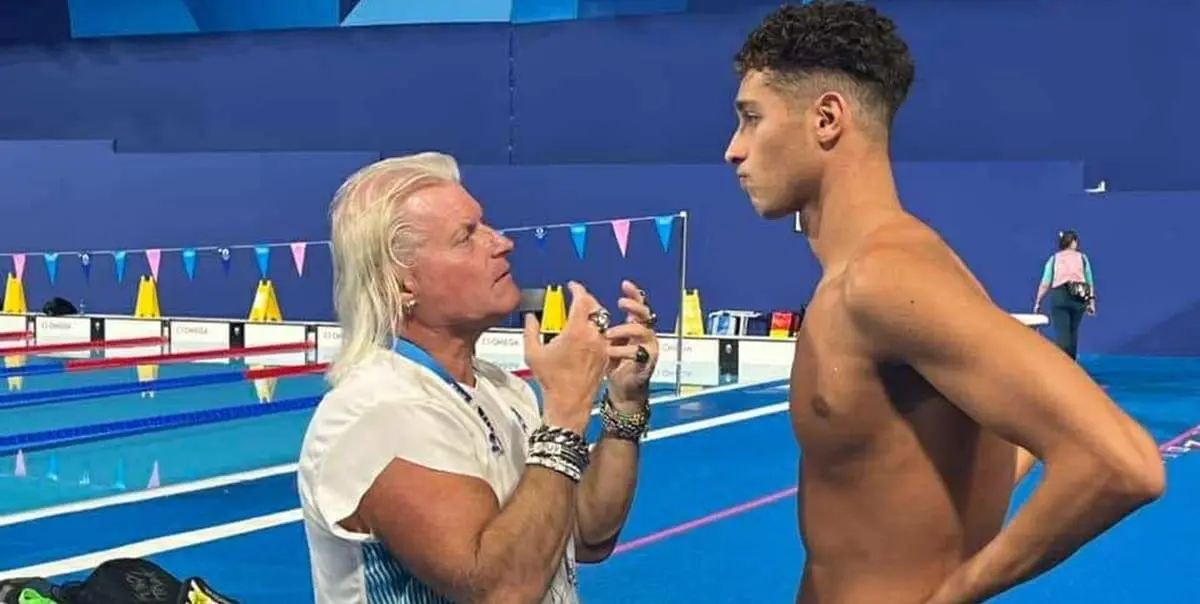
The affair between Ahmed Jaouadi, double world swimming champion, and the Tunisian Swimming Federation (FTN) goes far beyond the framework of a simple financial dispute: it illustrates a deeper malaise in the governance of Tunisian sport, the recognition of exceptional athletes, and the relationship between the federal institution and its champions.
A champion adored, but poorly supported?
Jaouadi, aged only 20, achieved a historic feat: he won gold at the 2025 World Championships in Singapore in the 800m and 1,500m.
This performance aroused national admiration, reinforced by a very symbolic official welcome – the President of the Republic honored him, highlighting Jaouadi’s potential as a model of excellence for youth.
But this media and symbolic influence seems to contradict the financial tensions that have emerged: Jaouadi and his trainer, Philippe Lucas, denounce a lack of payment from the federation, or even unfulfilled commitments. According to their camp, the amounts actually received would not even cover their annual expenses.
The Federation defends itself, but the dialogue fractures
For its part, the FTN responds with precise figures: it claims to have paid 185,000 dinars for the preparation of Jaouadi, and 105,000 dinars for supervision (coach, logistics, etc.).
It also indicates that the transfers were converted into currency and paid into the swimmer’s account in August, once bank authorizations had been obtained.
On the salary aspect of the coach, the federation affirms that a tranche of 50,000 dinars corresponds to his emoluments, while announcing that an additional amount will soon be released.
But for Jaouadi and Lucas, everything does not align: they claim that the amounts announced by the FTN are “inflated” and that the actual transfers remain significantly lower than what was agreed.
The dialogue, already fragile, is taking a legal turn on Lucas’ side, according to the media, which mention a possible lawsuit against the federation for non-payment.
The implications for Tunisian sport
This confrontation raises several structuring questions.
The value of champions: Jaouadi is certainly a source of national pride. His double world medal shows that he can take Tunisia to the highest level. But this case shows that symbolic recognition (awards, decorations) is not enough if logistical and financial support is lacking.
The credibility of federal institutions: If the FTN wants to be perceived as a pillar of talent support, it must demonstrate that commitments are not just communication. The lack of clarity perceived by the athlete and his coach weakens this image.
Transparency and contractual monitoring: The fact that Jaouadi and Philippe Lucas are in public disagreement over figures that should be clear (bonuses, salaries, transfers) shows that the control, contractualization and accountability mechanisms are perhaps insufficient in the federal structure.
The attractiveness of high-level sport in Tunisia: If talented athletes like Jaouadi feel that they are not supported to match their performances, this could discourage other talents or push some to train abroad.
A crisis to be managed with diplomacy
For the FTN, it is not just a question of responding to the accusations: it must renew a bond of trust with its champion. For Jaouadi, the choice is not trivial either: openly contesting may be a matter of principle, but it could also jeopardize his training partnership and his image.
The Jaouadi–FTN affair reveals a paradox: a young prodigy who flies the colors of Tunisia, and a federal institution which perhaps struggles to translate media promotion into concrete and lasting support.
If not handled carefully, this crisis could harm the development of other talents. On the contrary, its resolution could pose a model of collaboration between champions and federation: a win-win partnership, essential for the future of Tunisian sport.
Read also