
Old but evolving, economic cooperation between Tunisia and Saudi Arabia is developing in successive phases. The recent announcements made in Riyadh are part of a dynamic of recovery rather than disruption.
The declarations of the Tunisian Minister of Economy and Planning, Samir Abdelhafidh, during the Tunisian-Saudi Business Forum held in Riyadh, shed light on a bilateral relationship often mentioned but rarely placed in its historical depth. With a stock of investments exceeding $375 million at the end of 2024, Saudi Arabia is among the top ten foreign investors in Tunisia. A significant positioning, which reflects a real presence but without a clear break in the trajectory of cooperation.
An old cooperation, structured by cycles
Tunisian-Saudi cooperation is not a recent dynamic. The oldest and most documented benchmark dates back to 1975, when the Saudi Fund for Development financed projects in Tunisia. Since that date, 35 projects and programs have been supported, for a cumulative amount exceeding $1.3 billion, mainly in infrastructure, water, housing and regional development.
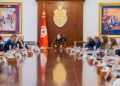
On an institutional level, the relationship was formalized by joint commissions organized at regular intervals. The 10th session was held in Riyadh from April 27 to 29, 2019, the 11th in Tunis on December 26 and 27, 2023, and the 12th in Riyadh on December 28 and 29, 2025. This rhythm illustrates cooperation relaunched in sequences, rather than a continuous and linear process.
The December 2025 session concluded with the signing of five agreements and memoranda of understanding covering several areas, including water, irrigation, rural development, environment, industry, agriculture, health, education and certain services. This relaunch appears above all as a strengthening of the institutional framework, intended to consolidate the foundations of the relationship rather than to announce an immediate wave of new projects.
Key investments and projects, but a gradual dynamic
On the private investment side, the figures communicated by the Tunisian authorities converge on a central point: the stock of Saudi investment in Tunisia exceeds 375 million dollars at the end of 2024. On the other hand, estimates on the number of companies with Saudi participation vary depending on the sources and accounting methods, oscillating between around fifty direct companies and several hundred if we include indirect participations and holding companies.
One indicator, however, comes up constantly: seven companies with Saudi participation carried out expansions of activity during the first nine months of 2025, suggesting a progressive dynamic, based on consolidation rather than massive and rapid investments.
Costed projects that provide visibility
Cooperation appears more legible when observed through dated and costed projects. On February 23, 2024, the Saudi Fund for Development announced a $55 million loan for the renewal and development of the phosphate transport rail network, covering approximately 190 kilometers of track. In the housing sector, funding exceeding $150 million was granted for a program of 4,715 units, of which a first phase of 270 housing units was inaugurated in Zaghouan.
On June 28, 2025, a loan agreement of 143.3 million Saudi riyals, or approximately $38 million, was signed in Tunis for the realization of an oasis pole project in the south of the country. In the health sector, the King Salman University Hospital in Kairouan constitutes one of the most emblematic projects, with an initial announced donation of $85 million. Suspended for a long time, this project was relaunched in December 2025, with an announced completion time of 36 months.
On the commercial front, trade between the two countries has also progressed gradually. They are estimated at around 1.12 billion Saudi riyals in 2024, compared to nearly 820 million riyals in 2020, confirming a regular increase but without change in scale.
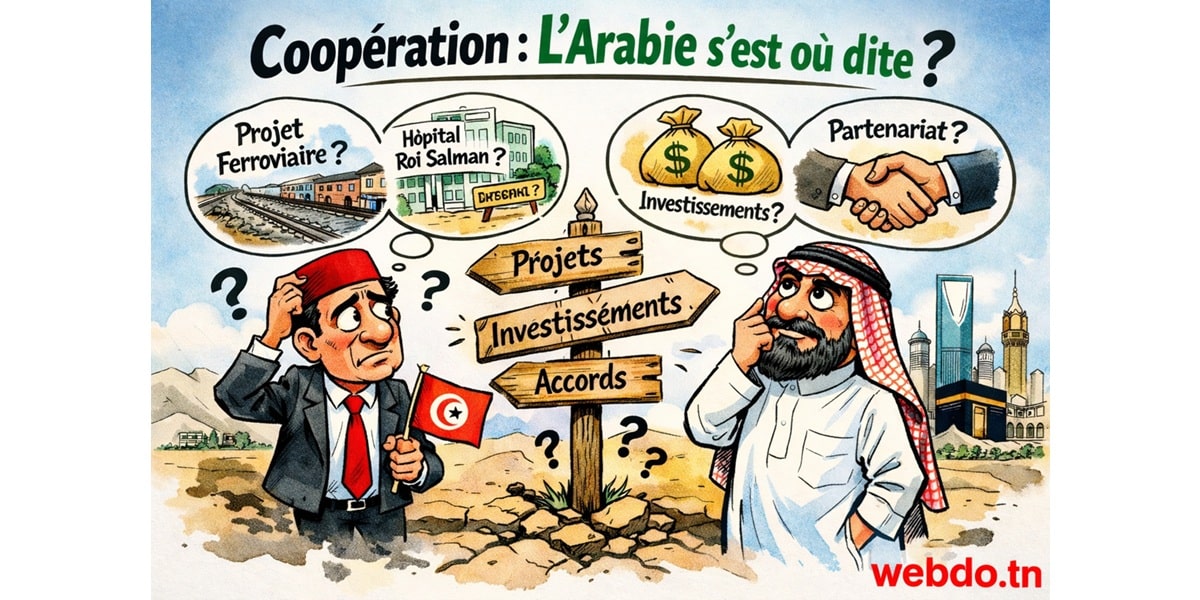
Over the decades, Tunisian-Saudi cooperation has been built in successive waves, alternating structuring projects, slowdown phases and institutional revivals. The question raised by the title does not refer to an absence of cooperation, but to its visibility and regularity. The challenge now lies in the capacity of the two countries to transform these recovery cycles into a more continuous dynamic, backed by sustainable projects and better integrated into the Tunisian economic fabric.
Also read: