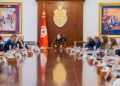

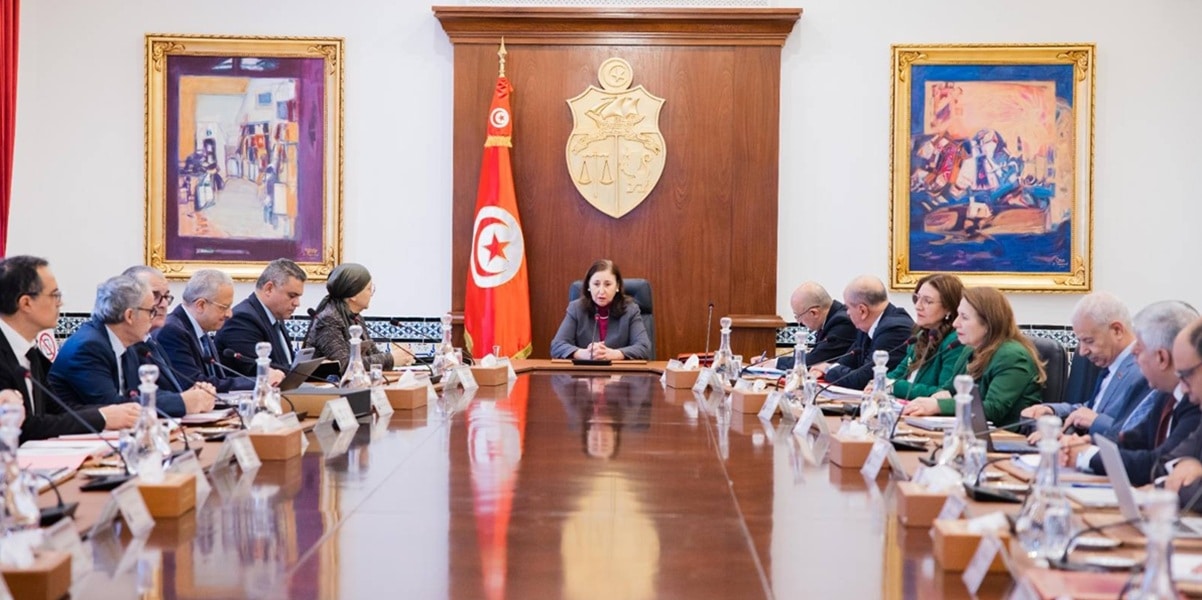
The head of government, Sarra Zaâfrani Zenzri, chaired a ministerial council this Tuesday at the Kasbah Palace devoted to the draft 2026-2030 Development Plan. Presented as a turning point in the country’s economic and social planning, this document intends to break with previous policies and lay the foundations of a new development model based on social justice, territorial balance and economic sovereignty.
A plan developed using a unique method in Tunisia
From the opening of the work, the head of government stressed that this plan was closely monitored at all stages of its development. For the first time, Tunisia is adopting a bottom-up approach, starting from the local level to the regional, then the interregional, before ending up at the national level.
The project is based on the synthesis of reports from local, regional and regional councils, within a framework guaranteeing the unity of the State and coherence between public policies and projects proposed by elected authorities. The stated objective is to install a new development model consistent with the vision of the President of the Republic, Kaïs Saïed, and meeting the social and economic expectations of Tunisians.
According to the head of government, the 2026-2030 Plan establishes the social dimension as a sustainable strategic choice of the State. It aims to establish equitable economic and social integration between regions and prepare the ground for a stronger and more resilient economy in the face of global changes.
The document takes into account, in particular, geopolitical tensions, the slowdown in global growth and the reconfiguration of production chains. It also integrates the challenges linked to the digital transition and the rise of artificial intelligence, as well as energy, climatic and environmental transformations, marked by the rise of renewable energies, environmental pressure and the need to invest in clean technologies.
Growth, employment and competitiveness at the heart of the economic component
On the economic front, the government aims to increase the pace of growth by focusing on sectors with high added value, strengthening innovation, research and development, as well as stimulating productive investment.
The objective is to consolidate the resilience of the national economy in the face of shocks, improve its competitiveness and create decent jobs, while significantly reducing unemployment, particularly among young people and higher education graduates.
On a social level, the plan aims to broaden the base of growth beneficiaries in order to reduce poverty and precariousness. It also provides for the strengthening of social protection mechanisms and the guarantee of equal opportunities in access to education, health and employment, with the aim of consolidating social cohesion and restoring citizens’ confidence in public policies.
Priority to disadvantaged regions and public investment
The territorial axis constitutes one of the pillars of the project. The government intends to prioritize investments, particularly public investments, towards the least developed regions, with emphasis on infrastructure and the improvement of basic services.
This strategy aims to reduce regional disparities, strengthen the attractiveness of territories and encourage the emergence of new growth poles outside traditional centers.
The head of government also insisted on the need to initiate the legislative reforms required to ensure coherence between the economic, social and territorial dimensions of the plan, as part of a global approach based on an equitable and inclusive development model.
She affirmed that the 2026-2030 Development Plan constitutes a decisive national step, marking a break with previous policies which, according to her, generated social, economic, environmental and institutional imbalances.
A detailed presentation from the Ministry of Economy and Planning
During this council, the Minister of Economy and Planning, Samir Abdelhafidh, presented a detailed communication on the macroeconomic framework, the summary of the work of local and regional councils, as well as on growth objectives and new sectoral perspectives.
In particular, he presented the directions planned in key sectors such as agriculture, industry, phosphate, energy, transport and exports, as well as the methodology retained for the selection and integration of projects in the 2026-2030 Plan.
Concluding the work, the head of government announced that the draft Development Plan 2026-2030 will soon be submitted to the Council of Ministers, after incorporating the observations made by members of the government.
This document is intended to become the central roadmap for the State’s economic and social action for the next five years.