
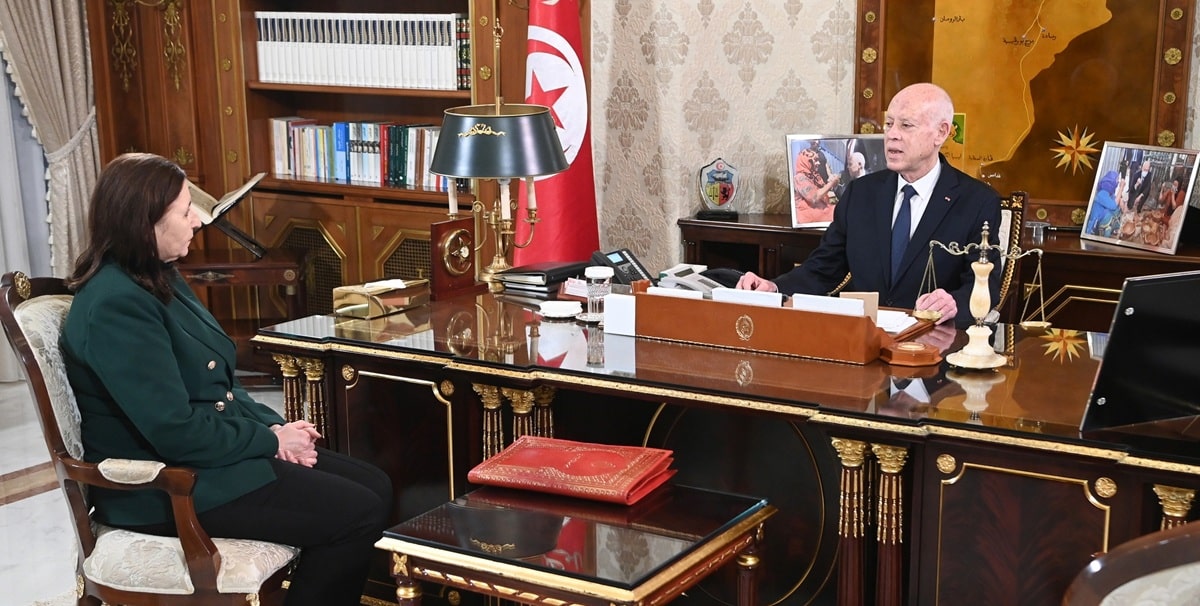
Receiving the head of government at the Carthage palace, President Kaïs Saïed urged the executive to change pace. Building on the popular support expressed recently, he insisted on comprehensive action, breaking with fragmented solutions, and warned that those responsible will face concrete responses. The Head of State reaffirmed that national interest, sovereignty and integrity must take precedence at all levels of decision-making.
The President of the Republic, Kaïs Saïed, met with the head of government, Sarra Zaafrani Zenzri, at the Carthage palace. At the heart of the discussions: the imperative to accelerate public action in all sectors. The Head of State linked this demand to the popular support recently expressed, which he described as a strong political message, indicates a press release from the Presidency of the Republic.
Caution against case-by-case approaches
President Saïed called for a move to “higher gear” in all areas, believing that the context requires rapid and coherent decisions. He warned against case-by-case approaches, calling for an overall vision capable of sustainably responding to citizens’ concerns. The stated objective is to restore confidence through legible policies and tangible results.
Insisting on the criteria of a good public official, the Head of State underlined the primacy of the national interest and the defense of sovereignty. He also recalled the requirement for integrity and loyalty, as well as the obligation to act to remove the obstacles that weigh on the daily lives of Tunisians. For Kaïs Saïed, the public service cannot be reduced to communication, but must produce concrete effects.
Concrete responses to failures
Faced with officials deemed incapable of loyally serving the citizen, the president warned that the response will not be limited to speeches or press releases. He promised measures with a real impact, intended to materialize the objectives of the revolution, particularly in terms of employment, freedom and national dignity.
Kaïs Saïed paid tribute to the civic conscience of the Tunisian people, which he considers to be a bulwark against maneuvers and attempts at destabilization. He praised the political maturity of citizens, believing that it protects the country against duplicity and agendas contrary to the national interest.