
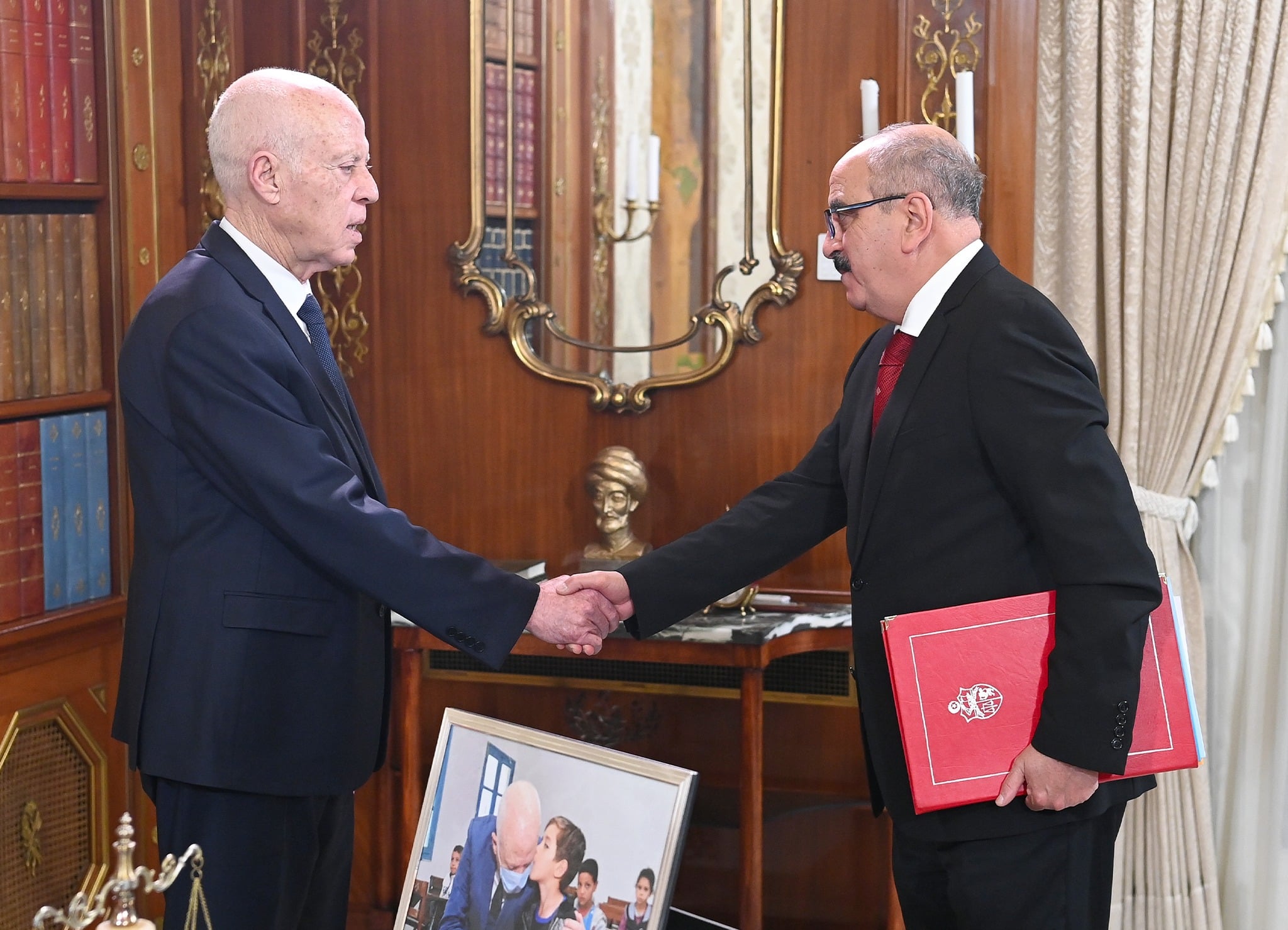
The President of the Republic, Kaïs Saïed, received the Minister of Foreign Affairs, Mohamed Ali Nafti, at dawn on November 28, to discuss recent European positions concerning the case of lawyer Sonia Dahmani. During this meeting, the head of state once again rejected what he describes as foreign interference, denouncing political pressure exerted under the guise of defending human rights. He particularly targeted the resolution adopted by the European Parliament calling for the immediate release of the lawyer, believing that it constitutes a direct attack on Tunisian sovereignty.
Kaïs Saïed affirmed that no link existed between this resolution and the recent judicial decision concerning Dahmani, released under judicial supervision after several months of detention. He insisted on the fact that Tunisian justice operates independently of any external pressure, stressing that Tunisia categorically refuses to associate a sovereign decision with the political initiatives of foreign institutions.
The president also instructed the Minister of Foreign Affairs to transmit a firm challenge to the European authorities, targeting the actions of a foreign diplomat stationed in Tunis, accused of having taken steps outside of protocol practices. Without naming her, Kaïs Saïed denounced actions that he considers “incompatible” with diplomatic rules and with the respect due to Tunisian institutions. This reaction comes a few days after a first summons from the European Union ambassador in Tunis, Giuseppe Perrone, for similar reasons.
Towards diplomatic tension?
The European resolution, adopted by a large majority, denounces the detention deemed arbitrary of Sonia Dahmani and calls for the repeal of Decree-Law 54 used against numerous journalists and lawyers. European institutions, for their part, affirm that their diplomats have the right to meet representatives of civil society and express their concerns about the state of freedoms in Tunisia.
This new episode marks an intensification of tensions between Tunis and Brussels. While the European Union claims to pursue a dialogue based on democratic values, the Tunisian presidency sees these positions as an intrusion into the country’s internal affairs. The conditional release of Sonia Dahmani, announced the same day as the European resolution, only fueled divergent interpretations. For Kaïs Saïed, the coincidence is not a coincidence: only Tunisian law is at the origin of this decision.
Read also