
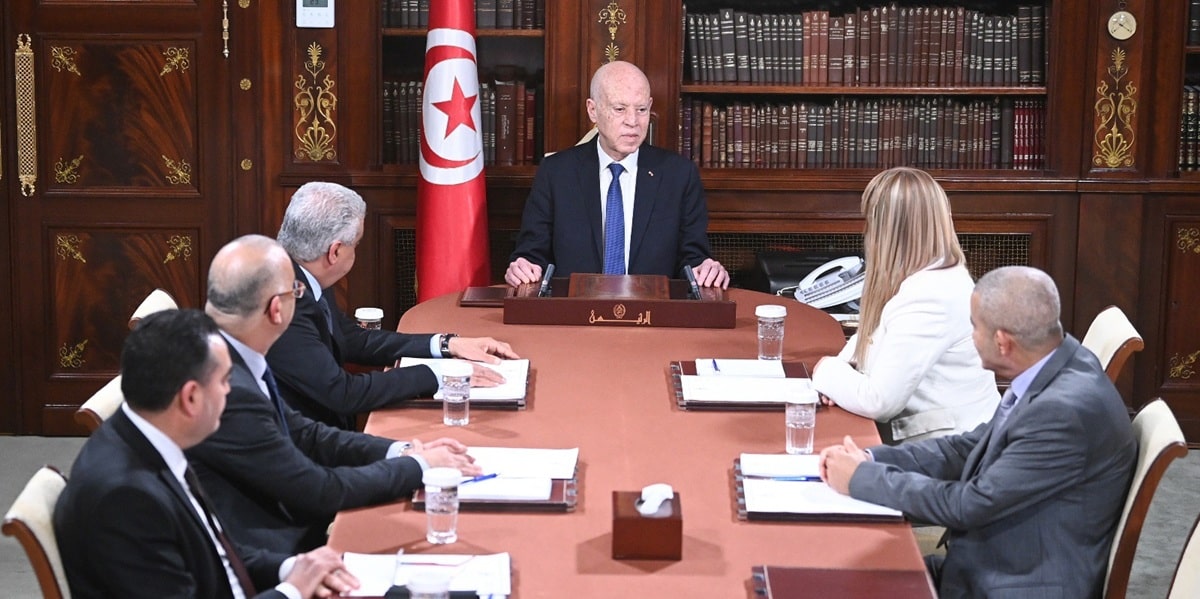
The President of the Republic brought together the main officials of the public media and the national press at the Carthage palace. At the heart of the meeting: the history of the Tunisian press, the mission of the public information service and the political and symbolic issues of the moment. Kaïs Saïed insisted on the continuation of the national liberation process and on the need to fundamentally rethink certain concepts inherited from the past.
The President of the Republic, Kaïs Saïed, received at the Carthage Palace the main managers of public media institutions and several national press groups, in a meeting with strong political and symbolic significance. Present were the leaders of Tunisian Television, Tunisian Radio, Agence Tunis Afrique Presse (TAP), SNIPE La Presse as well as the representative of Dar Assabah.
Between memory and national struggle
During this meeting, the Head of State reflected at length on the major stages which marked the history of the press in Tunisia, from the first founding texts of the end of the 19th century to the legal framework in force today. He spoke of the central role played by newspapers and intellectual figures in the national liberation movement.
Through this historical reminder, Kaïs Saïed wanted to emphasize that the press has never been a simple information tool, but a full player in the country’s major political and cultural battles.
The president insisted on the particular responsibility that falls to public media today: to reflect the daily concerns of citizens, to guarantee transparent information and to defend the general interest. He considered that this mission is all the more crucial in the current political context, marked by what he described as a “popular delegation” that took place recently.
According to him, the public media cannot be content with a passive or administrative role, but must be a living space, in direct contact with social expectations and the profound changes that the country is going through.
Concepts to rethink
Kaïs Saïed also affirmed that many concepts inherited from previous periods are now outdated and no longer correspond to current realities. He reiterated that the challenges remain considerable to achieve the objectives of the Revolution, while ensuring that the national liberation process continues in accordance with the will of the people.
Through this meeting, the message addressed to media leaders appears clear: in the current phase, the battle for information and meaning is inseparable from the political battle itself.