
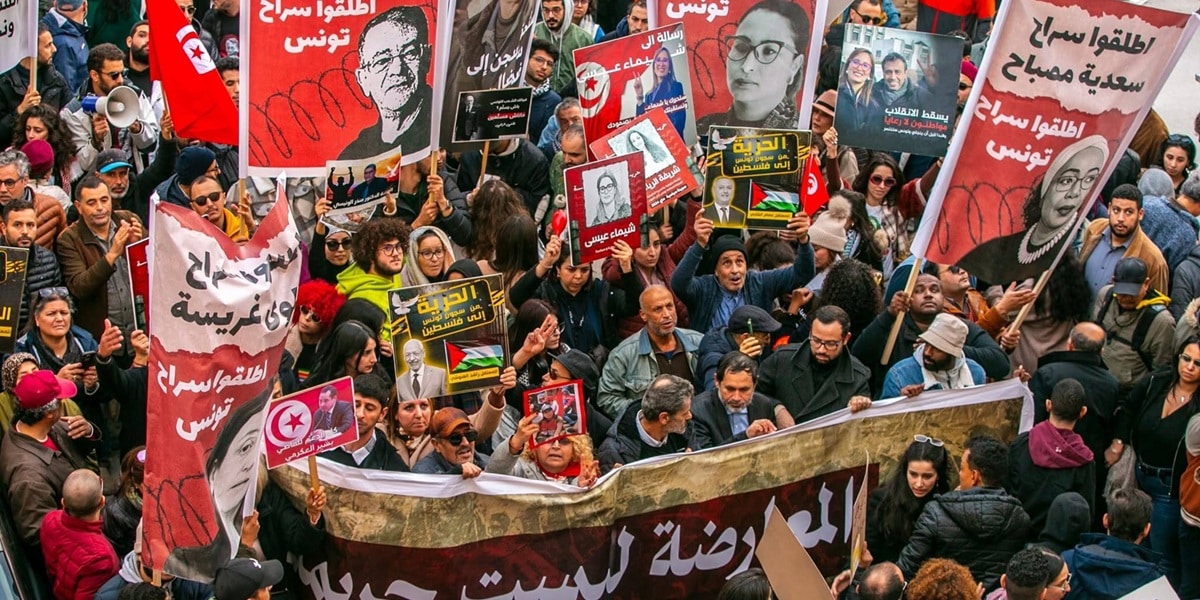
The march organized on Saturday December 6 in the center of Tunis to denounce the criminalization of the opposition brought together between 1,000 and 2,000 people. Modest in its size but notable in its context, this mobilization – the third in two weeks – confirms that the protest continues to be expressed despite the arrests linked to the “plot” affair.
The march left Bab El Khadhra to reach the area around Habib-Bourguiba Avenue, under significant security supervision. The participants chanted “Opposition is not a crime” and brandished the portraits of Ahmed Néjib Chebbi, Ayachi Hammami and Chaïma Issa, recently incarcerated after the confirmation of their conviction in the “plot against state security” case.
Even if participation remained limited, this mobilization remains significant in a climate where public demonstrations are closely monitored.
A movement that is part of a broader sequence
Yesterday’s march follows two other rallies organized at the end of November, notably on the 29th on Place Pasteur and on the 22nd in downtown Tunis. These three close mobilizations are part of a growing protest dynamic: according to the Tunisian Social Observatory (OST), 4,838 collective actions have been recorded since January 2025, compared to 2,638 over the same period in 2024.
The multiplication of these gatherings shows that civil society, despite its divisions and the caution of the parties, continues to mobilize on questions of public freedoms.
The procession brought together community activists, lawyers, students and families of detainees. The presence of many young people was one of the highlights of the day. Several participants claim to have marched to defend principles – justice, civil rights, freedoms – more than political figures.
This trend confirms that mobilization goes beyond traditional partisan structures, often weakened, and relies more and more on citizen collectives and local initiatives.
A tense context ahead of the January 21 strike
The demonstration comes as the political climate remains marked by arrests in the “conspiracy” case. The final convictions handed down against well-known figures have revived concerns about the political use of legal proceedings.
At the same time, another social meeting is looming: the UGTT has called for a general strike on January 21, a movement which could take on a particular dimension after the sequence of mobilizations observed in recent weeks. Several observers believe that the current gatherings are a reminder that the street remains a space for political expression, even when it is not massively crowded.
The caution displayed by the UGTT in the December marches contrasts with the potentially broad scope of its next movement, which adds additional tension to the period.
The organizers believe that the mobilization sends a clear message: a part of civil society refuses the criminalization of political action and wishes to preserve the openness of public space.
The succession of gatherings observed in November and December confirms that a core of protest remains active and that the question of public freedoms continues to mobilize people.
In a context marked by political and social tensions, this march reminds us that protest has not disappeared from the Tunisian landscape.
Also read: