

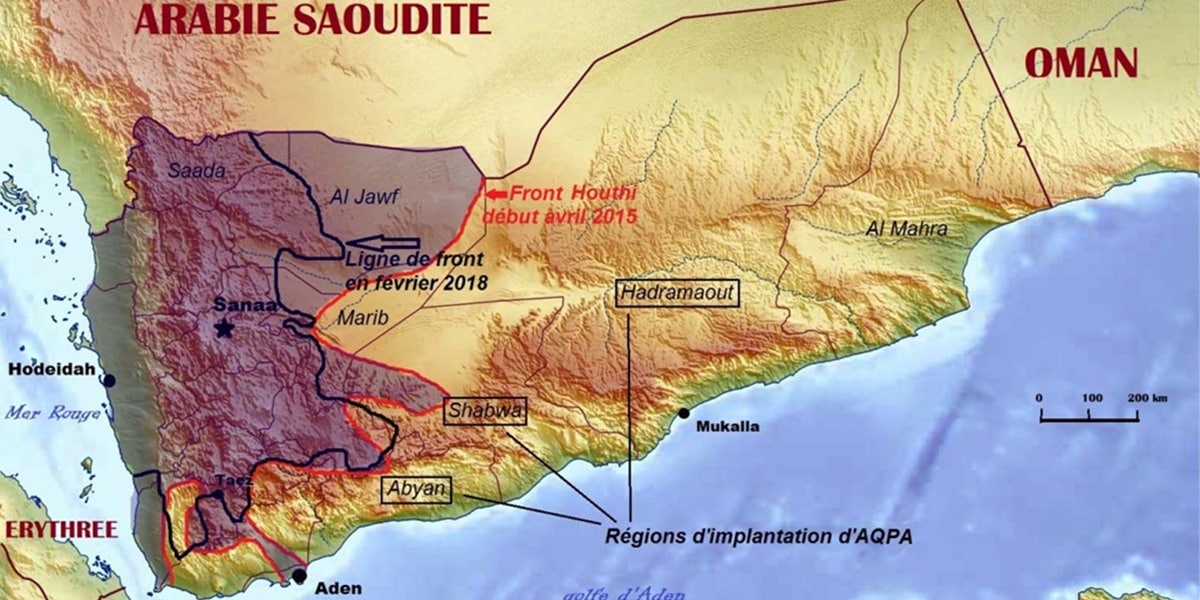
The ongoing clashes in southern Yemen mark a major strategic shift. In Hadramout, the conflict goes beyond the local framework and reveals a long-contained regional divide, while the Southern Transitional Council is now moving forward openly towards its historic objective: separation.
Hadramout, from backyard to strategic front
Having remained on the fringes of the main front lines for a long time, the province of Hadramout is today establishing itself as the new center of gravity of the Yemeni conflict. Bordering Saudi Arabia, this region has become the scene of direct clashes between forces loyal to the recognized government and the Southern Transitional Council (STC), which has reinforced its military presence there in recent weeks.
According to STC officials, at least seven people were killed and more than twenty injured in airstrikes attributed to the Saudi-led coalition, including against a military camp in the al-Khasah region. These figures have not been independently confirmed. The operation announced by the local authorities to retake positions controlled by the STC quickly transformed into an episode of open escalation.
The southern project, now assumed
Created in 2017, the STC has never given up on its ambition to restore an independent South Yemeni state, as it existed before the unification of 1990. Until now, this demand remained contained by fragile political agreements and the need to preserve regional balances.
Today, the movement believes that the moment is favorable. With its control over Aden and other key areas, it multiplies political signals: announced closure of Aden airport, accusations of air blockade, open questioning of the Presidential Council and the Arab coalition. Southern separatism is no longer limited to a demand for identity; it asserts itself as a project of power.
Riyadh, Abu Dhabi and the Gaza effect
Abu Dhabi, without officially commenting on the latest clashes, continues to favor an approach based on its local relays in the south of Yemen, banking on security stability and control of strategic axes rather than on the institutional balances promoted by Saudi Arabia.
Behind the local confrontation lies a broader regional divide. Riyadh implicitly accuses the United Arab Emirates of encouraging and arming the Southern Transitional Council, exposing a long-suppressed rivalry in the name of Gulf unity.
This development takes place in a regional context deeply shaken by the war in Gaza, which has redefined perceptions of security and weakened Arab collective frameworks. In this climate of fragmentation, South Yemen appears as one of the most visible laboratories of the ongoing recompositions, raising the prospect of a lasting partition of the country.