

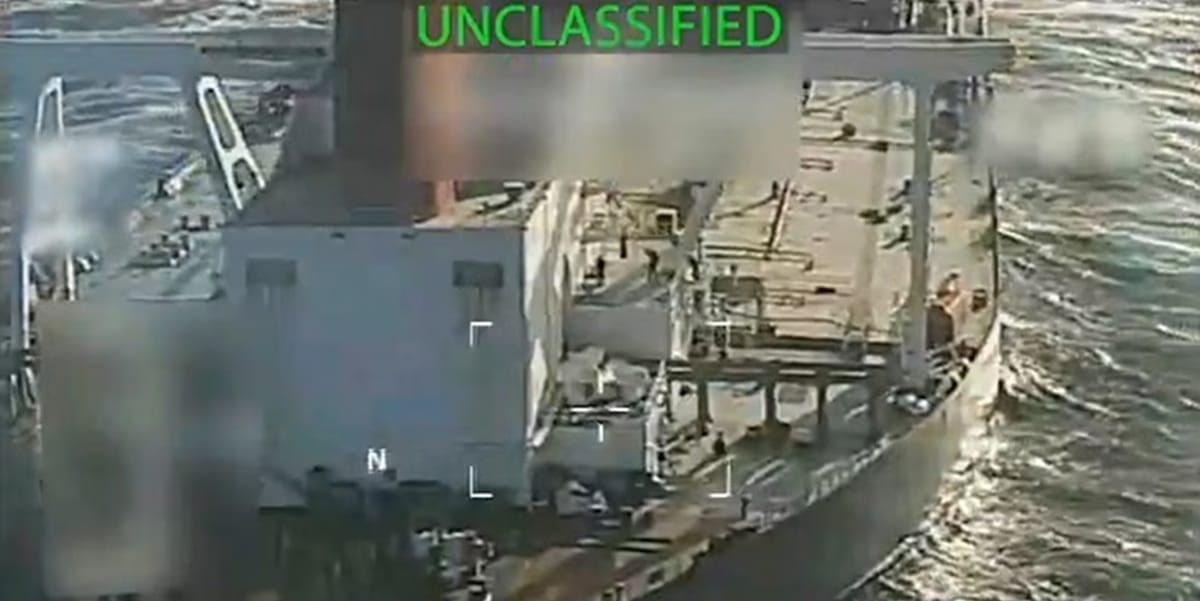
Behind the helicopter operation off the coast of Venezuela, Washington is targeting a parallel economy that links Tehran, Moscow and Caracas.
The video posted by former US Attorney Pam Bondi — showing commandos descending by “fast rope” from a helicopter onto the deck of the oil tanker The Skipper — has made the rounds on social media. But if the image impresses, the geopolitical message it carries is even stronger.
The operation, launched from the aircraft carrier USS Gerald R. Ford, marks an assumed toughening by Washington in its fight against clandestine oil networks. The ship had just left a Venezuelan port when American forces intervened, supported by two helicopters, Marines and an elite Coast Guard unit.
For Caracas, it is an “act of international piracy”. For Washington, on the contrary, it is a step in a broader strategy.
An emblematic tanker of clandestine Iran-Russia-Venezuela architecture
The Skipper, 333 meters long, is no ordinary ship. Under its former name Adisa, it was sanctioned by the US Treasury in 2022 for its role in a maritime nebula led by Russian oligarch Viktor Artemov, accused of transporting Iranian oil under false identities.
Washington claims that these clandestine exports finance:
- the Revolutionary Guards (IRGC) in Iran,
- Hezbollah,
- and partly Venezuela’s flagging economy.
These multiple re-registered tankers, often under fraudulent flags (the Skipper claimed to sail under the flag of Guyana), allow these countries to circumvent sanctions. They cut their transponders, change their identities at sea, take secondary roads and use front companies in Nigeria, Dubai or Russia.
The Skipper was one of the centerpieces of a global parallel economy.
Why Washington acted now
According to several American officials, the intervention was not an improvisation. It occurs in a context where several factors have combined.
On the one hand, Iran has increased its oil exports to Asia and the Caribbean in recent months, despite sanctions imposed by the United States.
At the same time, maritime networks linked to Russia, strengthened since the start of the war in Ukraine, have intensified their offshore operations in order to support Moscow’s financial circuits.
Venezuela, for its part, depends more on these parallel routes to sell its oil and circumvent American restrictions.
The prolonged presence in the region of the USS aircraft carrier Gerald R. Ford also constituted a signal of the American desire to strengthen its presence in the Caribbean.
In this context, the seizure of Skipper appears to be an operation intended to interrupt a network already monitored by Washington and to reaffirm the ability of the United States to act in the area.
The Caribbean, transit zone under surveillance
According to several observers, the operation comes as the region has seen a proliferation, over the past year, of ships operating outside of declared circuits, particularly around Venezuela, Curaçao, Trinidad and Guyana.
The mention of a falsified Guyanese flag on the Skipper has revived sensitivity between Venezuela and Guyana, already at odds over the Essequibo area.
For the United States, the development of these routes could promote the emergence of a parallel oil export system involving Iran, Russia and Venezuela, circumventing international sanctions. Washington says it wants to prevent the consolidation of these circuits and strengthen its presence in a region that has once again become strategic.
An increased American approach to parallel circuits
According to Washington, the operation against Skipper illustrates the limits of economic sanctions to curb oil flows from countries subject to international restrictions. The American authorities now claim to be using an expanded system including air assets, coordination between the Navy and the Coast Guard and committed public communication around these interventions.
Venezuela denounced an action described as “piracy”, but the United States presents the boarding as a measure aimed at disrupting export circuits considered clandestine and preventing the continuation of oil transfers linked to Iran and Venezuela.
For Washington, the Skipper represents an example of the ships used in these networks. Its interception is part, according to American officials, of a broader effort to contain practices deemed destabilizing for the international energy market.
Read also