
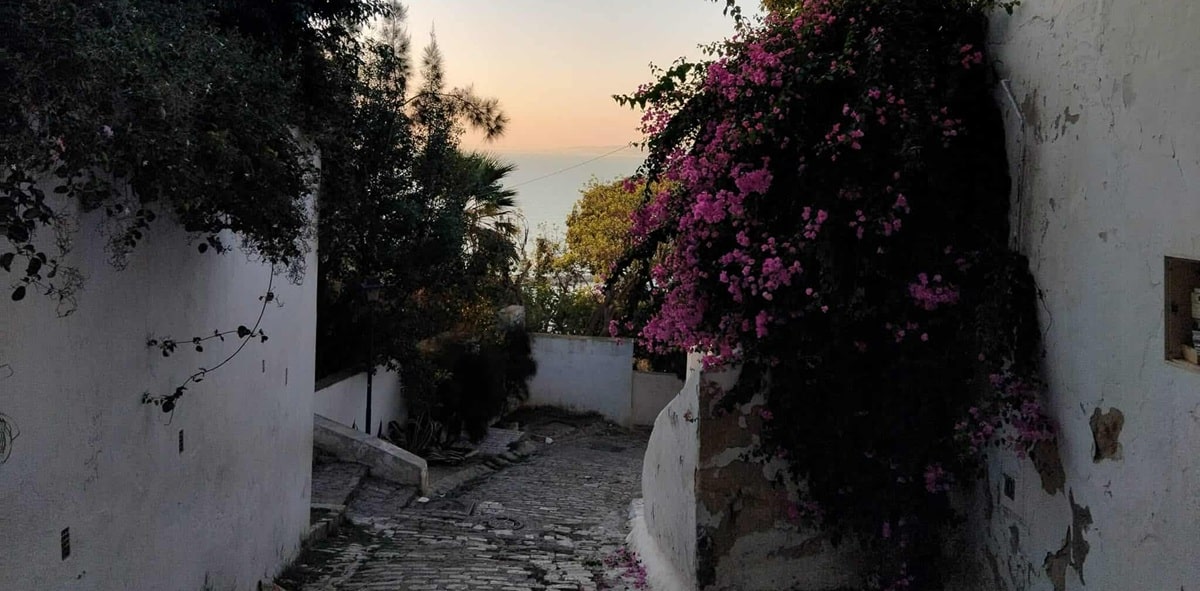
Near the tomb of Sidi Bou Said is that of Lella Chérifa who is none other than the daughter of the holy person. Mysterious, always closed, the sanctuary of Lella Chérifa reminds us that Sidi Bou Said, according to its legend, would have had two daughters Chérifa and Salha whose tomb is located in the mausoleum which bears his name in Carthage
This also reminds us that on the mystical hill of the northern suburbs, several women, like Ommi Messaouda, Lella Meimoura and Lella Chérifa, also had their halo of holiness. In our post we take a look at a popular tradition at the heart of our intangible heritage.
The zaouia of Sidi Bou Said dominates the hill that has been said to be mystical and inspired. Nicknamed Rais el Bhar (The Master of the Seas), the holy character lived from 1156 to 1231.
His real name, Abou Said Ibn Khalef Ibn Yahia Ettamimi Al Béji, is the patron saint of the village which was formed around his mausoleum, the target of a cowardly Salafist attack in recent years.
If the mosque and the tomb of Sidi Bou Said are known to everyone, this is not the case for the tombs of several other holy people who lived in these places.
The best known are undoubtedly Sidi Dhrif, on the other side of the promontory, and Sidi Chabaane, whose name a café bears. Built on the hillside, facing the sea, this café was built around the tomb of the saint. This is the famous Café des Délices sung by Patrick Bruel.
Marabouts honored by popular memory are numerous in these mystical places. Let us cite, for example, Sidi Boufarès, for which a hotel is named, or Sidi Ghebrini, which gave its name to a street which houses a very famous art gallery.
Let us cite among these marabouts Sidi Hassine or Sidi Jebali or even Sidi Bou Teraa who have all marked the history of the village.
Not far from the Café des Nattes is the small zaouia of Sidi Azizi. This holy character lived until 1928 and Ahmed Karoui reports that he was called “Babana” (Our father) and that he was also crowned with holiness.
This is also the case of Ommi Messaouda who, according to the same witness, lived until 1942 with a reputation for holiness emanating from his pious and generous acts.
Two other names of female saints are also cited: Lella Cherifa and Lella Meimoura.
Finally, Sidi Faouah el Mesk with its poetic name (the one which spreads the scent of musk) completes these twelve “saints”, geographical companions of Sidi Bou Said.
Read also