

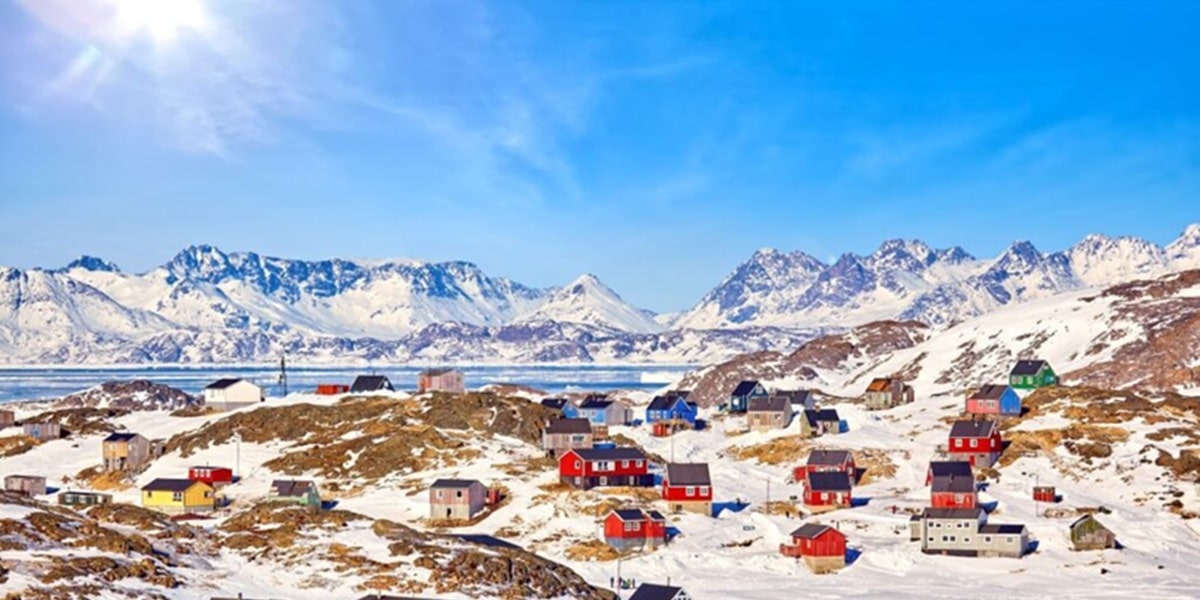
Between defense, resources and Arctic rivalries
The new tension between Washington and Copenhagen over Greenland is not a simple diplomatic whim. American interest in this immense Arctic territory reflects military, economic and geopolitical issues of a scale rarely discussed. As the melting of the sea ice opens new maritime routes and redistributes the balance of the North, Greenland appears as a central part of a global confrontation between powers.
The Arctic, a new strategic frontier
Greenland, the largest island in the world with nearly 2.16 million km² and only 56,600 inhabitants, around 90% of whom are Inuit, has been a pivot of North American defense since the Cold War. The American base at Pituffik (formerly Thule), built in 1943, remains at the heart of the early warning system against Russia. Its current staff of around 150 soldiers contrasts with the approximately 6,000 soldiers from the 1950-80 period, but its strategic role remains intact.
Located on the shortest trajectory taken by possible Russian missiles, Greenland also controls the GIUK Gap, a crucial maritime corridor for monitoring submarines. While Moscow has reactivated more than fifty military installations in the Arctic, including seven nuclear icebreakers, and Beijing defines itself as a “quasi-Arctic state”, Washington wants to secure its advanced position in the North.
Critical Resources and Emerging Shipping Routes
American interest is also mineral. Greenland contains up to 20% of the world’s unexploited reserves of rare earths, according to the USGS, as well as nickel, cobalt, uranium and graphite. A dozen mining sites are being evaluated, in a context where China dominates nearly 40% of global extraction and an even larger share of industrial processing.
Accelerated melting reinforces this interest: emerging polar routes could reduce the distances between Asia and Europe by 30 to 40%, with Shanghai–Rotterdam potentially going from 20,000 km to around 12,800 km. For Washington, controlling Greenland means securing future global trade highways.
Greenlandic independence and transatlantic tensions
Autonomous since 2009 but whose defense remains Danish, Greenland is gradually moving towards greater political sovereignty, while the annual subsidy from Copenhagen – around 700 million dollars, or almost a quarter of the local GDP estimated at 3.2 billion – remains essential for administrative functioning.
A majority of Greenlanders support a process of independence in the medium term, opening the prospect of a territory potentially free to redefine its alliances. This dynamic worries Brussels and Copenhagen, who see the risk of a strategic shift to the benefit of Washington emerging. For several European officials, a transfer of sovereignty, even partial, would test NATO’s cohesion.
The White House has not limited its ambitions to the diplomatic field. According to CNN and several European sourcesthe American administration is examining three options: a negotiated purchase with Denmark and the autonomous Greenlandic government, as Harry Truman attempted to do in 1946; a shared sovereignty or enhanced presence agreement, offering Washington increased military and logistical control without a formal transfer of territory; and, more controversially, the possible use of force, a hypothesis raised by several members of the administration and never publicly ruled out by Donald Trump, who has repeatedly affirmed that he would obtain Greenland “one way or another”.
These signals have provoked a united European front in support of Copenhagen, while American elected officials from both parties openly oppose any coercive approach. Greenland, for its part, affirms that its future “belongs to its people” and now asks to be involved in any discussions involving its status.
Also read: