
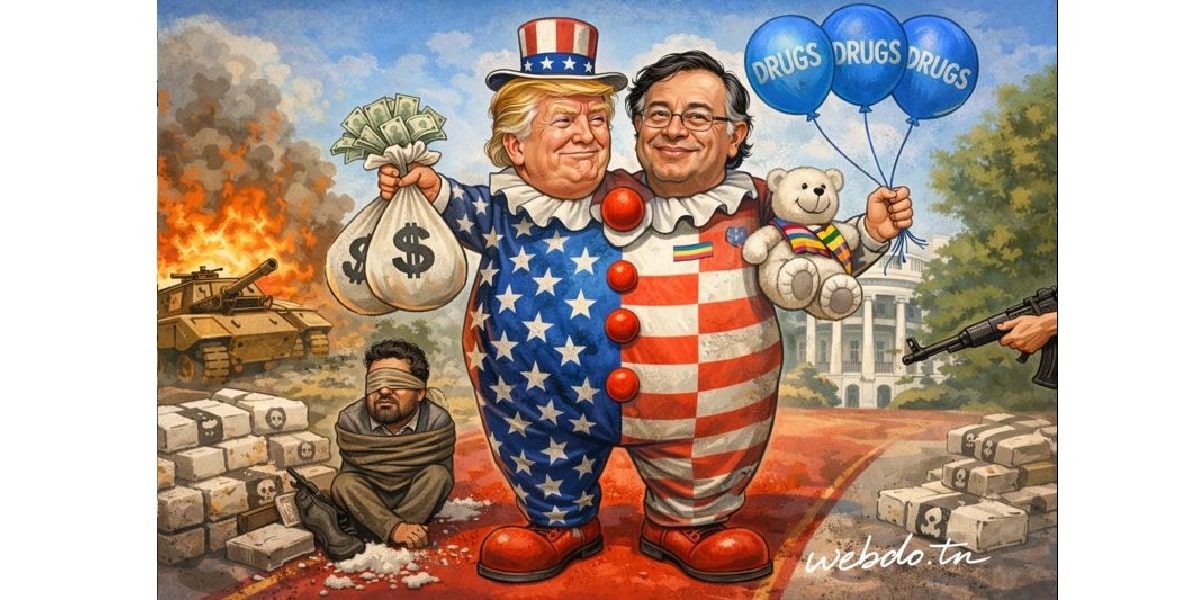
Washington and Bogota shifted in a few days from maximum tension to an unexpected diplomatic opening. After accusing Colombia of being complicit in drug trafficking and raising the possibility of military intervention, Donald Trump now announces that he wants to receive Colombian President Gustavo Petro at the White House.
From verbal escalation to express rapprochement
Last week, Trump attacked the Colombian government head-on, claiming that his counterpart was linked to drug trafficking – accusations made without evidence. The American president even mentioned that military action could be considered if Bogota “does not regain control” of certain areas of the country.
These declarations caused a shock wave in the region, already experienced by the American military operation in Venezuela which ended with the capture of Nicolás Maduro. In Colombia, protest rallies took place, denouncing a return to the logic of interference of the past and warning against regional escalation.
But the tension suddenly eased on Monday, when Trump announced that he had had his first telephone conversation with Gustavo Petro since taking office. The American president welcomed on social networks a “respectful” exchange during which the Colombian leader explained “the drug situation and other disputes”.
In Bogota, Petro confirmed the call to his supporters, saying he had requested the resumption of bilateral dialogue, suspended for several months, while recalling that national sovereignty “is not negotiable”.
Also read: After Venezuela, Trump threatens a military operation against Colombia
A strategic invitation in an explosive regional context
At the White House, it is now claimed that “arrangements are being made” to organize an official visit by the Colombian president to Washington. No date has yet been announced, but the two chancelleries have reopened diplomatic channels.
This turnaround illustrates the extent to which the relationship between the two countries has become unstable, oscillating between verbal confrontation and pragmatic cooperation. Colombia remains a key partner of the United States in Latin America, particularly in the fight against transnational cartels and in managing the consequences of the Venezuelan crisis.
For Trump, this change in tone could be part of a now accepted method: maximum pressure before diplomatic opening – a strategy that he has already used with Mexico, North Korea or Europe. For Petro, the visit represents an opportunity to turn a risky standoff into a high-level political tête-à-tête.
There remains an unknown factor: will this relaxation survive the next tweet?
The relationship between Washington and Bogota remains volatile, but the invitation to Washington marks a rare moment of calm in a region under tension.
Also read: