

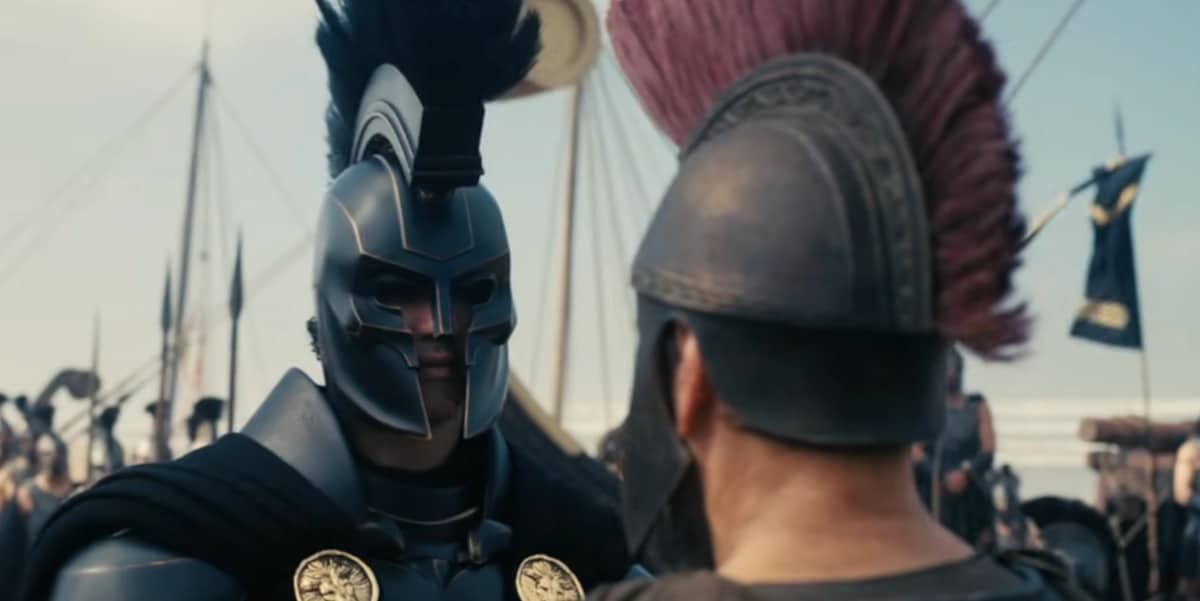
More than a year before its release, The Odyssey has already established itself as one of the most anticipated films of 2026. Announced very early, supported by the signature of Christopher Nolan, often presented as the contemporary heir of Stanley Kubrick, the project has aroused rare enthusiasm: tickets have even been reserved more than a year in advance in certain circuits.
But the release of the first trailer suddenly shifted the debate. Not on the story, nor on the staging, but on a detail that has become central: Agamemnon’s helmet.
A helmet that concentrates all the criticisms
From the first images, King Agamemnon’s armor attracts attention, particularly his helmet. If the front side is intriguing, it is especially the rear – extended by an outgrowth reminiscent of a column or a dorsal “tail” – which crystallizes the criticism. On social networks, the criticism comes back again and again: an aesthetic considered anachronistic, too close to the superheroic universe or video games, and far from the Mycenaean imagination.
Some Internet users are ironic about a visual recycling of Batman, others denounce a confusion between ancient Greece and a dark fantasy universe, going so far as to compare the accessory to armor from Mordor rather than Mycenae.
Between artistic freedom and historical requirement
Beyond mockery, more structured critiques emerge. History buffs and informed spectators alike are wondering: how far can we stylize a myth without blurring its cultural roots? The helmet thus becomes the symbol of a broader debate on the cinematographic adaptation of founding stories: should we aim for historical verisimilitude, or assume a radical reinterpretation in the name of spectacle?
This barrage, however, does not exhaust curiosity. Many recall that The Odyssey is also populated by fantastic creatures, monsters and unrealistic visions, and that these aesthetic choices could find their coherence in the final film.
For some observers, the controversy surrounding Agamemnon’s helmet goes beyond the simple question of historical fidelity. It revives an older criticism addressed to the cinema of Christopher Nolan: a predilection for powerful and spectacular visual choices, sometimes perceived as taking precedence over the depth of the subject. In this reading, The Odyssey would crystallize a recurring tension between aesthetic ambition and the demand for meaning.
A debate set to evolve
For now, Agamemnon serves as a lightning rod for immense expectation. But as new images are revealed, the controversy could shift — or die out — in favor of a more global judgment on the work.
The Odyssey is expected in theaters on July 17, 2026. Until then, Nolan will have to deal with a now familiar reality: every detail of his cinema is scrutinized, dissected, and sometimes contested even before the first screening.