
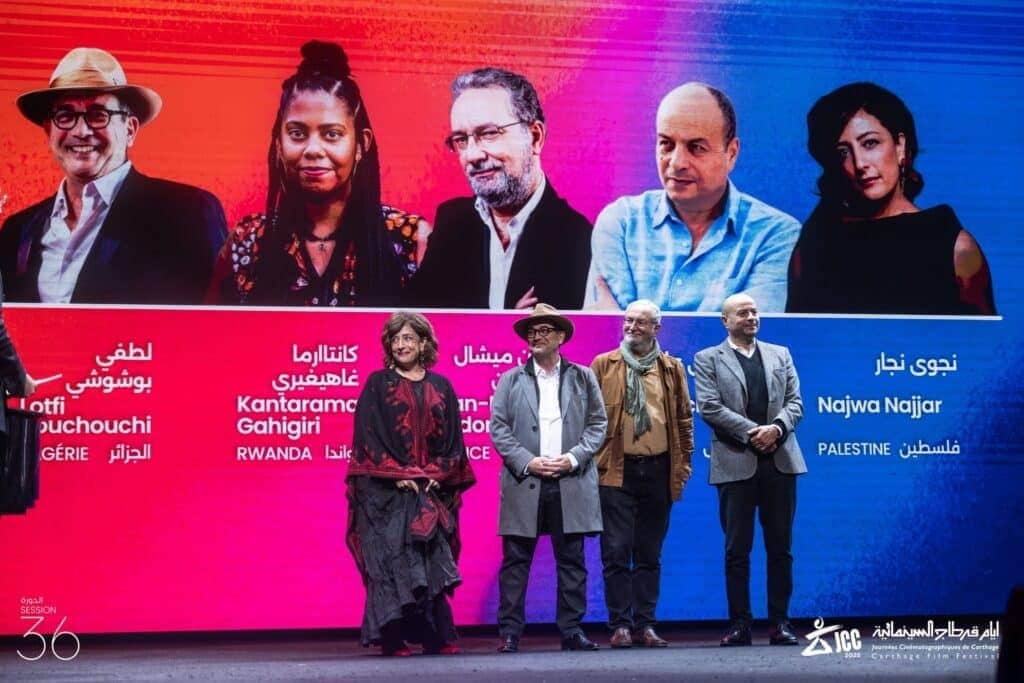
The jury of the fiction feature film competition of the 36th edition of the Carthage Cinematographic Days, chaired by Najwa Najjar, Palestinian screenwriter and director, and composed of French film critic Jean-Michel Frodon, Tunisian director and producer Lotfi Achour, Rwandan screenwriter and director Kantarama Gahigiri and Algerian director and producer Lotfi Bouchouchi, issued a statement to explain his absence the day before during the closing ceremony of the festival.
Written and broadcast simultaneously in Arabic, French and English, this declaration was made public on December 21, 2025. It has since begun to circulate widely on social networks, quickly going beyond the Tunisian framework to be relayed on an international scale. Through this text, the jury reviews the progress of its work, the conditions of the deliberations, as well as the precise circumstances which led to the collective decision not to attend the closing ceremony.
Grand Jury Statement
It was a great honor to be among you as a Palestinian filmmaker and President of the international jury of the Carthage Film Festival. The festival director, Mr. Mohamed Tarek Ben Chaâbane, and his team have brought together a remarkably thoughtful selection of 14 films from Africa and the Arab world. In these particularly dark times — marked by genocide in Palestine and immense suffering across the region — we were reminded that Carthage has always been much more than a festival. It is, and always has been, a space for freedom of thought, expression and conscience.
Our international jury viewed the films over five days with the greatest care and a deep sense of responsibility. We debated, reflected and compared our points of view at length, with our final deliberations lasting over six hours. Each of us took our personal, professional and family time – this mission being carried out on a voluntary basis, a necessary clarification in view of certain rumors – in order to honor cinema and judge the works with rigor and fairness. We collectively wrote clear motivations explaining the choices of the winning films and submitted the final list to the JCC the day before the closing ceremony.
On Saturday morning, we received a call from the JCC informing us that the winning films would be announced and presented by people other than the jury members. Surprised – this practice being very unusual in international festivals – we refused this proposal.
It should be noted that, throughout this process, the JCC has played a bridging and supportive role, conveying our concerns in good faith and maintaining dialogue with us. Final decisions regarding the format of the ceremony, however, were made at an institutional and administrative level beyond the direct authority and sole discretion of the festival.
We then proposed an alternative solution: that the parties concerned could read our written motivations in advance and that, if the challenge was to bring personalities on stage, the jury would present the motivations while the guests would award the prizes.
Our concerns were relayed by the JCC, and we were called to a rehearsal at 3:30 p.m. at the Opera. We were explicitly told that we were free to present the incentives and prices as we saw fit. After three hours of rehearsals with all the juries, we returned to the hotel to prepare for the evening.
At 7:30 p.m., we received another call informing us that we were back to square one: the prizes would again be awarded by people other than the jury, and our reasons would not be read. We then indicated that such a decision could result in our absence and requested that our position be conveyed to the parties concerned in the hope of reaching a compromise. A new call, a few minutes later, confirmed that no changes would take place.
Despite this, we stayed in the hotel lobby until 9:15 p.m., hoping that a dialogue was still possible. Alas, no further calls came.
An extremely difficult decision was then made unanimously by the jury. Out of respect for our role, our work and the ethical responsibility entrusted to us, we chose not to attend the ceremony. This decision was not taken lightly, but on principle. An international jury is not a symbolic entity: it is at the heart of the integrity of any festival. To silence its voice is to weaken the very foundations of cinematographic freedom and the trust that festivals like Carthage have always embodied.
Najwa Najjar,
President of the Jury