

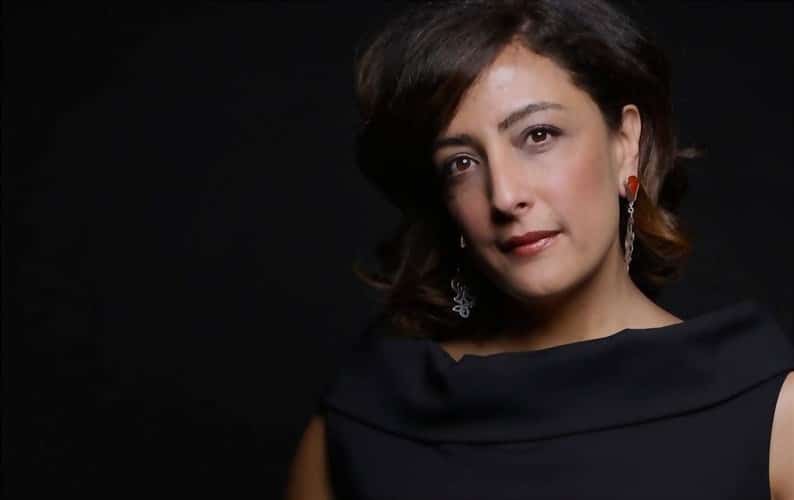
The 36th edition of the Carthage Film Festival (Journées Cinématographiques de Carthage, JCC), taking place from December 13 to 20, 2025, has selected Palestinian screenwriter and director Najwa Najjar to preside over the jury of its Official Feature Film Competition. She will be joined by French film critic Jean-Michel Frodon, Tunisian director and producer Lotfi Achour, Rwandan filmmaker Kantarama Gahigiri, and Algerian director and producer Lotfi Bouchouchi, forming a jury that reflects the very DNA of the JCC — African, Arab, and open to the world.
Najwa Najjar: Between Political Studies and Cinema
Of Jordanian and Palestinian descent, Najwa Najjar grew up in the Middle East. She later studied political science and economics in the United States, where she also earned a master’s degree in film directing and production before turning to writing and directing. After returning to Palestine, where she continues to live and work, she built a body of work defined by this dual foundation — intellectual and artistic — shaping an auteur cinema grounded in political reality yet deeply attentive to the human dimension of storytelling.
A Palestinian Filmmaker with a Transnational Path
Since the late 1990s, Najjar has directed several documentaries and short films exploring memory, heritage, and everyday life in Palestine. Her early works include Naim and Wadee’a (1999), Quintessence of Oblivion (2000), A Boy Called Mohamed (2002), Blue Gold (2004), They Came from the East (2004), and Yasmine Tughani (2006) — films often screened at international festivals, gradually establishing her voice within the Palestinian film landscape.
In 2009, she also produced the anthology Gaza Winter, a collection of international short films that already reflected her interest in collective forms of creation and the circulation of stories around Palestine.
Three Feature Films with International Reach
In 2008–2009, Najwa Najjar directed her first feature film, Pomegranates and Myrrh, centered on the story of a young Palestinian dancer facing her husband’s imprisonment and the constraints of occupation. The film traveled widely, screening at over 80 international festivals and earning multiple awards, including Best Arab Film at the Doha Tribeca Film Festival and the Cinema in Motion Award at the San Sebastián International Film Festival.
She followed with Eyes of a Thief (2014), her second feature, shot in the West Bank. Inspired by a true story, the film received several distinctions, including Best Actor for Khaled Abol Naga at the Cairo International Film Festival and Best Director at the Kolkata International Film Festival. It was also selected to represent Palestine in the 2015 Academy Awards’ Best Foreign Language Film category.
The film follows Tarek, a man released after ten years in prison, who returns to his hometown of Nablus in search of his missing daughter. Retracing his steps, he finds a society marked by mistrust, the wounds of occupation, and the struggle for survival. Between buried secrets, conflicting loyalties, and the desire for redemption, Eyes of a Thief examines forgiveness, the weight of the past, and the persistence of hope within a wounded land.
Her third feature, Between Heaven and Earth (2019), takes the form of a road movie across checkpoints and administrative borders, following a couple in the midst of divorce who must travel through Palestine to obtain official papers. Presented at the Cairo International Film Festival, where it won the Naguib Mahfouz Award for Best Screenplay, the film confirmed her talent for blending intimacy, social observation, and political reflection.
These three works extend the trajectory begun with her documentaries: stories of couples, families, constrained movement, and attachment to land and memory — all set against the everyday realities of occupation.
A Fourth Feature in Development
Najwa Najjar is currently developing her fourth feature film, Kiss of a Stranger, a musical she wrote during the Covid-19 lockdown. Set in 1930s Egypt during the golden age of cinema, the story unfolds in cosmopolitan Alexandria, where music, dance, and cinema intertwine to depict the birth of an industry and a collective dream. Produced by Ustura Films, the company she co-founded with Hani E. Kort, the film promises to be a celebration of creativity, imagination, and Arab cultural memory.
Producer, Mentor, and Jury Member
Beyond directing, Najjar co-founded Ustura Films, based in Ramallah, alongside her husband and producing partner Hani E. Kort. The company’s goal is to support independent Palestinian cinema rooted in its land yet connected to international networks.
In interviews — including one during last year’s Cairo International Film Festival — she has often emphasized the importance of portraying Palestinians as complex characters, far removed from clichés and simplifications. Her entire filmography reflects this commitment: to show multiple existences caught between political constraint and inner freedom.
She has also been involved in training and mentoring programs, serving as a reader and later advisor for the Rawi Sundance Scriptwriters Lab, dedicated to Arab screenwriters, and giving masterclasses, such as at the Galway Film Fleadh in 2016. Najjar has served on numerous festival juries — both regional and international — strengthening her presence within the global filmmaking community.
In recognition of her career and contribution to Arab and international cinema, Najwa Najjar was elected a member of the Academy of Motion Picture Arts and Sciences in 2020, joining filmmakers worldwide who vote for the Oscars. This distinction underscores the reach of her work and the esteem she commands beyond Palestine’s borders.
A Presidency in Tune with the Spirit of the JCC
Najwa Najjar’s appointment as President of the JCC 2025 Feature Film Jury reflects a natural continuity between her artistic path and the festival’s mission: to question the world through cinema. Since her early work, she has defended a vision of filmmaking where storytelling and responsibility coexist, where memory serves not as refuge but as momentum.
Her Palestinian perspective brings a particular sensitivity to narratives of resistance, yet what she contributes to Carthage goes beyond national identity — a capacity to connect experiences, to listen to what films reveal about collective wounds and shared hopes.
In a context where political, aesthetic, and cultural borders seem to close in, her presidency reaffirms cinema’s fundamental purpose: to create passages. And perhaps this is where the essence of the JCC still lies — in its enduring belief, exemplified by Najwa Najjar’s presence, that cinema can continue to unite where so much seeks to divide.
Neïla Driss