

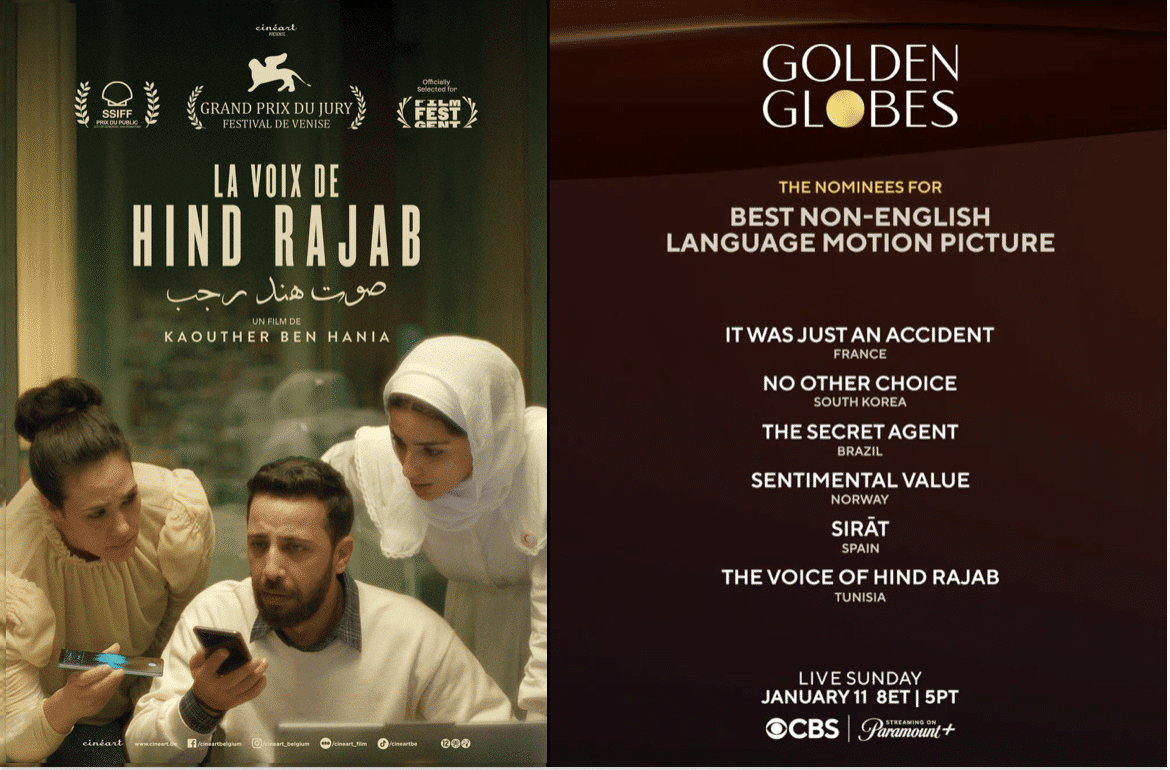
The nominations for the 2026 Golden Globes have just been announced, and Tunisian cinema has made history. The Voice of Hind Rajab, the latest film by Kaouther Ben Hania, has been nominated for the Golden Globe for Best Motion Picture – Non-English Language. This milestone marks another step in the extraordinary journey of a film that began in Venice and went on to be selected as Tunisia’s official entry for the 2026 Academy Awards.
This new recognition crowns the work of a filmmaker who, film after film, has carved out a unique place on the international scene. It also confirms the growing visibility of Tunisian cinema worldwide.
From Venice to International Acclaim
The journey of The Voice of Hind Rajab took off at the 2025 Venice International Film Festival, where it premiered in official competition and won the Silver Lion for Best Director, one of the festival’s highest honors.
In addition to this major prize, the film received six awards in Venice’s parallel sections, underlining the enthusiasm it generated among independent juries and film associations: the Premio CinemaSarà, Sorriso Diverso Venezia Award, Human Rights Film Network Award, Arca Cinema Giovani Award, Lizzani Award and SIGNIS Award.
These distinctions established the film as one of the major highlights of that year’s festival, praised for both its artistic strength and its moral and political resonance.
A Film Inspired by the Story of Hind Rajab
The Voice of Hind Rajab is based on the true story of a young Palestinian girl killed in Gaza after calling the Red Crescent for help. Kaouther Ben Hania transforms this tragedy into a deeply human work that blends documentary elements and fiction, exploring memory, re-enactment and the ethics of representation.
The film follows the thread of that desperate phone call — the child’s voice and those who heard it — to reflect on what it means to listen, to bear witness and to tell. Centered on the act of speaking and remembering, it continues the filmmaker’s exploration of the fragile boundaries between the intimate and the political, the visible and the unseen, the real and the reconstructed.
This project extends a filmography already defined by hybrid forms and narrative experimentation. After Le Challat de Tunis (2014), Beauty and the Dogs (2017), The Man Who Sold His Skin (2020) and Four Daughters (2023), The Voice of Hind Rajab furthers this aesthetic quest — a cinema that gives voice to those whom history tends to silence.
A Collective Commitment
Around Kaouther Ben Hania, several leading figures of world cinema have expressed their support. Brad Pitt, Joaquin Phoenix, Alfonso Cuarón and Jonathan Glazer have all stood behind The Voice of Hind Rajab, helping to amplify the film’s reach and message on the international stage.
Their involvement accompanies a wider movement among artists who seek to champion stories from regions often marginalized in global cinema — especially the Arab world — when those stories confront urgent contemporary realities.
From Venice to the Oscars
After Venice, The Voice of Hind Rajab continued its festival journey and was chosen to represent Tunisia at the 2026 Oscars in the International Feature Film category. This decision reaffirmed the film’s central role in the awards season and highlighted Kaouther Ben Hania’s contribution to the modern history of Tunisian cinema.
Tunisian cinema had already reached a historic milestone when The Man Who Sold His Skin (2020) and Four Daughters (2023) became the first two Tunisian films ever nominated for the Academy Award — a breakthrough moment for the nation’s film industry.

The 2026 Golden Globes Nomination
Now, with The Voice of Hind Rajab, another chapter opens. The film has become the first Tunisian film ever nominated for a Golden Globe, in the category of Best Motion Picture – Non-English Language. It is an unprecedented moment in the history of Tunisian cinema — the country’s first-ever recognition at this level in Hollywood.
This new accolade extends the film’s exceptional run and confirms the rising prominence of Tunisian cinema within the global awards circuit. For the director, her team and the film’s co-producers, this nomination marks a symbolic turning point — the moment when a national cinema steps confidently onto the world stage.
A Tunisian Film at the Heart of Global Conversations
Produced by Tanit Films and co-produced by Tunisia, France, Qatar and Palestine, The Voice of Hind Rajab exemplifies a collaborative model that allows locally rooted stories to reach a universal audience without losing their authenticity. For the Palestinian people, the film carries a special significance: it gives voice to those so often silenced and demonstrates, through cinema, the enduring power of testimony.
Cinematographer Sofian El Fani’s work enhances the film’s meditative rhythm, creating visual spaces that honor presence and absence alike. Every frame is designed to make us hear — and feel — the echo of a child’s call that still resonates through time.
In this sense, the film connects deeply with the recurring themes of Kaouther Ben Hania’s cinema: the body, fragmented storytelling, women’s voices, and the intersection of the personal and the collective.
Toward the Carthage Film Festival (JCC)
After its international success, The Voice of Hind Rajab will return home. The film will compete in the Fiction Feature section at the upcoming Journées Cinématographiques de Carthage (Carthage Film Festival), one of the oldest and most respected festivals in the Arab and African world.
This dual presence — between global recognition and a return to regional roots — reflects the film’s unique trajectory. For Tunisia, having The Voice of Hind Rajab simultaneously in the race for the Golden Globes, the Oscars and the JCC places the country at the center of this year’s cinematic conversation.
A Landmark Moment for Tunisian Cinema
The nomination of The Voice of Hind Rajab for the Golden Globe for Best Motion Picture – Non-English Language is far more than another accolade. It symbolizes the entry of Tunisian cinema into the global conversation, affirming the strength of its storytelling and the singular voice of its filmmakers.
With this film, Kaouther Ben Hania continues a remarkable path — from Cannes to Venice, from the Oscars to the Golden Globes — demonstrating that Tunisian cinema can both preserve its roots and speak powerfully to the world.
Neïla Driss