
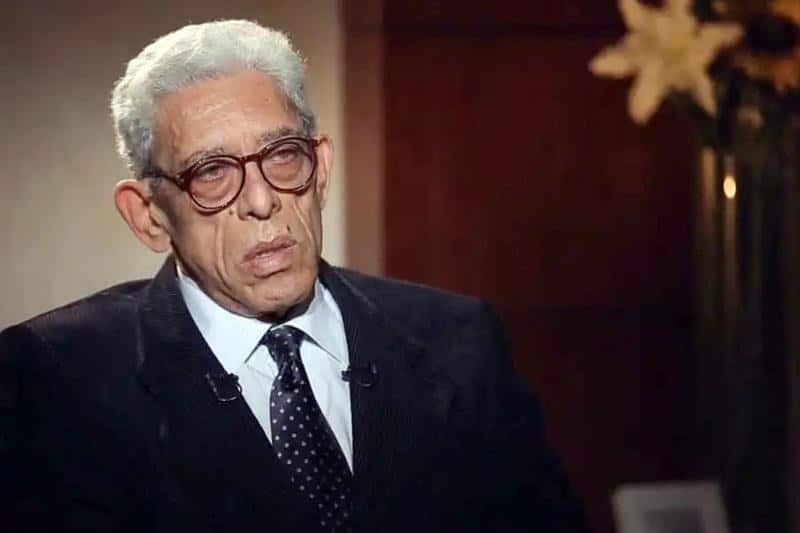
Egyptian filmmaker Daoud Abdel Sayed died on December 27, 2025, in Cairo. He was 79.
With his passing, Egyptian cinema loses one of its most significant filmmakers. Born in Cairo on November 23, 1946, Abdel Sayed leaves behind a body of work that stands as a cornerstone of contemporary Arab cinema, built over time with rigor, coherence and an unwavering commitment to a singular vision of filmmaking.
A graduate of the Higher Institute of Cinema in Cairo, where he specialized in directing, Daoud Abdel Sayed began his career as an assistant to some of Egypt’s most prominent filmmakers, including Youssef Chahine. This formative period proved decisive, both in terms of hands-on experience on set and in shaping his understanding of cinema as a space for artistic freedom and reflection on society.
He initially worked in documentary filmmaking, a foundational phase that would leave a lasting imprint on his later fiction films. This background informed his close attention to reality, human behavior and social mechanisms, without ever resorting to didacticism or overt explanation.
His first feature film, The Search for Sayyid Marzouk (1989), follows an ordinary man who, after an incident in a café, becomes trapped in a succession of absurd and oppressive events. From the outset, the film establishes Daoud Abdel Sayed as a filmmaker attuned to shifts in circumstance and implicit power dynamics, far removed from the dominant narrative conventions of commercial Egyptian cinema.
With Al Kit Kat (1991), Daoud Abdel Sayed delivered a film that would become deeply embedded in Egypt’s collective memory. Set in a working-class Cairo neighborhood, the film portrays its residents through the central figure of a blind man, around whom individual paths, aspirations and frustrations intersect.
In 1999, his career continued with The Land of Fear, which follows a police officer sent undercover into the drug trade, gradually losing his bearings as the mission drags on. Upon its release, the film sparked considerable debate and has since come to be regarded as one of the defining works of late 20th-century Egyptian cinema.
In 2001, Daoud Abdel Sayed directed A Citizen & a Detective & a Thief, weaving together the intersecting lives of a writer, a man connected to the police and a thief, following the theft of a car that sets off a chain of personal, professional and emotional entanglements. The film also marked an important moment for its cast: Abdel Sayed entrusted leading roles to two young actors at the beginning of their careers who would later become major stars, Khaled Abol Naga and Tunisian actress Hend Sabry, for whom this was among her very first roles in Egypt. Having only recently arrived in the country and not yet fluent in the Egyptian dialect, Sabry nevertheless delivered a performance noted for its precision, one that impressed Egyptian audiences themselves.
In 2010, Daoud Abdel Sayed returned with Messages from the Sea, centered on a solitary man living in Alexandria whose life is upended by his encounter with a married woman, through a relationship defined by intimacy and exchange.
Five years later, he released Out of the Ordinary, which tells the story of a scientist searching for humans with extraordinary abilities, believing he has found what he seeks in a motel inhabited by a range of characters, each carrying a story connected to this notion of the extraordinary.
Both of these later films were selected for the Carthage Film Festival. Separately, in 2022, the festival paid tribute to Daoud Abdel Sayed, an homage he was unable to attend due to health reasons.
Throughout his career, Daoud Abdel Sayed received numerous awards, including the Silver Pyramid, Best Arab Film and Best Screenplay prizes at the Cairo International Film Festival in 1999 for The Land of Fear; Best Director in 2002 for A Citizen & a Detective & a Thief; and Best Director for Messages from the Sea at the Egyptian National Film Festival in Cairo in 2013.
Beyond awards, his films have become part of the history of Egyptian and Arab cinema and have ranked prominently in several major critical polls. Among them is the list of the 100 Greatest Arab Films, established in 2013 at the initiative of the Dubai International Film Festival, based on a survey of 475 critics, programmers and Arab and international film professionals. Three films by Abdel Sayed appear in that ranking, underscoring the importance of his work within Arab cinematic heritage: Al Kit Kat placed 8th, The Land of Fear 48th and Messages from the Sea 83rd.
Beyond his films, Daoud Abdel Sayed was known as a man of dialogue. For many years, as long as his health allowed, he was a familiar presence at the Cairo International Film Festival, where he would regularly sit at Café El Hanager, inside the Cairo Opera House. His table became a gathering place for filmmakers, actors, critics and cinephiles alike. They were united by a shared passion: cinema. And Daoud Abdel Sayed took genuine pleasure in sharing that passion.
In January 2022, Daoud Abdel Sayed officially announced his definitive retirement from filmmaking, citing his inability to adapt to prevailing audience tastes and to the evolving dynamics of the film industry.
Following his death, the Cairo International Film Festival released an official statement paying tribute to the late director, describing him as one of the major figures of Egyptian and Arab cinema, and recalling that Daoud Abdel Sayed left a lasting imprint on the history of the seventh art through works that shaped the sensibility of generations of film lovers, including Al Kit Kat, The Thief of Joy, The Land of Fear and Messages from the Sea.
In the statement, Hussein Fahmy, president of the Cairo International Film Festival, said that with the passing of Daoud Abdel Sayed, Egyptian cinema loses one of its most important, sincere and singular creators, noting that he possessed a rare philosophical and human vision and leaves behind works that will remain benchmarks of beauty, awareness and meaning. He added that Abdel Sayed helped establish cinema as an art of contemplation and reflection on humanity and society.
The Cairo International Film Festival also extended its condolences to the director’s family, friends, students and to audiences of Egyptian and Arab cinema.
Through his career, his films, the documented critical recognition of his work and the coherence of his artistic choices, Daoud Abdel Sayed leaves behind the legacy of a great filmmaker and a great man, whose place in the history of Egyptian and Arab cinema is firmly established.
Neïla Driss