

This year, the Cairo International Film Festival (CIFF) offered its guests a unique experience: a visit to the Grand Egyptian Museum, which opened to the public barely ten days before the festival’s own inauguration. Organized for journalists, filmmakers, actors, and industry professionals, the excursion was far from a simple side event — it felt like a natural extension of the festival’s programming, uniting three of its deepest purposes: celebrating memory, exploring narrative, and transmitting through image.
Inside this vast new space, where colossal halls breathe stone and silence, the connection between ancient Egypt and cinema emerged as self-evident. Both strive to make the invisible endure, to render visible what must not vanish. Whether carved in stone or captured on film, both arts share the same struggle against time.
An Opening That Foreshadowed the Museum
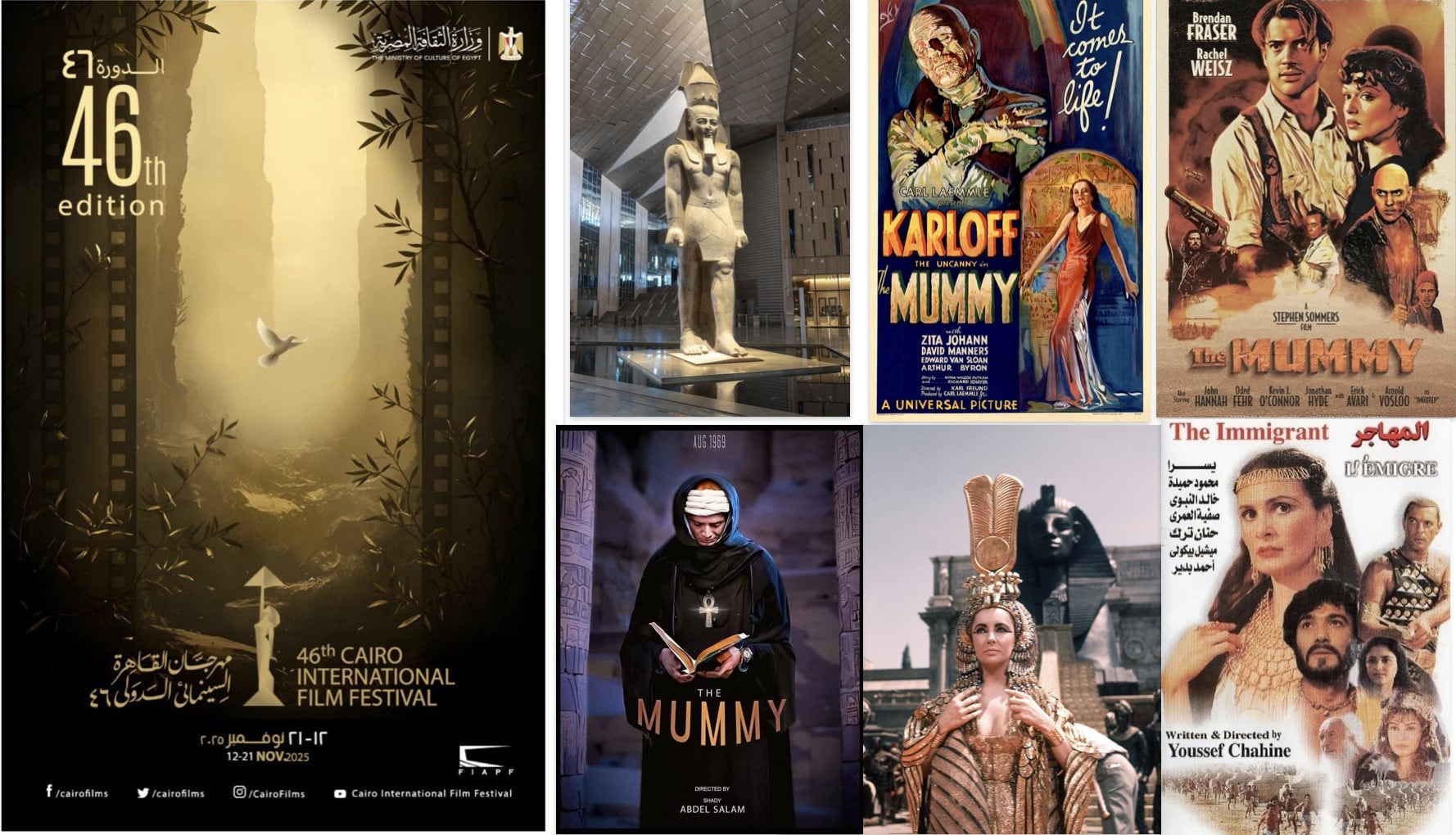
From the festival’s very first moments, this dialogue between ancient and modern arts had already been established. The opening video, tied to the official festival poster, began with the close-up of a temple wall. The texture of the stone — raw yet refined — filled the screen like a living material. Gradually, a strip of film appeared and began to move, gliding across the hieroglyphs, bringing the ancient signs to life. A white dove then crossed the frame in slow motion, before the entire scene dissolved into the colors of the CIFF 2025 poster. ( Click here to watch the video )
This short sequence conveyed a powerful idea: Egypt, before being a setting, is a land of images. Ancient Egyptians had already invented visual storytelling, using images to say what words could not. The stone was the first screen, the carvings the first screenplay, the sunlight the first projector. The video thus affirmed that cinema is not an imported art form, but a natural continuation of Egypt’s millennia-old visual tradition. When the festival guests later stood before the museum’s own walls, the video served as a kind of visual prelude — a transition from projected stone to real stone, from imagined temple to tangible architecture.
The Museum: An Archaeological World Premiere
The Grand Egyptian Museum unfolds like a monumental work of art, its architecture in constant dialogue with the Pyramids of Giza. Vast volumes, natural light, and measured perspectives evoke the grandeur of the civilization it shelters, blending solemnity and modernity — like a restored film recovering its former splendor.
For the festival’s guests, the visit offered a rare privilege: the discovery of artifacts that had never been displayed before. Treasures buried for centuries, drawn from storerooms and now revealed for the first time. For journalists and filmmakers accustomed to “world premieres,” the emotion felt familiar. Here too, it was a premiere — not cinematic, but archaeological. The museum itself became a site of revelation.
Two Gazes on Memory: Journalists and Filmmakers
Among the visitors, journalists were the quickest to react. With cameras and phones constantly in hand, they filmed and photographed relentlessly, seeking material for their reports and articles. Their gaze was documentary — to capture, to record, to accumulate.
Filmmakers, on the other hand, moved more slowly. They questioned the guides, studied the light on the stone, the positioning of statues in space, the way a carved face seemed already composed within a frame. Where journalists collected footage, filmmakers imagined shots. The museum thus became a meeting ground for two forms of writing — journalistic and cinematic — united by a shared desire: to turn what they saw into story.
Monumentality as a Language
As the visit unfolded, the coherence between the museum’s architecture and the civilization it celebrates became striking. Its design speaks the language of ancient Egypt itself: monumentality, verticality, hierarchy, and harmony. Each gallery feels like a sequence shot — imposing its rhythm, its tension, its progression toward the light. The museum is built like a film: opening, suspense, revelation.
This monumentality is more than a question of scale — it is a mode of storytelling. As visitors walked among colossal statues and glass cases, they became part of a narrative in motion. This is where the kinship between cinema and museum is clearest: both use mise en scène to provoke emotion and draw the spectator into a movement. Here, staging is not illusion but structure — a continuation of the ancient artists who conceived temples and tombs as vast scenographies.
Immortality: A Millennial Thread
Gradually, one theme imposed itself with almost overwhelming clarity: immortality.
Everything in the Pharaonic world points toward it. The ancients carved their names so they would not be erased, painted their faces to be recognized, narrated their lives to be remembered. For them, death was not an ending but a passage. The tomb was not a closure, but a work — a book of stone meant to tell the story of a life.
This yearning to endure finds its mirror in cinema.
Filmmakers, too, seek to preserve. Through their films, they capture faces, voices, gestures, emotions — saving them from oblivion. Like hieroglyphs etched in stone, images on film are messages sent to the future.
Inside the museum’s halls, the parallel felt almost tangible. Before a statue with an unbroken smile, before a relief still vibrant with color, one could not help but think of a close-up preserved through decades. Ancient and modern arts converge in the same desire: not to disappear.
Today’s Artists, Heirs to Yesterday’s
This continuity is not abstract — it lives within the material itself.
In the details of the sculptures, the frescoes, and the objects, one recognizes the same obsession with precision, the same search for balance and expression, the same instinct for composition. The artists of ancient Egypt were visual storytellers. They directed the gaze, played with light, and built narratives through images — exactly what Egyptian cinema continues to do today, with different tools but the same spirit.
Modern Egyptian filmmakers are, in many ways, their descendants. Heirs to a centuries-old visual tradition, they renew it without ever betraying its essence. This invisible lineage runs through the history of Egyptian cinema — once the beating heart of the Arab film world — and still visible in its ongoing passion for image, narrative, and legacy.
The Mummy: Memory and the Question of Plunder
Few films resonate more directly with this visit than The Mummy (1969) by Shadi Abdel Salam. A masterpiece of Egyptian cinema, it explores the looting of Pharaonic tombs. The film follows a tribe surviving by selling stolen antiquities and a young man who discovers that his community’s survival depends on the desecration of its own ancestors. Behind the story lies a haunting question: what happens to a civilization when it allows its memory to be scattered, sold, or destroyed?
That same tension could be felt throughout the Grand Egyptian Museum. Much of Egypt’s ancient heritage was plundered over the centuries — some by thieves in the night, others through “official” expeditions at a time when archaeology and appropriation often blurred together. The objects now on display are those that escaped disappearance, or that Egypt managed to recover and preserve.
Where Shadi Abdel Salam’s film depicts loss and guilt, the museum embodies the opposite gesture: saving, conserving, restoring, to keep history within reach. The film and the museum form a diptych — one showing what was lost, the other what has been reclaimed.
The collection devoted to Tutankhamun illustrates this perfectly. His tomb, one of the smallest in the Valley of the Kings, yielded the largest collection ever discovered. The paradox lies in its fate: after an early, partial robbery, it was resealed and remained untouched until Howard Carter broke its seals in 1922. Its survival, almost miraculous, explains its central place in the new museum. Unlike so many royal tombs emptied over the centuries, Tutankhamun’s still had treasures left to tell the story.
Standing before those display cases, The Mummy seemed to echo through the air.
The film dramatizes dispersion and complicity; the museum answers with reunification and preservation. Both, in their own ways, ask the same question: what does it mean for a nation to reclaim its memory?
The Curse and the Fascination: Tutankhamun on Screen
At the heart of the museum, Tutankhamun’s collection remains its most magnetic. Rich, mysterious, and endlessly retold, the young pharaoh’s legend has long haunted the popular imagination. After the 1922 discovery, the sudden deaths of several members of the excavation team fueled what would become the infamous “Curse of the Pharaoh.”
Historically unfounded, the story nonetheless captured the world’s imagination — and cinema quickly seized upon it.
From the 1930s onward, filmmakers turned the legend into myth. Horror films with vengeful mummies, exotic adventures of the 1950s, and later, contemporary reinterpretations blending science fiction, archaeology, and fantasy.
The first and most defining remains The Mummy (1932) by Karl Freund, starring Boris Karloff as Imhotep — directly inspired by the discovery of Tutankhamun’s tomb. It shaped the mummy’s cinematic image for generations: the resurrected, avenging dead. Later came the British Gothic productions of the 1960s (The Curse of the Mummy’s Tomb) and Hollywood blockbusters like Stephen Sommers’s The Mummy (1999) and its 2017 reboot.
Across genres — horror, adventure, or fantasy — the fascination remains the same: the survival of the dead, and the fear of violating what was meant to remain sealed.
If the “curse” belongs largely to Western imagination, it nevertheless reveals a universal fascination: the longing to touch eternity, and the anxiety of trespassing upon the sacred.
Standing before Tutankhamun’s treasures, one felt that double life of the pharaoh: real mummy and cinematic legend. Archaeological history and screen mythology reflected each other like twin mirrors — one grounded in earth, the other in light.
Cleopatra and Restored Films: The Memory of Cinema Reborn in Cairo
Another film echoed this dialogue between antiquity, museum, and festival: Cleopatra by Joseph L. Mankiewicz (1963). This monumental Hollywood epic, long remembered for its extravagant production, found new life through a restored version screened in 2024 in CIFF’s Cairo Classics section.
It was more than a programming coup — it was an act of preservation. Restoring a film is akin to restoring an archaeological artifact: repairing, protecting, transmitting.
By projecting Cleopatra in its restored form, CIFF allowed audiences to see ancient Egypt as Hollywood once imagined it, but now through the clarity and respect of restoration.
The dialogue between museum and movie theater became clear: both strive to rescue images — carved, painted, or filmed — from the risk of erasure.
The Emigrant: Faith, Identity, and Transmission
This year, another film deepened that connection: Youssef Chahine’s The Emigrant, also screened in Cairo Classics. A major work exploring faith and identity, it tells the story of a young man inspired by the biblical figure of Joseph. Chahine portrays ancient Egypt not as a static backdrop but as a living mirror for modern consciousness — a space where questions of heritage, freedom, and artistic responsibility intertwine.
The screening carried particular resonance in 2025, as CIFF honored the film’s lead actor, Khaled El Nabawy, with the Faten Hamama Excellence Award. During his onstage conversation with the audience, El Nabawy spoke movingly about the role, describing how profoundly it shaped his career and his understanding of acting itself.
Watching The Emigrant at CIFF, then hearing El Nabawy reflect on it, extended the museum’s experience in another register: a living transmission between generations, a dialogue between past and present.
Chahine’s Egypt — spiritual, symbolic, introspective — seemed to respond directly to the museum’s Egypt — physical, monumental, eternal. Both reaffirm the same lineage: artists today continuing what ancient artists began — telling the world in images so it will never fade.
Festival, Museum, and the Idea of Immortality
Leaving the museum, one could feel a quiet sense of unity. The Cairo International Film Festival and the Grand Egyptian Museum seemed bound by the same energy: the preservation of memory. One curates films, the other artifacts — but both tell the story of a people through images. By organizing this visit, CIFF reaffirmed that culture is not spectacle, but continuity — a gaze passed from generation to generation.
Immortality, in this context, is not metaphysical. It is an act: to film, to carve, to exhibit, to transmit.
Ancient art and Egyptian cinema share the same obstinate will to endure.
And perhaps that is why the visit left such an imprint: it reminded everyone that their profession, at its core, is to do what Egyptians have always done — to tell the world’s story so it does not disappear.
Will a Film Be Born from This Visit?
This visit to the Grand Egyptian Museum was not a mere ceremonial event. It embodied the CIFF’s essence: making past and present, seen and imagined, speak to one another.
And beyond the treasures unveiled, one question lingered: among those filmmakers in attendance, did any of them feel the spark of a new story? Did an idea begin to form in the silence of a gallery?
Perhaps one day, on a screen somewhere, an image, a face, or a beam of light will recall this encounter.
And when that moment comes, we might say that between the museum and the festival, history never stopped being written.
Neïla Driss