

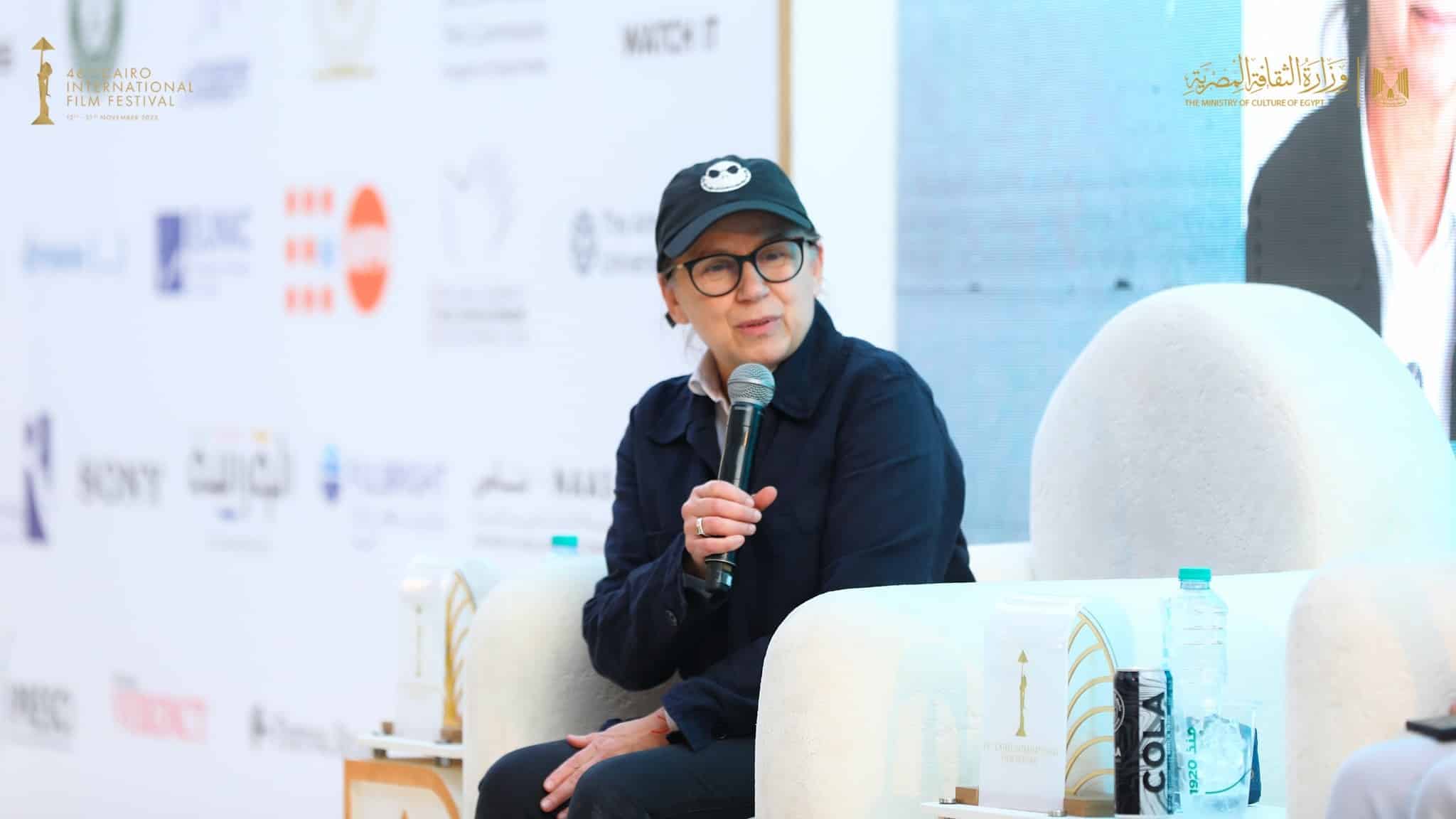
At its 46th edition, the Cairo International Film Festival (CIFF) pays tribute to Hungarian filmmaker Ildikó Enyedi, awarding her the Golden Pyramid for lifetime achievement. The distinction, to be presented during the closing ceremony, celebrates a body of work both rare and profound — one defined by artistic rigor, poetic sensibility, and a deeply humanistic gaze on the world.
As part of this tribute, the CIFF has published a book entitled The Cinema of Ildikó Enyedi: So That Magic Does Not Disappear from the World. The festival also hosted a public conversation moderated by Mohamed Tarek, during which the filmmaker reflected on her journey, her influences, and her philosophy of cinema.
Born in Budapest in 1955, Ildikó Enyedi first studied economics before turning to fine arts and film. This multidisciplinary education — combining intellectual precision with creative curiosity — shaped a remarkably personal approach to artistic creation. Her debut feature, My 20th Century (1989), which won the Caméra d’Or at Cannes, immediately established her as a unique voice blending poetry, philosophy, and observation of reality. This was followed by Magic Hunter (1994), Tamas and Juli (1997), and Simon the Magician (1999), all films defined by their dreamlike tone and search for cinematic freedom. After a long hiatus devoted to teaching and television, she returned in 2017 with On Body and Soul, winner of the Golden Bear at the Berlinale, then in 2021 with The Story of My Wife, selected for the Official Competition at the Cannes Film Festival. This year, Silent Friend continues her exploration of perception, life, and otherness.
Speaking to the Cairo audience, Enyedi was both gentle and candid. “Many things have influenced me,” she said. “As a teenager in the 1980s, I had the privilege of choosing among these influences, often unconsciously. I was always very curious; I loved natural sciences, which shaped me deeply in my youth.”
That curiosity — which she describes as instinctive — has guided her entire career. “I’m shy, which makes things difficult for me sometimes, but I follow my own path. My upbringing and culture are European, but my voice is my own. Years ago, I read a book about filmmakers and found myself listed under the chapter ‘Outsiders.’ That’s exactly who I am.”
For Enyedi, her films are not built on moral or ideological oppositions, but on a fluid vision of reality. “I don’t see polarization in my films. There are no good or bad people; there’s a bit of everything. I’m on the side of human beings — and sometimes animals. I see reality as something fluid; I don’t divide it.”
That philosophy runs through Silent Friend, screened at the CIFF — a film about a neuroscientist researching how plants perceive the world. “It’s an exploration of how we experience reality.” She quotes a line from the film: “We are hallucinating every time, and when we agree about hallucination, we call it reality.” For her, reality itself is merely a convention — a shared agreement.
She also spoke of her youth, marked by curiosity and experimentation. “When I was seventeen, it was a time of openness to new forms of communication. We walked barefoot on the grass, trying to understand how to exist in the world without confrontation. It was a naïve but formative time. There’s still a bit of that teenager inside me.”
When discussing writing, her process appears to be a blend of intuition and discipline. “I write for a long time; it’s never easy. Each project is different. Sometimes, a piece of music accompanies me from the start. For Silent Friend, everything began with a song about the fragility of human existence.” For Enyedi, writing always starts with sensation. “I jot down impressions and emotions first; the story comes later. I need to share sensations. The story becomes a sponge that absorbs them all.”
Her approach to directing actors reveals the same humanity. “With animals, you have to create situations that provoke reactions. You wait, you stay alert, and sometimes they surprise you. With non-professionals, it’s similar — you have to earn their trust, build a safe space for them. Professionals, on the other hand, have more resources within themselves; they can sometimes find what the role demands even without rehearsal. The two energies feed one another, and that’s what makes it so enriching.”

Speaking about the tenderness that runs through her cinema, Enyedi recalled how On Body and Soul was born from a very precise moment: “One spring day, I was walking in the street. The flowers were about to bloom, and I felt moved for no particular reason. I wondered what life, love, and loneliness really were.” At the time, she was reading a lot of poetry. One poem, in particular, left a lasting impression on her, evoking the image of a snowstorm and a fire burning deep within. “I thought it would be wonderful to make a film about that kind of experience. That same day, I swore to God that these two characters would be fully real to me — I would know their past, their lives.”
These two characters, who became the protagonists of On Body and Soul, are two lonely people who share the same dream each night without speaking in real life. “They would never have met if I hadn’t put them in a situation where they had to. I pushed them toward that encounter and simply followed them. That’s my vision of tenderness.”
Her attention to detail and observation goes back a long way. “In school,” she recalled, “we were asked to write a short story about a personal experience. I took it very seriously: I went to a café terrace, sat there for hours, and simply observed people living their lives. I took notes about what I saw — their gestures, their faces, their movements.” From those notes, she wrote her assignment, describing that afternoon of quiet observation. “My teacher was furious; he thought I had sabotaged the exercise. The others had written about dramatic incidents, about problems they had faced, and I had simply described life as it unfolded.” This anecdote — where she merely transcribed what she observed — already revealed her approach to cinema: an art of looking, listening, capturing, without exaggeration.
“In cinema, our senses are limited to sound and image,” she explained. “We have to learn to express as much as possible without dialogue. Light becomes essential — it can say everything.” Since her very first film, she has worked with the same cinematographer. “He remembers the purpose of each scene, how every moment fits into the film. Filmmaking is teamwork. I share my vision with everyone; I write letters explaining what I expect from them.”
She also insists on the importance of collaboration and the smallest details. “Since my first film, I’ve worked with the same cinematographer. I share with him my vision for every scene, and I write to the entire crew to explain what I expect.” She recounts an anecdote about an assistant during a scene where a character had to use a pepper shaker. “There were several shakers on the table — all made from different materials. She had to pick one. She could have just grabbed any of them, placed it on the table, and moved on. But I overheard her explaining why she had chosen that particular shaker, how it revealed something about the character.”
The fact that she had first made a selection and then justified her choice in terms of meaning and personality showed how deeply she understood the essence of the scene and the role. “What beautiful energy she radiated,” Enyedi smiled.
The filmmaker also spoke about the difficulties she faced at the beginning of her career. “I had received some funding from Hamburg, but in Hungary, the police were following me, and my film was banned. It wasn’t easy.”
Asked about artificial intelligence in filmmaking, Enyedi expressed openness and curiosity. “I’ve lived through many phases — from celluloid to digital. There was a time when shooting on film became almost snobbish. I’m glad that’s behind us. What matters is freedom — choosing the form that best serves the film, whether it’s black and white, color, 35 mm, or digital. If AI allows me to play, to mix techniques, to use my imagination and connect with the audience — why not?”
At the end of the talk, a filmmaker from the audience recalled: “I was a member of the Caméra d’Or jury in 1989. Your film stood out immediately. We knew we were witnessing the birth of a great director.”
Enyedi smiled, visibly touched. “That was my first festival. My diploma had been taken away from me for political reasons, but I managed to make the film — and it went to Cannes.”
The tribute at the Cairo International Film Festival thus closes a long chapter — that of a filmmaker who, since her beginnings, has sought to understand the world without judging it, to observe life with gentleness, and to celebrate the fragility of existence. The Golden Pyramid honors not only a body of work, but a way of being in the world — curious, open, and sincere.
Neïla Driss