

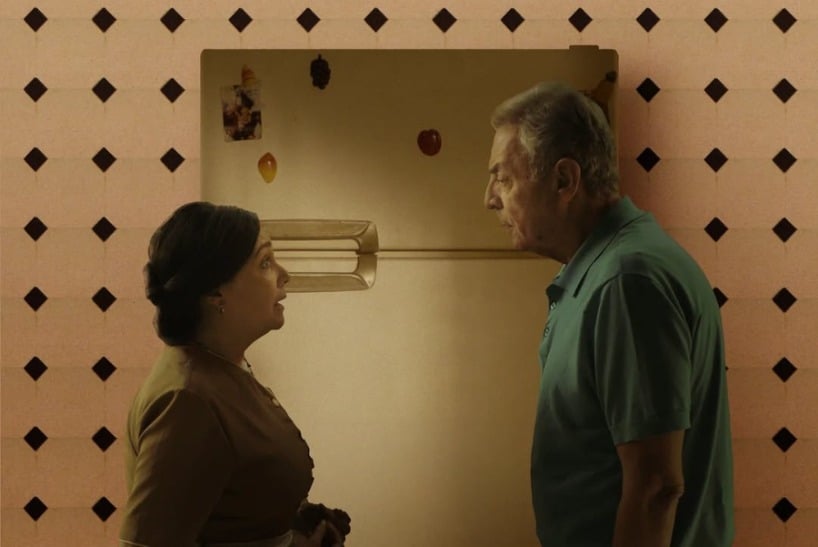
Premiering in the “Horizons of Arab Cinema” competition at the 46th Cairo International Film Festival, Complaint No. 713317, the first feature by Egyptian filmmaker Yasser Shafiey, demonstrates that great cinema can spring from the smallest of domestic incidents. No sweeping landscapes, no star-studded cast, no melodramatic plot—just a modest Maadi apartment, a retired couple, and a refrigerator that refuses to close. From that starting point, Shafiey builds a film that is at once a marital chronicle, a social satire, a portrait of aging, and a meditation on dignity. The film went on to win the Best Screenplay Award at this 46th edition, honoring the sharpness of its writing and the delicacy of its human observation.
What begins as a trivial nuisance—the freezer door won’t shut, ice keeps forming, the husband stubbornly decides to “fix it” himself and accidentally punctures the wall—gradually becomes the first visible crack in an already fragile structure: the couple, their household economy, their sense of time, and their perception of themselves.
Shafiey drew on a personal experience once filed under case number 71. By extending that number into Complaint No. 713317, he immediately situates the story within a bureaucratic logic that multiplies files, figures, and grievances until it drains people of their energy. The number is not a mere administrative detail—it symbolizes the endless loop of complaints, expectations, and broken promises that define everyday life.
Inside their small Maadi apartment, Magdy and Sama have shared thirty-seven years together. Their home tells their story: dated furniture, worn objects, a dusty computer, old souvenirs, and vegetable-shaped magnets decorating the fridge. It feels like a place suspended in time, both a refuge and a cage—a space filled with memories of dinners, laughter, and long workdays, yet where the future seems reduced to repetition.
The film captures this precise tipping point. Sama is about to retire with a severance bonus larger than Magdy’s pension—a small but piercing imbalance that reopens his wounded pride. For a man whose social relevance has been quietly eroding for years, this shift cuts deep. When Magdy insists on handling the repair himself, dealing with the maintenance company, and taking every decision, it’s as much about defending his dignity as about fixing an appliance.
Sama, by contrast, wants peace. She wants the house to function again, whether through repair or replacement—anything but the endless tension. Having carried the practical burden of their home for decades, she now longs for serenity. The film observes with uncanny precision this asymmetry: he needs to assert that he still matters; she seeks to preserve what remains of their fragile harmony.
The refrigerator becomes far more than an object—it mirrors their marriage. It holds their leftovers, their habits, the sediment of their life together. When its door stops closing, it’s not only cold air that escapes but everything inertia had kept sealed: unspoken resentment, muted jealousy, forgotten tenderness.

Shafiey films Magdy and Sama with tenderness and rigor, never judgment. Their exchanges are simple, almost banal—cups of tea, quiet talks, fleeting smiles—but every detail carries weight. A careless remark, a small lie about repair costs, or an allusion to retirement can ignite an argument. These moments aren’t loud; they’re meticulous, revealing decades of compromise and disappointment.
Still, the bond endures. The gestures of affection and the old routines hold them together even as friction grows. This impossibility of both separation and continuity lies at the film’s heart.
The second major thread of Complaint No. 713317 follows Magdy’s stubborn confrontation with the maintenance company. What begins as a service request turns into a tragicomic descent into bureaucracy. The technician—played with brilliance by Mohamed Radwan—is a compulsive fabulist, claiming to be a top engineer, a welding expert, even a former NATO employee. Each visit brings new promises, new lies, and no results. The company’s manager, played with deceptive gentleness by veteran Enam Salousa, listens politely, reassures, and promises to “look into the file,” while nothing ever happens.
This isn’t just satire—it’s anatomy. The talkative technician and the placid manager personify a system where words replace action, where charm and delay have become a national reflex. Against this machinery of polite futility, Magdy stands his ground. He calls, writes, demands answers, refuses to pay again, and eventually contacts a consumer protection association. For him, the issue transcends the refrigerator. It’s a matter of principle.
Shafiey turns this domestic absurdity into a metaphor for social survival. Magdy has spent a lifetime yielding, staying quiet, letting things slide. Not this time. His insistence, however small, becomes an act of defiance—an aging man’s way of reclaiming respect in a world that has long stopped seeing him.
This double movement—the unraveling of a marriage and the awakening of self-respect—is carried by two remarkable performances. Mahmoud Hemida plays Magdy as both comical and tragic: ridiculous in his obsession with a fridge, yet noble in his refusal to surrender. His performance is layered with fatigue, anger, and pride. Hemida is extraordinary here—he doesn’t just play Magdy, he breathes life into him. He gives the man a soul, turning him into one of the most moving and authentic characters of his career.
Opposite him, Sherine delivers a subtle and affecting portrayal of Sama. She is not merely a patient wife; she’s a woman weighed down by years of quiet endurance, who eventually admits she is exhausted—by the arguments, the silences, the endless compromises. Her face reflects tenderness and frustration all at once. Their estranged son, forever “too busy to visit,” adds another layer of loneliness: they are two people left face to face with nothing but each other and time.
Shafiey’s direction captures this tension with elegant restraint. The camera often keeps its distance, as if the apartment itself were watching. Frames are composed like stage tableaux—doorways, narrow corridors, the refrigerator looming like a third presence. The light, softly amber and slightly faded, gives the scenes the worn beauty of spaces that have absorbed too many lives.
At times, the film recalls Ayten Amin’s Villa 69—the same closed universe steeped in memory, the same contemplative pace, the same physical and emotional confinement. Time seems to stand still; walls and objects become witnesses to what the characters can no longer say aloud.

Humor runs beneath this quiet melancholy. When the boastful repairman spins his tall tales or the company manager feigns efficiency, the absurdity becomes darkly funny. It’s a humor rooted in recognition—Egyptian in tone but universal in truth. We laugh, uneasily, because we’ve all faced similar circles of incompetence and evasion.
As the story unfolds, the meaning of the title deepens. Complaint No. 713317 is not just one case number but an emblem of countless unresolved grievances stacked in dusty archives. Shafiey builds a looping narrative where nothing truly progresses: promises repeat, repairs fail, life resumes its stalled rhythm. Even the fridge, alternately broken and fixed, mirrors the illusion of closure.
In the final scene, Magdy and Sama embrace, their reflection framed within the refrigerator door. It’s a tender yet ambiguous image—yes, they’ve survived another ordeal, but they remain confined within the same four walls, the same routines, the same unresolved sorrows. Life, Shafiey suggests, is a series of temporary repairs.
Complaint No. 713317 lingers because it refuses shortcuts. It’s simultaneously a portrait of a fading marriage, a social allegory about bureaucracy and aging, and the story of one man’s stubborn stand against humiliation. The refrigerator is never just an appliance—it’s the condensation of a lifetime of compromises, pride, and love.
With this debut, Yasser Shafiey proves himself a filmmaker of rare sensitivity. He unites absurdist comedy and emotional truth, turning the mundane into the profound. Through Magdy and Sama, he gives voice to every couple that has grown old in silence—and to every citizen who, one day, decides not to be ignored, even if it’s only to demand that a refrigerator finally be repaired.
By Neïla Driss