
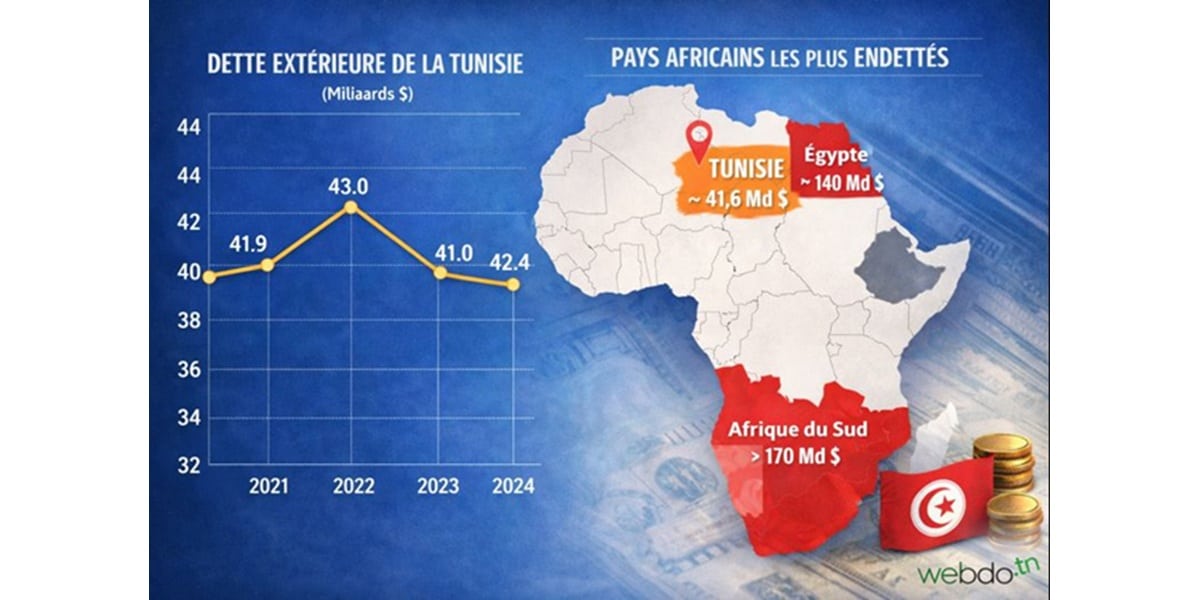
At the end of 2024, Tunisia will be among the African countries most indebted to the outside world. With an estimated outstanding amount of around $41.6 billion, according to data from the World Bank and taken up by several African financial institutionsthe country is at the top of the continental ranking in terms of absolute amounts, without however belonging to the group of very large African economies.
Depending on the methodologies used and the nature of the debt taken into account, Tunisia oscillates between seventh and tenth place in Africa. This variation is mainly explained by the distinction between total external debt, including the private sector, and external public debt alone.
The top places remain largely dominated by South Africa and Egypt, whose assets exceed $140 billion, driven by the size of their economies and smoother access to international markets. Tunisia thus operates in an intermediate group, alongside countries like Morocco, Angola or Mozambique, with more limited volumes but more restricted budgetary room for maneuver.
A trajectory marked by a peak then stabilization
The evolution of Tunisian external debt over recent years highlights a phase of marked increase at the beginning of the decade, followed by a gradual stabilization. The peak was reached in 2021, in a context of exceptional financing linked to the economic consequences of the pandemic. Since then, the outstanding amount in dollars has stopped growing significantly, despite an unfavorable international environment characterized by rising interest rates and the increase in the cost of external financing.
| Year | External debt ($ billions) |
|---|---|
| 2020 | ~41.9 |
| 2021 | ~43.0 |
| 2022 | ~41.0 |
| 2023 | ~42.4 |
| 2024 | ~40.4 – 41.6 |
This stabilization reflects a combination of factors, including a moderation of new borrowings in foreign currencies and greater repayments, in a context of strong pressure on the balance of payments.
A still fragile financial balance
Beyond the volume of the debt, the most revealing indicator remains its weight in relation to national wealth. The external debt to GDP ratio increased from around 44.7% in 2023 to almost 39.1% in 2024, signaling a relative improvement in external sustainability. This development was made possible by better performance of foreign currency revenues, particularly those from tourism and transfers from Tunisians residing abroad.
At the same time, the Tunisian State has increased its use of domestic financing in order to limit exposure to exchange rate risks. In 2024, domestic debt exceeded external debt in the overall structure of public debt, a choice which makes it possible to reduce dependence on foreign currencies but which increases pressure on the local banking system and on the financing of the economy.
In 2024, Tunisia honored repayments exceeding 14 billion dinars, a significant effort which helped to contain external debt. This stability nevertheless remains fragile and dependent on exogenous factors, notably the country’s capacity to maintain sufficient foreign currency inflows and to access multilateral financing, which represents a significant part of its external debt.
Thus, Tunisia’s position in the African ranking reflects an intermediate situation. The country is not facing critical over-indebtedness, but remains subject to structural constraints which require rigorous and prudent management of its financial balances in order to preserve its economic credibility and its medium-term financing capacity.
Also read: