


The latest reports from the Ministry of Finance highlight several structural weaknesses of Tunisian public companies, particularly in terms of human resources management, productivity and contribution to the creation of national wealth.
These findings come from the National Report on Enterprise in Tunisia 2025, prepared by the Arab Institute of Business Leaders (IACE) on the basis of data from the Ministry of Finance, covering the analysis of 50 public enterprises, including social security funds and financial institutions.
These data reveal a persistent paradox: high average remuneration per employee, but economic performance often falls short of expectations.
An average annual salary of more than 45,000 dinars
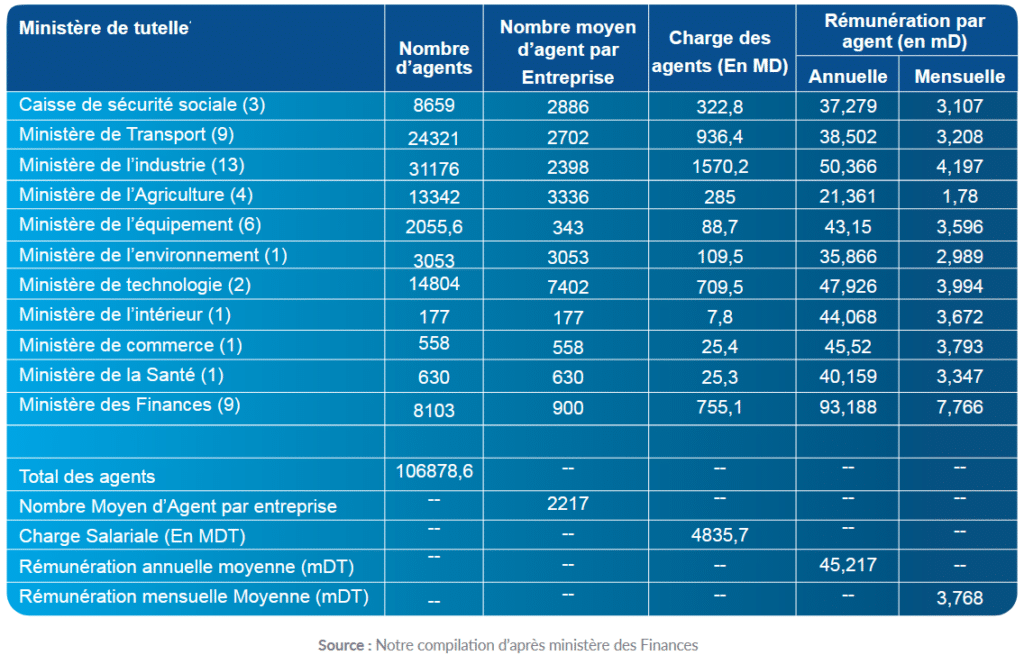
According to the analysis of 50 public companies, including social security funds and financial institutions, the average annual cost per worker reached 45,217 dinars, or approximately 3,768 dinars per month. A level of remuneration higher than that observed in a large part of the private sector.
This data, taken in isolation, could suggest high individual productivity. But it contrasts with the financial reality of many public companies, often marked by chronic deficits and increased dependence on state budgetary support.
Large workforce and a structure considered cumbersome
On average, each public company employs 2,017 agents, a figure indicative of a heavily staffed organization. This oversizing is partly explained by social and political considerations, notably the fight against unemployment and the preservation of social stability.
However, this logic poses major challenges in terms of operational efficiency, payroll control and skills management, in an increasingly constrained economic context.
Productivity that questions
In the private sector, productivity remains a central lever of competitiveness and economic survival. Conversely, in the public sector, priorities seem more oriented towards continuity of service, job security and social balance, sometimes to the detriment of economic performance.
This difference in logic helps explain why relatively high pay in the public sector does not necessarily translate into increased profitability or efficiency.
The distribution of public enterprises by supervisory ministry also reveals strong heterogeneity. The workforce and salary costs are concentrated in particular in the ministries of Transport, Industry, Finance and Agriculture, which alone bring together a significant proportion of public officials.
This diversity of situations complicates any uniform approach to reform and reinforces the need for differentiated policies, adapted to sectoral specificities.
These findings relaunch the debate on the future of public companies in Tunisia, at a time when the authorities are called upon to reconcile financial balance, economic efficiency and social imperatives. The question of productivity, workforce rationalization and governance now appears to be a central issue in future structural reforms.