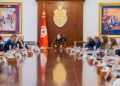


Meeting at the Kasbah under the presidency of the head of government Sarra Zaâfrani Zenzri, the Council of Ministers examined several draft organic laws with strong economic implications. These texts aim to update the free trade agreements linking Tunisia to its Euro-Mediterranean partners. The stated objective is to consolidate the country’s anchoring in regional and international value chains.
On the instructions of the President of the Republic Kaïs Saïed, the Council of Ministers examined a series of draft organic laws relating to Tunisia’s strategic trade agreements. The meeting was held at the Government Palace in Kasbah, under the leadership of Sarra Zaâfrani Zenzri. These texts are part of a dynamic of strengthening the economic integration of the country and respecting its international commitments.
Trade agreements: key texts for economic opening
The Council examined three draft organic laws relating to the updating of structuring agreements. The first concerns the approval of amendments to the Pan-Euro-Mediterranean Convention on Preferential Rules of Origin. The second aims to modify Protocol B of the free trade agreement between Tunisia and the States of the European Free Trade Association. The third concerns the updating of the Euro-Mediterranean association agreement linking Tunisia to the European Union and its member states.
According to the official press release, these projects reflect the State’s desire to preserve the achievements obtained over the years, while the Tunisian industrial fabric is already deeply intertwined in the Euro-Mediterranean area through multiple partnerships.
A strategic space for Tunisian exports
The Euro-Mediterranean region remains the main destination for Tunisian exports, particularly in the industrial, agricultural and agri-food sectors. Its geographical proximity, the complementarity of economies and the interconnection of value chains make it a leading strategic market.
This economic area brings together more than 500 million consumers and absorbs nearly 80% of Tunisian exports. Partnership and free trade agreements offer Tunisian products preferential access to these markets, thus strengthening the competitiveness of national companies.
The adoption of the draft laws examined should allow Tunisian companies to better integrate into European and global production chains. The automotive components, electrical and electronics industries, as well as textiles and clothing sectors are particularly affected.
Beyond trade, the Euro-Mediterranean region also constitutes an attractive hub for investment, technology transfer and the development of know-how. A dynamic called to diversify Tunisian exports and improve their quality.
Structural reforms and new government approach
At the close of the work, the head of government insisted on the need for increased coherence of public action in order to improve the functioning of State services and the quality of services intended for citizens. She called for accelerating major structural reforms within public bodies and meeting project completion deadlines, with the aim of stimulating investment and creating new jobs.
Sarra Zaâfrani Zenzri also called for a global approach breaking with methods considered obsolete, based on the simplification of procedures and the search for immediate solutions to cases, at all levels of governance.