
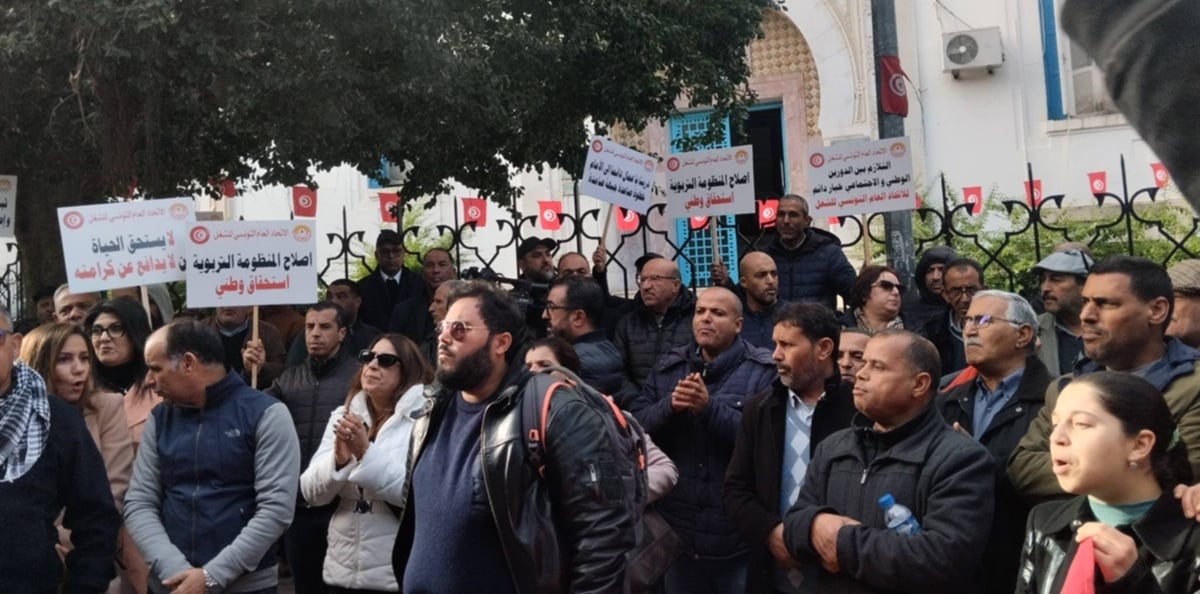
The unions of nine educational bodies organized a sit-in in front of the Ministry of Education to denounce the freezing of negotiations and the non-implementation of signed agreements. They warn of an alarming deterioration in the education system and demand respect for union rights.
In Tunis, the anger of education unions was expressed publicly this Thursday, through a sit-in organized in front of the headquarters of the Ministry of Education. At issue: the freezing of negotiations, the non-implementation of agreements already signed and what the unions describe as repeated attacks on the right to organize. The protesters are demanding the immediate opening of serious discussions with the supervisory authority and the full execution of the commitments made.
Frozen agreements and broken promises
At the initiative of nine educational bodies, this mobilization is part of a protest sequence that began several months ago. The unions denounce a persistent blockage of social dialogue and the lack of implementation of the agreements concluded with the ministry, despite their binding nature.
Mohamed Essafi, secretary general of the General Federation of Secondary Education, recalled, in a statement to the TAP agency, that the agreement signed on May 23, 2023 provides for an annual salary increase of 100 dinars over three years, to come into force from January 2026. However, according to him, the ministry unilaterally reduced the duration of this agreement by ten months, in flagrant violation of its commitments.
The union official also insisted on the application of the retroactive effect of promotions from July 1, 2025, considering that any questioning of this achievement constitutes a direct attack on the rights of teachers.
Broken social dialogue
The unions criticize the ministry for calling into question the very principle of negotiation. Mohamed Essafi strongly criticized the Minister of Education’s statements during the budget debates for 2026, saying that the agreements would be “under study”. A position deemed unacceptable by union representatives, for whom a signed agreement cannot be renegotiated but only applied.
Beyond the financial demands, the protesters denounce a climate which they consider hostile to union action, marked by restrictions and marginalization of professional organizations.
An education system under pressure
The unions draw up an alarming observation of the situation in educational establishments. Overcrowding of classes, shortage of teachers, lack of planning and deterioration of working conditions are at the heart of the criticisms addressed to the central administration.
Boulbaba Selmi, general secretary of the general union of supervisors and general supervisors, highlighted the concrete impact of the freezing of negotiations for almost a year. He mentions dilapidated school infrastructure, boarding schools closed or threatening ruin, as well as a glaring security deficit, particularly in the North-West and Center-West regions.
According to him, nearly 3,000 supervisory positions remain vacant, to which is added a structural lack of general supervisors, compromising the supervision of students in a context marked by the rise in violence, drugs and crime in schools.
The unions warn that this sit-in is only one step in a broader movement, as long as the agreements are not implemented and credible dialogue is not re-established. They hold the ministry responsible for the worsening educational crisis and call for urgent decisions to preserve the stability of the sector.