
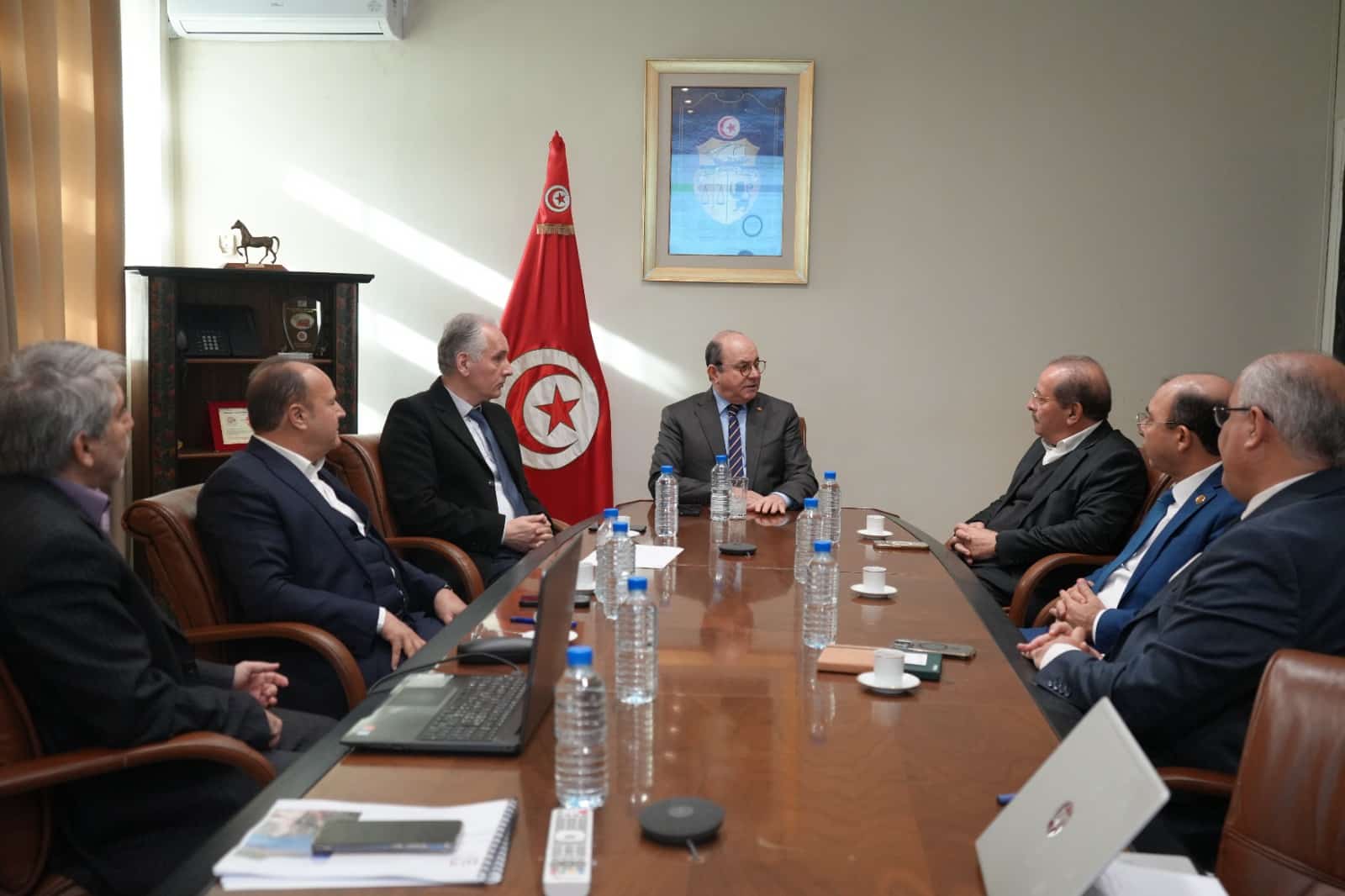
The Minister of Tourism, Sofiane Tekaya, underlined the importance of integrating the regional dimension in the implementation of tourism investments, during a working session held Thursday at the ministry’s headquarters, dedicated to monitoring the progress of the “Costa Coralis” project. This approach aims, according to him, to ensure a more balanced distribution of tourist activity between the different areas falling within the regional area concerned.
The minister explained that this orientation is based on the joint development of natural resources, archaeological sites and cultural heritage specific to each area, with the aim of boosting the local economy and strengthening the attractiveness of the territories. He also insisted on the need for rational exploitation of available resources, while giving a central place to the support of traditional industries, considered as a lever for sustainable and inclusive development.
The meeting took place in the presence of representatives of the company carrying the project, headed by the chairman of the board of directors, Mohamed Fawzi Drissi, as well as the president of the Tunisian-African Business Council, Anis Jaziri, and several executives from the ministry. On this occasion, a detailed presentation of the project was made, highlighting its integrated nature and its regional roots, as an investment initiative originating from the region itself.
Financing and administrative procedures
The discussions also focused on the various constraints which have delayed the realization of the project until now, in particular those linked to financing and administrative procedures. The participants examined the mechanisms likely to remove these obstacles and accelerate the procedures, in order to allow the effective launch of the project as soon as possible.
In this context, Anis Jaziri indicated that contacts are underway with several donors, both in Tunisia and abroad, with a view to mobilizing the necessary financial resources. He specified that the authorities concerned, in particular the Ministry of Tourism, will be regularly informed of the progress of these negotiations.
The meeting concluded with an agreement on several operational measures, including the upcoming holding of an extended meeting bringing together all stakeholders, in particular the Tourist Land Agency, in order to resolve issues related to land. The participants also reaffirmed the importance of integrating the environmental and ecological dimensions into all components of the project, through the use of renewable energies and the recovery of waste.
Return to the project
Imagined in December 2016, Costa Coralis is the result of a collective initiative of local and regional investors united within the company Haifa for Development and Investment (Haifa HDI)created specifically to manage this integrated tourism megaproject in the governorate of Jendouba. The project covers 140 hectares of land belonging to the State, which must be transferred to the Agence Foncière Touristique before any construction operation.
After feasibility studies carried out by renowned firms such as Deloitte, and several preliminary approvals, its launch is still hampered by administrative blockages. This frustration, highlighted by the Italian agency Novais widely shared by local investors. Beyond the multiplicity of institutional actors, the project faces several obstacles:
- Environmental constraints : the Tabarka region, rich in biodiversity and partially protected, requires strict impact studies and the application of rigorous environmental standards.
- Complex regulatory framework : the rules governing tourist development on public land involve delicate coordination between different state agencies.
- Long land procedures : the transfer of land from the State to the Tourist Land Agency is subject to cumbersome legal procedures, sensitive in the Tunisian context.
- Post-revolutionary context : since 2011, economic and political uncertainty has sometimes slowed down major investment operations, particularly in peripheral regions.
Technical aspects of the project
Nature and typology of the project
The “Costa Coralis” project is designed as an integrated tourism project. It is not a simple hotel unit, but a structured whole combining accommodation, services, leisure and development of the territory. Its design is based on destination logic rather than isolated infrastructure.
Territorial and regional approach
The project is part of a regional approach, aiming to connect several areas of the first tourist district. On a technical level, this involves integrated spatial planning, taking into account tourist flows, accessibility, existing infrastructure and the complementarity between the surrounding natural, cultural and archaeological sites.
Functional components
The project should include:
– Diversified tourist accommodation units (hotels, tourist residences, ecolodges).
– Leisure and entertainment spaces with low environmental impact.
– Areas dedicated to crafts and local products, integrated into the tourist route.
– Service facilities (catering, cultural spaces, discovery tours).
Infrastructure and accessibility
The implementation of the project requires:
– Road access and tourist signage arrangements.
– A functional connection with existing networks (electricity, water, telecommunications).
– Coordination with local authorities for the development of public spaces and peripheral areas.
Land and regulatory framework
Technically, the project depends on:
– Clarification of the land situation in coordination with the Tourist Land Agency.
– Compliance with current tourist and environmental specifications.
– Obtaining administrative authorizations related to town planning, the environment and investment.
Financing plan and phasing
The project is based on a mixed financial package, combining national and international financing. On a technical level, this involves a phasing of construction, starting with the basic infrastructures, followed by the progressive development of the different components of the complex.