
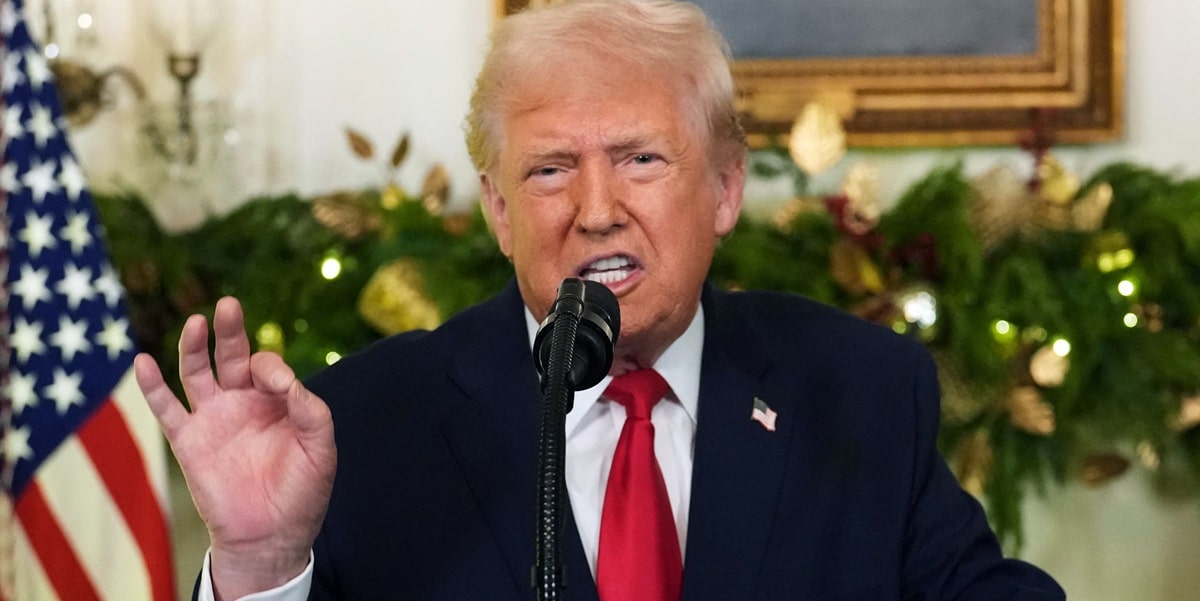
In a solemn speech from the White House, Donald Trump delivered much more than a simple assessment of his actions. In 19 minutes, the US president articulated three central policy narratives — immigration, world peace and energy resources — indicative of a presidency that favors strategic storytelling over factual exposition. He also mentioned, more briefly, the internal economic situation, border security and the fight against drug cartels, without these themes constituting the central framework of his speech.
Immigration as an internal enemy
At the heart of his speech, Donald Trump once again designated illegal immigration as the source of several structural ills in the United States. Employment, health system, public security, housing crisis: so many areas that the president linked to the arrival of migrants, accused of “stealing jobs” and weighing on public finances.
A well-honed rhetoric, which nevertheless ignores numerous economic data. Several studies show that immigrants contribute significantly to the American economy, particularly in agriculture, construction and services, and that they pay more in taxes than they receive in public assistance. By 2023, their tax contribution exceeded $650 billion, generating nearly $1.7 trillion in economic activity.
Trump’s speech also included comments targeting certain communities, notably Somalis, who were unfoundedly accused of having “taken control” of Minnesota’s economy. An outing which contrasts with the personal trajectory of the president, whose two wives are from European immigration.
World peace as a personal trophy
Internationally, Donald Trump presented himself as a peacemaker, claiming to have “settled eight wars in ten months” and put an end to the conflict in Gaza, going so far as to evoke an unprecedented peace “for 3,000 years” in the Middle East.
These spectacular declarations, however, are not based on any recognized diplomatic framework. No comprehensive peace agreement has been signed, and violence continues in the Palestinian territories and elsewhere in the region. The historical reference itself appears largely exaggerated, Israel having been founded in 1948.
This hyperbolic register is part of a logic of personalization of diplomacy, where complex conflicts are reduced to individual successes, without multilateral recognition or lasting institutional mechanism.
Venezuela, between silence and lust
Notably, the US president has barely addressed the crisis with Venezuela, despite growing tensions and an increased US military presence in the region. This silence contrasts with statements made a few hours earlier, in which Trump claimed to want to “recover” American oil rights in the South American country.
An implicit reminder of the nationalization process initiated in 2007 under Hugo Chávez, which led to the ousting of several American companies. Since then, Venezuelan oil has remained a major geoeconomic issue, at the heart of a standoff combining sanctions, diplomatic pressure and a show of force.
By avoiding any formal announcement, Trump maintains a strategic ambiguity, leaving the option of an escalation floating without publicly assuming its contours.
The same common thread
Immigration, peace, oil: three distinct themes, but a common mechanism. That of a power exercised by narrative, based on the designation of enemies – internal or external -, the simplification of power relations and the centralization of success around the presidential figure.
Behind the image of an America “back” and “stronger than ever”, Donald Trump’s speech above all reveals a method: governing through storytelling, even if it means leaving the facts in the background.
Also read: