

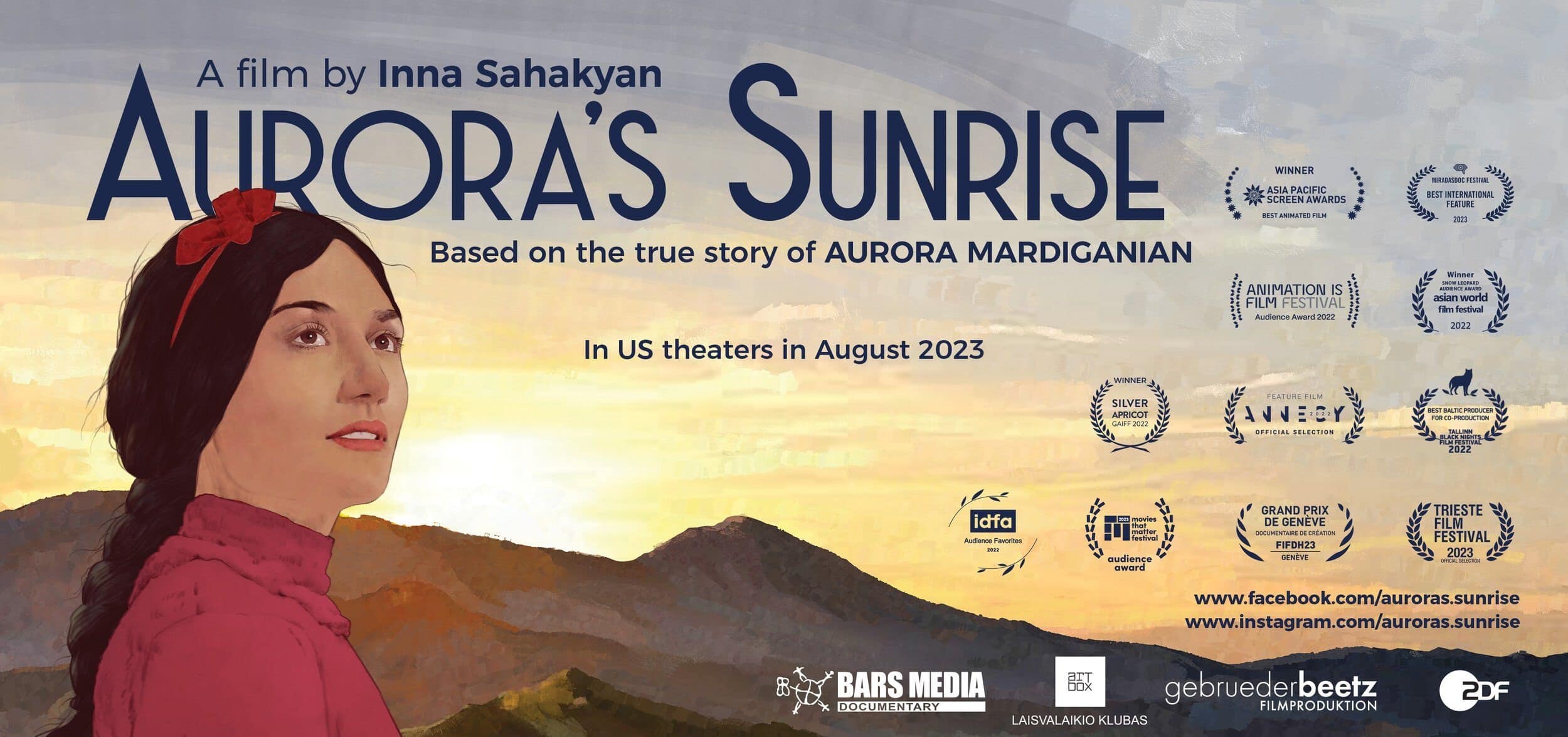
Selected as part of the 36th edition of the Carthage Film Festival (JCC), taking place from December 13 to 20, 2025, Aurora’s Sunrise (Aurora, an Armenian Star), directed by Inna Sahakyan, is presented in the section “Focus on Armenian Cinema.” The film retraces the life of Arshaluys Mardiganian, known as Aurora, a survivor of the Armenian genocide, and uses her personal story as the entry point to a far broader narrative, in which individual memory becomes inseparable from the collective history of a people brought to annihilation.
Aurora was still a teenager when the Armenian genocide began in 1915 in the Ottoman Empire. She witnessed the extermination of her family, the destruction of her world, and endured the extreme violence of deportations, death marches, enslavement, and abuse before managing to escape. Taken in charge by an association while she was still in Armenia, her departure was organized, allowing her to reach the United States. This early support made not only her survival possible, but also, later on, the dissemination of her testimony.
The genesis of Aurora’s Sunrise is rooted in rare material: filmed and recorded interviews with Aurora Mardiganian conducted shortly before her death in 1994, at the age of 93. Preserved by the Zoryan Institute, these testimonies form the backbone of the film. Inna Sahakyan builds her work around this direct voice, embracing the fragmentary nature of memory while rejecting any exhaustive or illustrative reconstruction.
The film’s form is decisive, and Aurora’s Sunrise establishes its principles from its opening minutes. The film begins with the premiere of Auction of Souls (Souls for Sale), a silent film released in 1919 based on Aurora Mardiganian’s testimony, in which she played her own role. This opening immediately situates the narrative within a cinematic history marked by disappearance, erasure, and the survival of images.

Constructed from several distinct materials, Aurora’s Sunrise combines animated sequences, photographic and cinematic archival images from the early 20th century, filmed interviews with Aurora recorded shortly before her death, as well as recovered fragments of Auction of Souls. Long believed to be lost, the 1919 film survives only in partial form. It was only decades later, after Aurora’s death, that a few scenes were rediscovered and incorporated into Sahakyan’s film, allowing these vanished images to resurface and enter into dialogue with a contemporary work.
Through this engagement with missing images, Aurora’s Sunrise also raises the question of cinema as a form of substitute archive. When official documents are lacking, when images have been destroyed, lost, or erased, cinema becomes a space in which history can continue to exist in another form. Not as legal proof or institutional documentation, but as a sensitive, embodied trace. The film does not replace the absent archives; it affirms their disappearance while refusing to let that absence amount to oblivion.
Animation plays a central role in this cinematic dispositif. It allows the film to depict what was never filmed: Aurora’s childhood, the destruction of her family, the death marches, her escape, the daily violence she endured. The drawings are stylized, bodies sometimes reduced to silhouettes, faces merely sketched, allowing absence, loss, and deprivation to emerge rather than offering a realistic reconstruction. This animation constantly interacts with archival material and fragments of the 1919 film, creating a circulation between lived memory, filmed memory, and reconstructed memory.
It is precisely this hybrid form that gives Aurora’s Sunrise its exceptional narrative power. By combining animation, archival footage, fragments of silent cinema, and direct testimony, the film creates no distance from reality; on the contrary, it renders it more tangible. Aurora’s story asserts itself as a lived experience, indisputable in its reality, and allows the Armenian genocide to be conveyed in all its horror. Had the film been conceived as a conventional documentary relying solely on archival footage and interviews, it would not have possessed this narrative force. The chosen form gives substance to what was destroyed and allows a reality long relegated to the margins of official history to exist onscreen.
Within this framework, Aurora’s body occupies a central place. It is not merely the body of a survivor marked by violence, but becomes a genuine political space. A body filmed in 1919 in Auction of Souls, a body publicly exposed in Hollywood, a body subjected to legal control when Aurora was placed under guardianship, a body that still speaks decades later through a recorded interview, and finally a body reconstructed through animation. Across these different layers of representation, the film shows how a single body passes through multiple regimes of visibility and power, revealing the close links between image, authority, narrative, and domination.
Through Aurora, Aurora’s Sunrise tells the collective history of an entire people. Her individual trajectory — the loss of her family, the violence endured, exile — becomes the prism through which the annihilation of the Armenians is read. The genocide appears not only as a historical event, but as an open wound that has never healed. Aurora’s story leads to no reparation, no official recognition, no justice. Survival does not mean being repaired, heard, or acknowledged by those who exercised violence. The film thus recalls that the Armenian genocide remains a crime without a tribunal or condemnation, and that this impunity continues to weigh heavily on contemporary Armenian memory.
At one specific moment in the film, Aurora explicitly addresses this absence of sanctions. She regrets that those responsible were never judged and states that this impunity may have allowed the repetition of mass crimes throughout the 20th century. She advances the idea that had the perpetrators of the Armenian genocide been tried and punished, the Holocaust might perhaps have been avoided. She nonetheless makes clear that the justice she calls for does not involve vengeance or armed retaliation: she rejects any logic of bloodshed and insists instead on the necessity of genuine trials conducted within a legal framework.
Once she arrived in the United States, Aurora’s testimony was first published as a serialized account in the American press. It was then expanded into a book in 1918, before being adapted for the screen the following year with Auction of Souls (Souls for Sale). This film became part of a vast campaign of awareness and mobilization. Aurora’s Sunrise states that this mobilization succeeded in raising 116 million dollars, an extraordinary sum for the 1920s, which was used to build orphanages in several countries around the world and to save 128,000 Armenian children left orphaned after the extermination of their families.
Yet the film does not reduce this history to a humanitarian success story. It develops a deeper reflection on the power of narrative itself. Aurora’s story was very early understood as a tool capable of transforming perceptions, influencing mentalities, and making visible a tragedy that many ignored or preferred to ignore. Narrative did not merely serve to raise funds; it functioned as a political, cultural, and symbolic lever, capable of inscribing a people and its history into the public sphere. This question of narrative remains acutely relevant today, far beyond the film’s historical context.
This power of storytelling, however, did not come without cost. The film shows how Aurora’s story was also confiscated and exploited on an individual level by an American author who appropriated her rights, became her legal guardian while she was still a minor, and derived personal financial profit from her testimony. This exploitation unfolded within a profoundly unequal legal and economic power relationship, transforming a survivor into an object of control and profit, regardless of the humanitarian commitment to which Aurora herself had consented.
What runs through Aurora’s story resonates strongly with the contemporary world. The accelerated circulation of narratives, their instrumentalization, the hierarchization of tragedies according to geopolitical interests, and the selection of what deserves to be shown or ignored remain mechanisms at work today. Aurora’s Sunrise sheds light on these persistent dynamics and reminds us that narrative continues to shape perceptions and political responses to mass crimes.
The film’s reflection also unfolds within a broader political context. The media exposure of the Armenian genocide and the mobilization it generated in the United States intersected with postwar geopolitical projects, notably the one defended by President Woodrow Wilson, which envisioned an American mandate or protectorate over Armenia. Aurora’s story thus became a tool of international persuasion. But this project was abandoned as diplomatic priorities shifted and relations between the United States and Turkey normalized, revealing the fragility of political commitments and the extent to which the fate of a people can depend on strategic interests.
The disappearance of Auction of Souls, a film that had nonetheless been widely distributed and screened across the United States upon its release, cannot fail to raise questions. Long considered completely lost, it remained untraceable for many years. The film offers no definitive answer, but leaves open the possibility of an erasure linked to political stakes. The later rediscovery of fragments, after Aurora’s death, and their integration into Aurora’s Sunrise restore a fragile existence to these lost images while underscoring the magnitude of what has been irretrievably erased.

The film also brings to light another form of violence, more diffuse yet equally destructive: silence. Judicial silence, since those responsible for the Armenian genocide were never tried. Diplomatic silence, when geopolitical interests outweigh the recognition of crimes. Historical silence, when images disappear and narratives are relegated to the margins. Aurora’s Sunrise shows that silence is never neutral: it acts, prolongs violence, and enables repetition.
By restoring body and voice to Aurora, Inna Sahakyan does not claim to repair history or to heal its wounds. Instead, she shows that cinema can become a space of critical memory, capable of revealing both the power of narrative and its darker zones: its manipulations, silences, and political uses. Aurora’s Sunrise thus emerges as a film about survival — not only of a people, but of a story torn away, instrumentalized, and slowly reclaimed.
Poignant, the film ultimately allows those who know the Armenian genocide only vaguely to grasp more clearly its reality, its scale, and its horror. And it imposes a bitter conclusion: more than a century after these crimes, humanity has still not learned the lesson. Genocides and massacres are still unfolding today, for various reasons, as if human beings were unable to live without war and destruction. Aurora’s Sunrise thus reminds us, with implacable force, that to tell, to transmit, and to name remain essential acts — perhaps the only ones capable of resisting oblivion and repetition.
Neïla Driss