
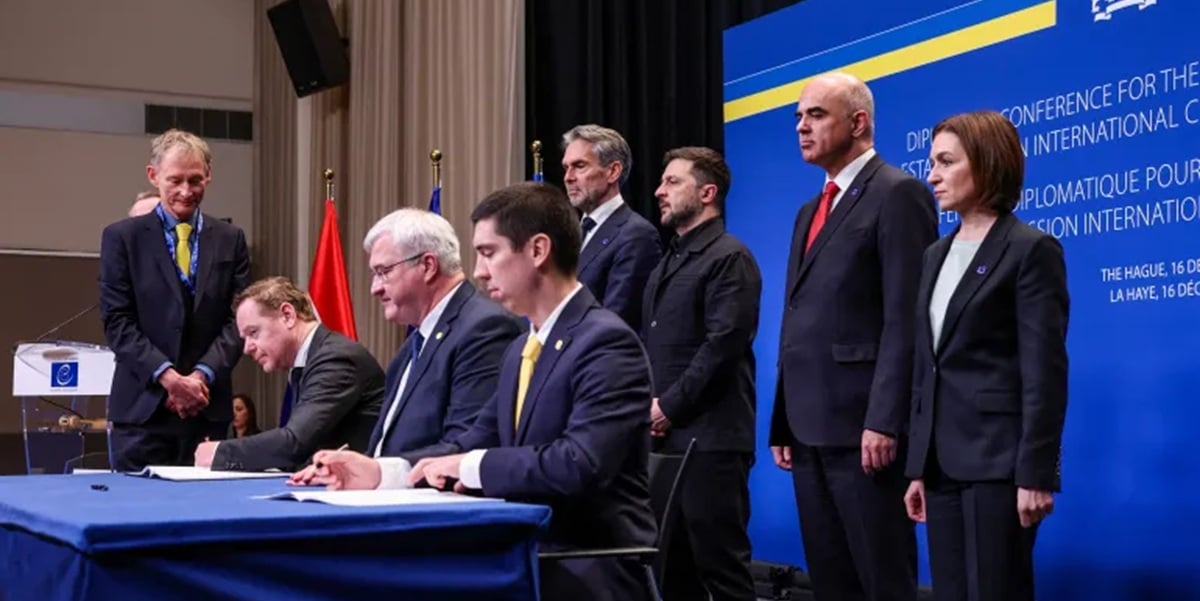
Thirty-five European and partner countries signed a treaty in The Hague on Tuesday establishing an International Claims Commission for Ukraine, responsible for examining and ruling on claims for compensation linked to the destruction caused by the Russian invasion, organizers announced.
The new body, placed under the coordination of the Council of Europe, will have the mission of assessing the material and human damage resulting from the war launched by Russia in February 2022 and of deciding on the amounts of reparations to be granted, without however specifying at this stage the payment mechanisms.
The commission is a continuation of the Register of Damages for Ukraine, created almost two years ago and which has already recorded more than 80,000 requests for compensation from Ukrainian individuals, companies and institutions.
No concrete payment terms have yet been decided. Discussions include the use of Russian assets frozen in Europe, as well as possible contributions from member states, a legally and politically sensitive subject within the European Union.
Zelensky: “Responsibility is the path to peace”
Present at the conference alongside several European leaders, Ukrainian President Volodymyr Zelensky welcomed the creation of the commission, believing that Moscow’s accountability constituted “the true starting point of a path towards peace”.
“This war and Russia’s responsibility must become a clear example, so that others do not opt for aggression,” he said, calling for “the rules that govern the world” to be respected.
European pressure on frozen Russian assets
The European Union has frozen several hundred billion euros of Russian assets since the start of the conflict. Their possible use to finance the reconstruction of Ukraine is the subject of intense debate, particularly in the run-up to a European summit devoted to financial aid in Kyiv.
According to the World Bank, the cost of rebuilding Ukraine was estimated at $524 billion by the end of 2024, an amount that does not take into account the damage caused by the most recent Russian strikes on energy and civil infrastructure.
Also read: