

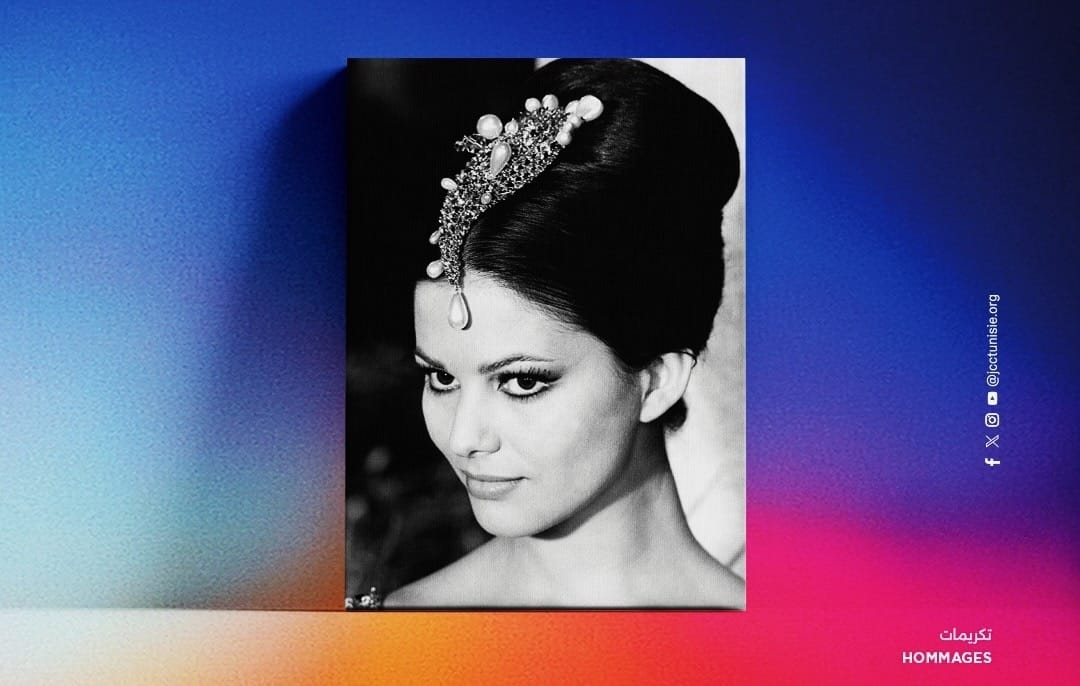
As part of the 36th edition of the Carthage Film Festival (Journées Cinématographiques de Carthage), held from December 13 to 20, 2025, a deeply moving evening paid tribute to the memory of Claudia Cardinale, “the most beautiful Italian from Tunis,” who passed away a few months ago. Hosted by Tarek Ben Chaabane, the event gathered a large audience to honor an icon of world cinema profoundly connected to Tunisia — her birthplace and the land she always called home.
The evening unfolded in three parts: Les Anneaux d’or (1956) by René Vautier and Mustapha El Fersi, the short film that marked Claudia Cardinale’s first screen appearance; Claudia Cardinale: The Most Beautiful Italian from Tunis (1994) by Mahmoud Ben Mahmoud; and finally Claudia Cardinale: Tunisia… Splendor and Beauty (2025) by Lotfi Bahri, dedicated to the actress. A beautifully designed poster was created especially for the occasion, symbolizing beauty, memory, and the timeless presence of a legendary actress.

Tarek Ben Chaabane opened the evening by recalling the uniqueness of Claudia Cardinale’s career and the unbreakable bond she maintained with Tunisia. Lotfi Bahri then took the floor to share a personal memory: “I first met Claudia Cardinale when she was filming Jesus of Nazareth (1977) by Franco Zeffirelli in Monastir. Since then, a long friendship has connected us. I wanted my film to explore her relationship with Tunisia and the deep love she had for it.” He also noted that the evening coincided with the 50th anniversary of his career — a milestone he dedicated to all those who had supported him throughout the years.

For his part, Mahmoud Ben Mahmoud presented his 1994 documentary — a vital work devoted to the Italian community of Tunisia. “This community was nowhere to be found — neither in history books nor archives. I wanted to preserve a memory that was disappearing,” he explained. “I started by filming elderly Italians living around Radès, whose testimonies were invaluable. Their stories would have vanished with them.” He recalled how he reached out to Claudia Cardinale during the project: “I traveled to Italy, met Bruno Cardinale and other members of her family. Claudia was then abroad on a film shoot, but I met her later in Paris. She was supposed to appear in this 52-minute documentary.”
The film was first screened at the Carthage Film Festival in 1994, during an earlier tribute to Cardinale, attended by the actress herself and her family. “We organized the screening at the Cathedral of Carthage. It was a special moment. I discovered then that Claudia was my neighbor in the Aéroport district of northern Tunis. We shared common memories,” he said. During one of her testimonies, Claudia revealed that it was in this same cathedral that she made her first communion.
Initially planned for RAI 3, the documentary was ultimately broadcast in prime time on RAI 1. It remains an essential work of remembrance dedicated to an Italian-Tunisian community long forgotten. “I was lucky to have filmed those elderly witnesses before their voices disappeared,” added Ben Mahmoud. For the Carthage screening, only the segment dedicated to Claudia Cardinale was shown.

The nearly full theater reflected the audience’s deep emotion and affection for a star who never denied her roots. Lotfi Bahri’s film will also air today in prime time on Tunisian national television.
Through the images and testimonies projected that evening, a profound and sincere love emerged — the love Claudia Cardinale carried for Tunisia, the homeland of her family for three generations. In all her interviews, she spoke of it with infinite tenderness, evoking her childhood memories, her family, her roots, and her attachment to the land that shaped her. Born in La Goulette, at a time when the neighborhood embodied the coexistence of multiple communities and faiths united by their shared love for Tunisia, she grew up immersed in an atmosphere of openness and harmony. In those days, no one asked another about religion or belief.
Claudia spent the first eighteen years of her life in Tunis. She spoke Sicilian, Arabic, and French, but not Italian — a detail she often mentioned with humor, recalling how she had difficulty communicating during her first trip to Venice for that very reason.
“I was born under a lucky star,” she used to say — and she was right. Around the age of sixteen or seventeen, she was cast in a small role in Les Anneaux d’or, filmed in Mahdia. The short won the Youth Film Award for Best Short Film Suitable for Young People at the 1959 Berlin Film Festival. Though her appearance was brief, the film included a close-up of her radiant face — perhaps it was that smile that prompted Jacques Baratier and Omar Sharif to wait for her outside her school, the Paul Cambon Lycée in Tunis, to offer her a part in Goha. Perhaps so.
Her career truly took off following a fateful twist of destiny. While helping her mother, who was involved in organizing a charity gala, Claudia was encouraged to step on stage and was unexpectedly crowned “The Most Beautiful Italian in Tunis.” The title earned her a trip to the Venice Film Festival. She later recalled that, in Venice, she felt somewhat lost — not yet speaking Italian — but that her Tunisian roots once again brought her luck. Dressed in traditional Tunisian attire, including a burnous, she stood out among the crowd and caught the attention of photographers. That visibility led to appearances in major magazines, featuring stunning portraits that helped establish her image and attract the attention of the film industry.
As a minor, Claudia needed her father’s consent to travel abroad. Initially reluctant to let his daughter go alone, he eventually traveled to Italy to sign her contracts himself — thus beginning her international career.
Another moving moment of the tribute came from the beloved Tunisian actress Mouna Noureddine, who also made her debut in Les Anneaux d’or and later in Goha, though her path did not lead to the same international fame. “Each of us has our own star,” she said, smiling.
What stood out most in both documentaries screened that evening was Claudia Cardinale’s enduring attachment to Tunisia — a love inherited from her parents and passed on to her children. She often spoke to them about her origins, took them frequently to Tunisia, and showed them various regions of the country, especially Tozeur, which she loved for the silence of the desert and the serenity of its palm groves. She used to say she loved palm trees because they reminded her of home. Even after her parents moved to Italy, Tunisian cuisine remained part of their household — mloukhiya, couscous, and other traditional dishes. Claudia’s roots were deeply Tunisian, and Tunisia remained the place she returned to whenever she sought peace.
Fittingly, destiny completed a perfect circle: her earliest roles were in Tunisian films, and her final performance brought her back to her homeland — in The Island of Forgiveness (2022) by Ridha Behi — a symbolic conclusion for a woman who belonged to the world, yet remained, above all, a daughter of Tunis.
Neïla Driss