
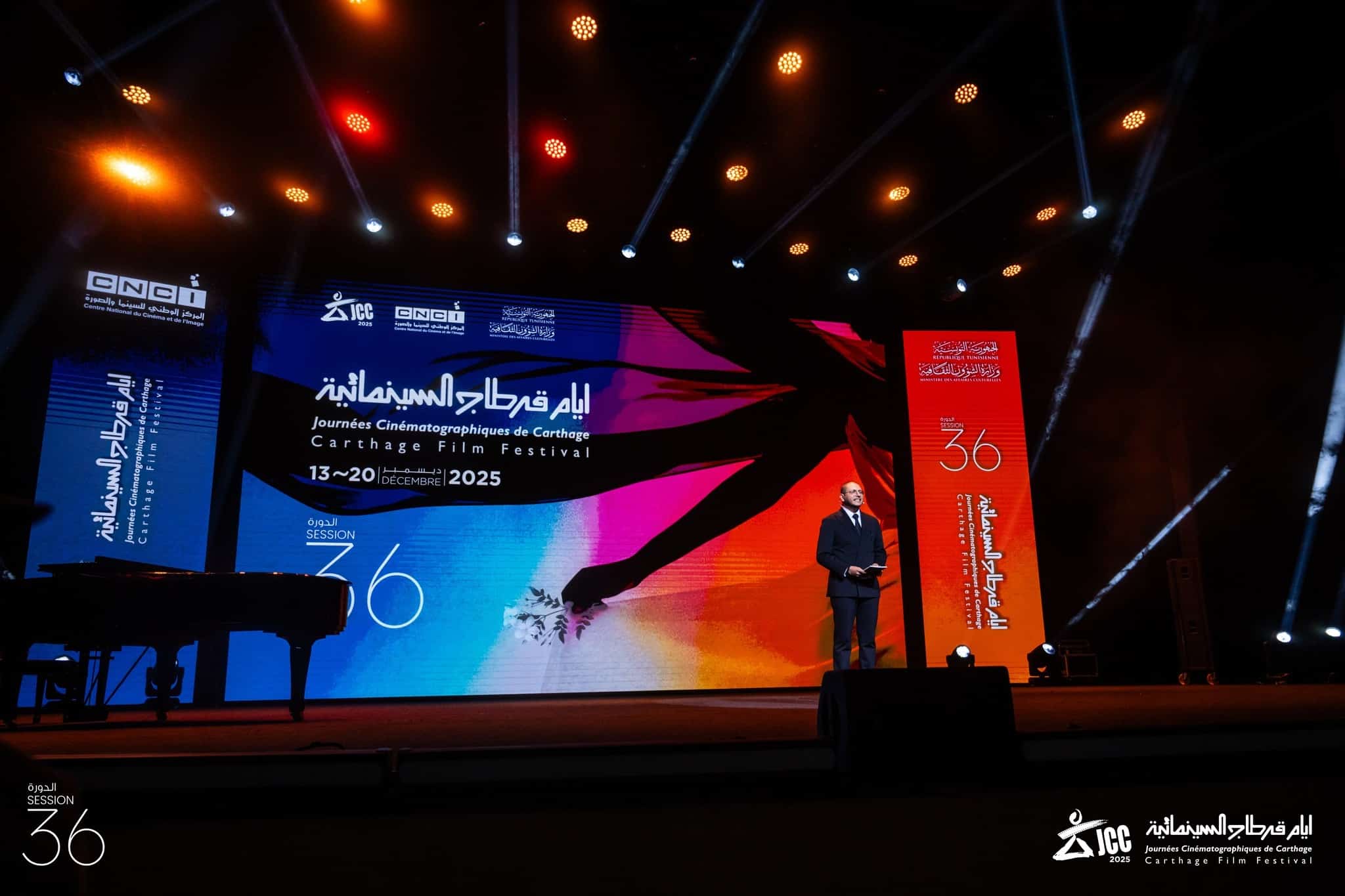
The 36th edition of the Carthage Film Festival (JCC), running from December 13 to 20, 2025, began last night at the Théâtre de l’Opéra in Tunis’s Cité de la Culture. Broadcast live on Tunisian Television, the National Radio, and the various channels of the Tunisian Radio Network, the evening stood out for its elegance and its focus on cinema itself. No official speeches were given, aside from a brief word of welcome from the festival’s General Director, Tarak Ben Chaabane.
Many guests appreciated the fact that the ceremony did not last long and avoided the usual succession of official speeches. That was indeed one of its strengths: cinema was meant to be the true star of the evening. Personally, however, I would have liked to see, in addition to the two songs by Ziad Rahbani, a brief artistic interlude — a touch of creativity or humor, as was done during the JCC 2021 opening ceremony, perhaps a short sketch inspired by a film or a lighthearted performance. It would have added a cheerful note to the evening. Moreover, it would have been fitting to include a segment paying tribute to all the Tunisian film professionals who passed away this year.
A Smooth and Uncomplicated Opening
Hosted by Amine Ben Hamza, the ceremony unfolded with restraint and grace. From the outset, the tone was clear: this was an evening to celebrate cinema, not to linger on protocol or lengthy addresses. Tarak Ben Chaabane only took the stage midway through the event to greet the audience — a gesture perfectly in line with the JCC’s spirit of keeping films, rather than formalities, at the heart of the celebration.
The evening opened with a tribute to Ziad Rahbani, the Lebanese composer and playwright who passed away a few months ago. A key figure of Arab culture, Rahbani left behind a body of work defined by creativity, political awareness, and modernity — qualities the festival chose to honor through a dedicated program.
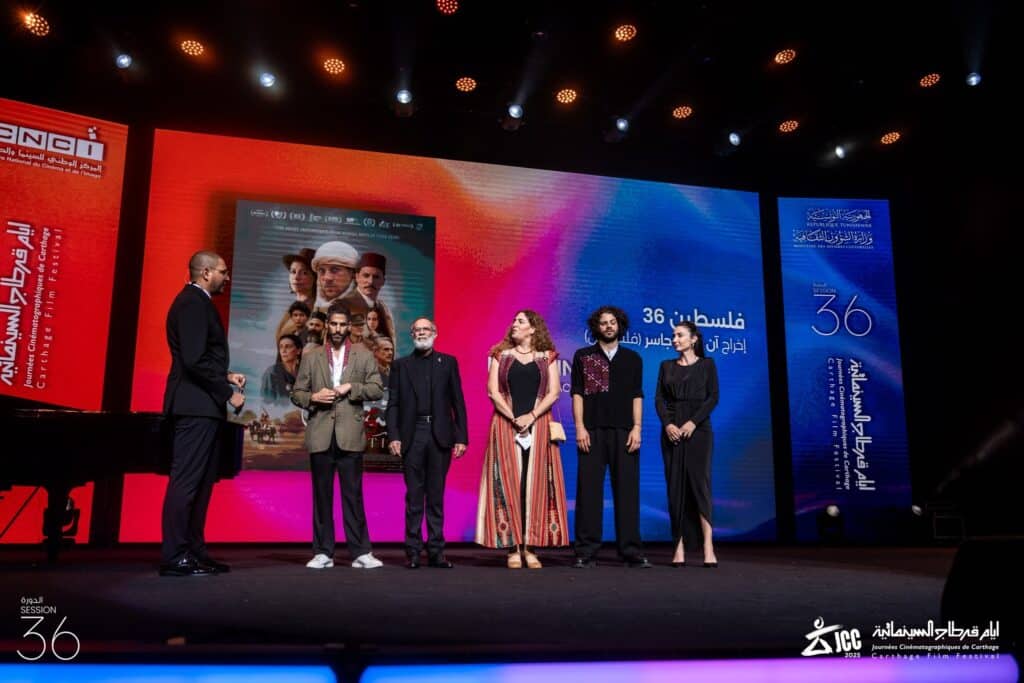
Immediately after the tribute, Amine Ben Hamza introduced Palestine 36, the festival’s opening film by Annemarie Jacir, and welcomed the film’s team, before moving on to present the week’s tributes and special sections. It was an unusual choice — rarely does a festival present its opening film so early in the evening.
The Figures Honored This Year
Throughout the ceremony, Amine Ben Hamza highlighted the tributes that will punctuate the 36th edition. Fadhel Jaziri (1948–2025) was celebrated through two key works: La Noce (1978), newly restored and screened in Tunisia for the first time, and Traversées (1982) by Mahmoud Ben Mahmoud, in which he plays the leading role. Mahmoud Ben Mahmoud himself will also be honored, with a master class devoted to his creative journey and artistic vision.
A special video segment paid tribute to Claudia Cardinale, who will be celebrated in a dedicated evening on Sunday, December 14. Three films accompany this homage: Les Anneaux d’or (1956) by René Vautier and Mustapha El Fersi, Claudia Cardinale: La plus belle Italienne de Tunis (1994) by Mahmoud Ben Mahmoud, and Claudia Cardinale: La Tunisie… splendeur et beauté (2025) by Lotfi Bahri — three films that, each in their own way, tell a lasting story of love between a woman and her homeland.
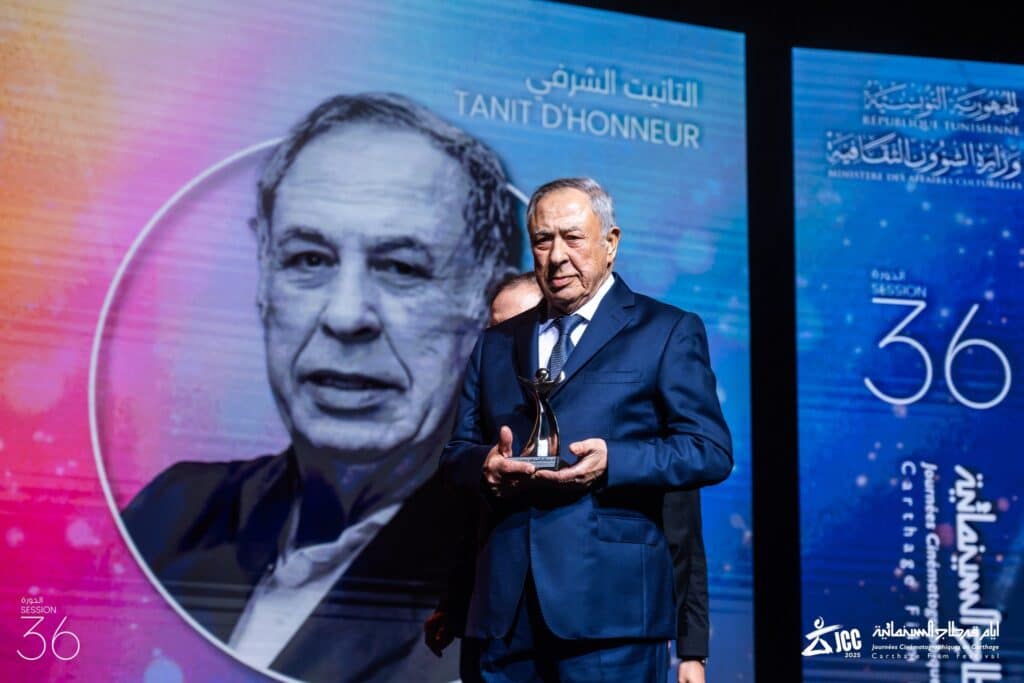
Abdelaziz Ben Mlouka received the Honorary Tanit Award for his life’s work. The trophy was presented by filmmaker Mohamed Dammak, following a video that retraced Ben Mlouka’s remarkable career as a producer. The festival also pays tribute to him through screenings of several of his productions, including the restored version of Star Wars: Episode I.
Highlights of the Program and the Juries
The ceremony also unveiled the main outlines of this year’s edition. Carthage Pro welcomes twenty projects, reaffirming the festival’s mission to support Arab and African filmmaking.
The competitive sections were then introduced: forty-two films from nineteen countries will vie for the Tanit awards across three official competitions.
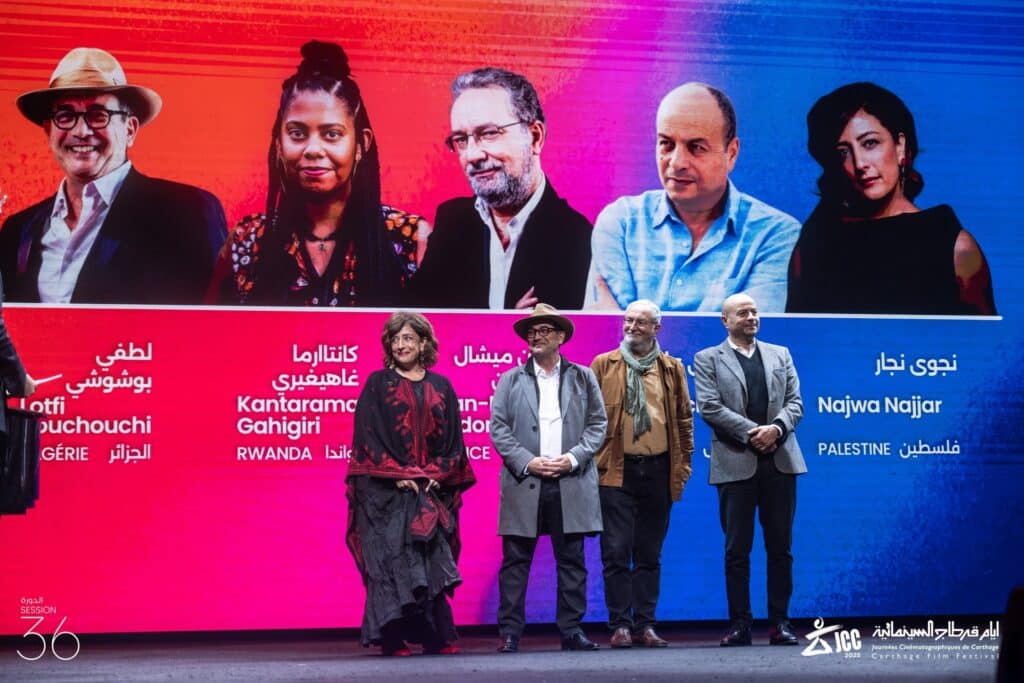
The members of the various juries were presented on stage. The jury for the feature film competition is chaired by Palestinian filmmaker Najwa Najjar. With degrees in political science and film, Najjar has directed several documentaries and fiction features, including Pomegranates and Myrrh, Eyes of a Thief, and Between Heaven and Earth. She is joined by Jean-Michel Frodon, Lotfi Achour, Kantarama Gahigiri, and Lotfi Bouchouchi.
Tunisia Showcased as a Land of Filmmaking
A video dedicated to films shot in Tunisia was then shown, combining excerpts and interviews, including one with Antonio Banderas. The sequence highlighted the country’s landscapes and filming potential, and concluded with a striking mention — the existence of a “one-stop shop” for cinema. Is it already a reality, or still a wish for the future? The question remains open.
An Opening Film That Embodies Resistance: Palestine 36
The team of Palestine 36 took the stage to introduce the film. Director Annemarie Jacir described the extremely difficult shooting conditions: “We built a massive set with Palestinian technicians. Then the war began, and everything was destroyed. We rebuilt it all — not for cinema, but to show that we are standing, that we love life, and that we will not be defeated.” She concluded by thanking Tunisia and the JCC for their support. Palestine 36 was selected by Palestine as its official entry for the Oscars.
The film follows Yusuf, a young man torn between his village and Jerusalem in 1936, as the revolt against the British Mandate begins. It explores memory and resistance through a narrative that is both historical and deeply human. The cast includes Dhafer L’Abidine, Hiam Abbass, Kamel El Basha, Saleh Bakri, Yasmine Al-Massri, Jeremy Irons, Liam Cunningham, and Billy Howle.
A Public That Stayed for the Film
Unusually, the majority of the audience remained after the ceremony to watch the film. Normally, many leave before the opening screening begins. This time, almost no one did. Why? Was it the desire to see a film that had sparked so much anticipation? Solidarity with Palestine? Or perhaps simply because, for once, there was no after-party?
The questions remain open. But this unexpected moment — a full theater choosing to stay and watch a film together — perfectly captures the spirit of JCC 2025: a festival refocused on cinema, on remembrance, and on dignity.
Neïla Driss
- JCC 2025 – Filmmaker Najwa Najjar to Chair the Jury for Feature-Length Fiction Films
- JCC 2025 – Tribute to Claudia Cardinale and Walid Chmait
- JCC 2025 – “Palestine 36” to Open the 36th Edition
- JCC 2025 – The 36th Carthage Film Festival Unveils Its Official Poster and Tunisian Selections
- Claudia Cardinale: A Cinema Legend Born Under the Tunisian Sky Passes Away at 86