

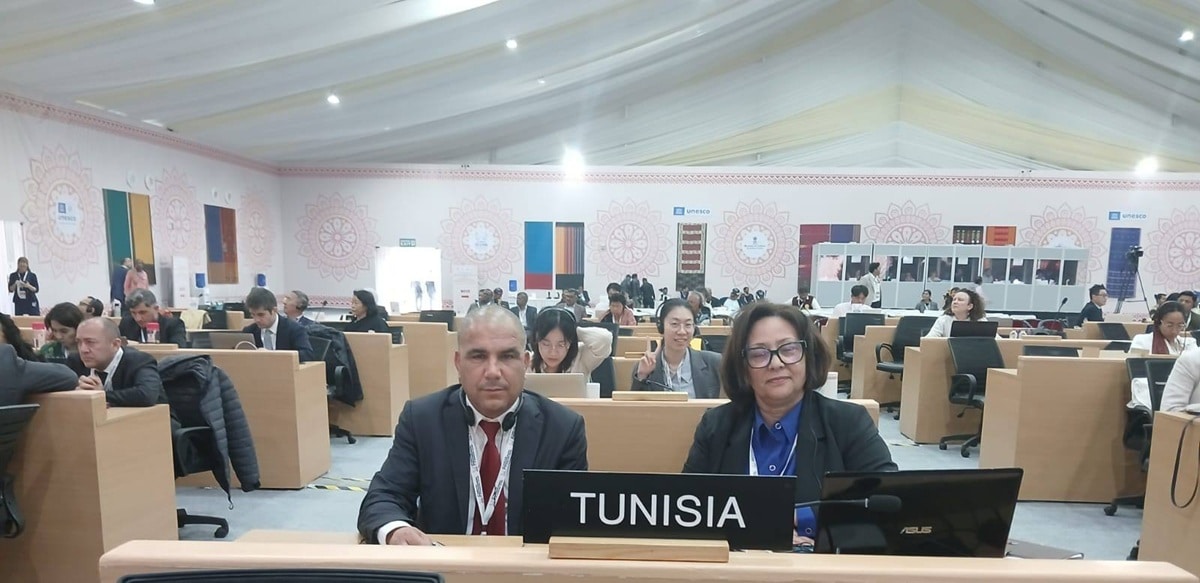
Tunisia now has ten elements listed as UNESCO Intangible Cultural Heritage, after the addition of the Arabic kohl during the 20th session of the Intergovernmental Committee held in New Delhi.
This international recognition highlights the country’s rich traditions, know-how and cultural practices. The recent inscription of kohl, in collaboration with several Arab countries, confirms the importance of this shared heritage within the Arab world.
An expanding national inventory
With the inscription of the Arabic kohl in 2025, Tunisia brings its cultural elements recognized by UNESCO to ten. These files, Tunisian, North African or pan-Arab, cover a wide spectrum of ancestral practices:
- The Arab kohl (Arab file – 2025)
- Henna: rituals, aesthetics and social practices (2024)
- Performing arts among the Twāyef of Ghbonten (2024)
- The arts, know-how and practices associated with metal engraving (2023)
- Harissa: culinary knowledge and practices (2022)
- Arabic calligraphy (2021)
- Charfiya fishing in the Kerkennah Islands (2020)
- Couscous, knowledge and practices (2020)
- Knowledge associated with the date palm (2019)
- Sejnane pottery (2018)
The Arabic kohl, a shared symbol
Used as cosmetic, protection and remedy, kohl constitutes a cultural marker anchored in the daily life of several Arab societies. Made from natural ingredients, it is prepared mainly by women, who pass on the techniques and rituals to their daughters. Kept in traditional containers called “makhala”, it embodies a family heritage and identity. In Tunisia, it is known under the names “Al khôl” or “Al khôl al ‘arbi”.
UNESCO also highlights the spiritual, social and aesthetic dimension of this practice, which has become a vector of dialogue between communities and a symbol of feminine expression.
The Tunisian Jebba file in preparation
The Ministry of Cultural Affairs is preparing the application of the Tunisian Jebba for future registration. Through this file, the authorities aim to officially recognize this traditional clothing as a pillar of national identity and a living witness to collective memory. The initiative also aims to preserve and pass on this clothing heritage to future generations.
Read also