

JCC 2025 – An Edition Between Renewal and Memory
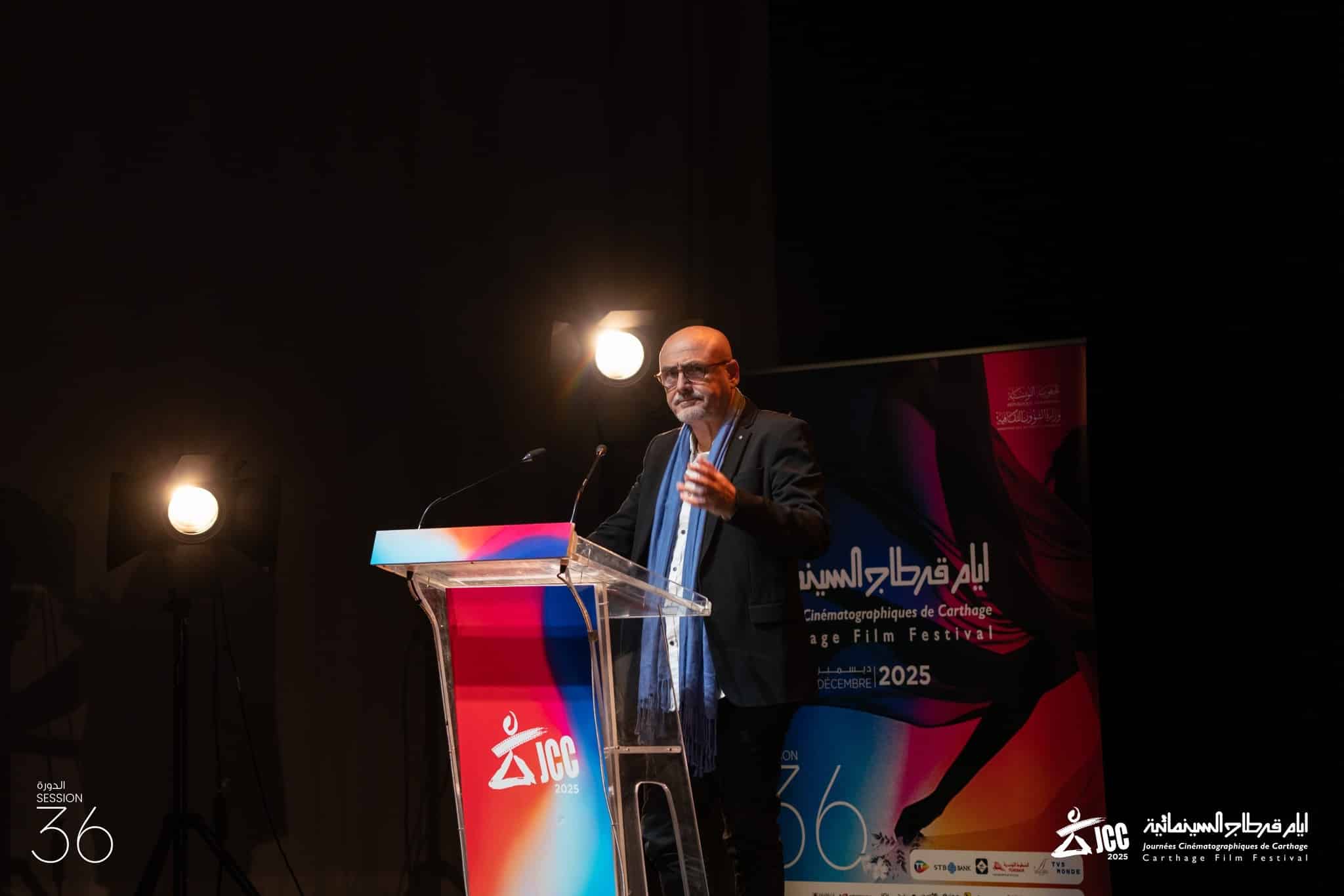
A press conference was held to present the 36th edition of the Carthage Film Festival (JCC), which will take place from December 13 to 20, 2025. Although most of the program had already been unveiled on the festival’s official Facebook page, this gathering offered deeper insight into the vision behind this year’s edition and the new elements it brings.
The familiar sections return — the official feature and short film competitions, the out-of-competition selection, the Tunisian cinema panorama, and various spotlights — alongside a few new features.
As every year, one of the most anticipated sections is World Cinema, the festival’s international window, where film lovers hope to discover major works of the year that rarely reach Tunisian screens. This year, four titles stand out in particular: three films representing their countries in the race for the Oscar for Best International Feature — Late Shift by Petra Biondina Volpe, chosen by Switzerland; Sirat by Oliver Laxe, winner of the Jury Prize ex aequo at Cannes and representing Spain; and O Agente Secreto by Kleber Mendonça Filho, awarded at Cannes with the Best Director, Best Actor and FIPRESCI Prizes, representing Brazil. Added to these is Zan o Bachech (Woman and Child) by Iranian filmmaker Saeed Roustaee, selected in the Official Competition at Cannes last May. All four are remarkable films, sure to attract a wide audience in Tunisia.
Back to the Roots – A Tribute to Palestinian Cinema
Tarek Ben Chaabane, Director of this 36th edition and President of the Organizing Committee, opened the meeting by thanking his team, composed mainly of young collaborators. He then outlined the key themes of this edition, conceived as a return to the original spirit of the Carthage Film Festival: honoring auteur cinema and celebrating Arab and African filmmakers.
Palestinian cinema will serve as the central thread of this year’s programming, featured across several sections. The opening film, Palestine 36, directed by Annemarie Jacir, has been chosen by Palestine as its official entry for the Oscar for Best International Feature. The festival will also screen the second part of From Ground Zero, an anthology film coordinated by Palestinian director Rashid Masharawi, bringing together several short films shot at the end of the Gaza war. This collective project, charged with emotion and memory, explores survival, resistance and reconstruction through multiple perspectives.
Another highlight of the Palestinian program, Once Upon a Time in Gaza by the Nasser brothers — winner of the Best Director Award in the Un Certain Regard section at Cannes 2025 and recipient of three prizes at the Cairo International Film Festival — will also be featured. The Voice of Hind Rajab by Kaouther Ben Hania, Tunisia’s official submission for the 2026 Oscars, will compete in the official competition at Carthage.
The president of the official feature film jury will be Palestinian filmmaker and screenwriter Najwa Najjar, whose film Between Heaven and Earth will be shown in the New Arab Cinema section. This film, which competed internationally, won the Best Screenplay Award at the Cairo International Film Festival in 2019.
Focus and Tributes
This edition will include a focus on Armenian cinema, featuring four restored films, works by emerging filmmakers, a poster exhibition, and a masterclass on Armenian Cinema and Identity, conducted by Armenian director Tamara Stepanyan on Wednesday, December 17, 2025, at 3:00 p.m. at MACAM – the National Museum of Modern and Contemporary Art, Cité de la Culture Chedly Klibi, Tunis.
Another focus will be dedicated to Philippine cinema, as well as a panorama of Spanish cinema and a journey through Latin American cinema, combining classic and contemporary works to offer a broad perspective on these film cultures. Among the Spanish titles, Sorda (Deaf) by Eva Libertad — nominated for the Arab Critics’ Awards for European Films — stands out for its sensitivity and formal precision.
Tributes and Restored Heritage
African cinema will of course hold a prominent place, with a tribute to Souleymane Cissé, accompanied by an installation devoted to his work and his exploration of light. Cissé, a pioneer of African cinema, was also one of the founders of the African Federation of Film Critics. His tribute will be enhanced by the presence of filmmaker Fatou Cissé, who will present her film A Daughter’s Tribute to Her Father, a work retracing the childhood, youth, and career of Souleymane Cissé, revealing the experiences that shaped his artistic vision and influence on African cinema.
A tribute will also be paid to Mohammed Lakhdar-Hamina, the first North African and African director to win the Palme d’Or in 1975 for Chronicle of the Years of Fire. The restored version of the film will be screened at the festival, reaffirming its historical importance.
The festival will also celebrate the centenary of Paulin Soumanou Vieyra, a foundational figure of African cinema, historian and critic whose work was essential to the recognition of the seventh art on the continent.
Several other tributes will enrich the program: one to Ziad Rahbani, the late Lebanese composer and theater director, honored through screenings of his films and music; one to Abdelaziz Ben Mlouka, with screenings of several films he produced, including the restored version of Star Wars: Episode I; one to Fadhel Jaziri (1948–2025), through two major works he contributed to — La Noce (1978), restored and screened for the first time in Tunisia, and Traversées (1982) by Mahmoud Ben Mahmoud, in which he plays the leading role; one to Mahmoud Ben Mahmoud himself, who will give a masterclass exploring his career and artistic philosophy; and finally, one to the legendary Claudia Cardinale, recently deceased, celebrated through three films: Les Anneaux d’or (1956) by René Vautier and Mustapha El Fersi, Claudia Cardinale, The Most Beautiful Italian Woman of Tunis (1994) by Mahmoud Ben Mahmoud, and Claudia Cardinale: Splendor and Beauty (2025) by Lotfi Bahri.
In this same spirit, the festival will introduce a new section titled JCC Classics, dedicated to restored films — an initiative aligned with the global movement to give cinematic heritage its rightful place within major festivals.
Presence and Recognition of Guests
When asked about the opening ceremony, Tarek Ben Chaabane gave few details, mentioning only a tribute to Ziad Rahbani. As for the presence of stars, he humorously echoed former JCC Director Nejib Ben Ayed: “The real stars of the JCC are the filmmakers.”
A fair statement, yet one that revives a recurring question: why don’t the JCC place greater emphasis on those they honor? Too often, tributes are limited to an award and a screening or two, without genuine interaction with the audience. The exception remains the 2016 tribute to Youssef Chahine, which included a photo exhibition and a panel bringing together several of his collaborators.
Why not return to that spirit of exchange? Festivals such as El Gouna, Cairo, or Cannes regularly organize panels, masterclasses, or public talks with their guests of honor. In Cairo, for instance, the jury president meets audiences each year.
For this edition, Carthage could have organized a talk with Najwa Najjar, the feature competition jury president, on Palestinian cinema — or with Egyptian screenwriter Mariam Naoum, president of the First Feature – Tahar Cheriaa Prize jury, about her career and success story. In Egypt, a screenplay bearing her name is almost synonymous with success.
Roundtable: A New Arab Cinema?
A roundtable will bring together Arab filmmakers and critics around an ambitious and symbolic theme: Is There a New Arab Cinema? Forty years after Férid Boughedir’s Camera Arabe, the question remains resonant. The discussion, scheduled for Wednesday at 10:00 a.m. at the Africa cinema, will be accompanied by screenings of landmark Arab films from the past two decades.
The topic is promising, yet it would have been equally interesting to address more practical themes — particularly those related to film production and shooting in Tunisia. Once a prime destination for international productions, the country has gradually ceded ground to neighbors such as Morocco, Jordan, Egypt, and even Saudi Arabia. Star Wars – Episode I, partly filmed in southern Tunisia and screening this year as part of the tributes, reminds us how important the country once was as a cinematic backdrop. One can’t help but dream of major productions returning, provided that legislation and production support structures evolve accordingly. Why not take advantage of the presence of so many filmmakers and journalists to showcase what Tunisia has to offer?
Other topics could also have been explored, such as the circulation of Arab and African films beyond regional borders. At a time when storytelling has become a geopolitical issue, it is crucial that we, as Arabs and Africans, assert our own narratives and perspectives instead of letting others tell our stories through their cultural lens. Another timely discussion could have centered on co-productions — which, while helping our films reach global audiences and compete under Western banners, raise essential questions about creative autonomy and potential constraints on content. So many topics that could have enriched the debate.
Reflection and Publications
Two book signings are scheduled: Arab Cinema Gems, Volume 1, published by the ATPCC, and Contractual Fields by Kamel Ben Ouanes. These presentations enrich the festival’s intellectual programming, which extends beyond screenings to embrace reflection and publishing.
Budget and Transparency
Chaker Chikhi, head of administration at the National Center for Cinema and Image (CNCI), emphasized this year’s commitment to transparency. For the first time, the complete financial details of the festival will be published on the official JCC and CNCI websites.
The overall budget for this edition amounts to 3.8 million dinars, compared to 2.5 million in 2024. Last year, the Carthage Film Festival reported a deficit of 400,000 dinars. For 2025, around 650,000 dinars come from sponsors and partners, while ticket sales are expected to generate 130,000 dinars. The budget will be evenly divided: one-third for human resources, one-third for rentals (equipment, venues, hotels), and one-third for artistic programming.
What Future for the JCC?
When asked about the festival’s future amid growing competition from other Arab events, Tarek Ben Chaabane responded calmly: “It’s a philosophical question. The essential thing is to preserve the soul of the Carthage Film Festival. Regardless of competition, our festival has its own identity, memory, and responsibility.”
As for a potential return to its traditional October or November dates, he acknowledged the challenge: “To achieve that, we must strengthen our professional platform. Major festivals pay high prices for world premieres. Cinema is also an industry, and we need to move in that direction.”
Memory, Archives and Continuity
On the eve of its 60th anniversary, to be celebrated in 2026, the question of the festival’s archives remains crucial and was raised several times by journalists. As early as 2020, a team had tried to reconstruct the Carthage Film Festival’s history in preparation for a retrospective, but that work now seems to have vanished. According to Chaker Chikhi, the archives do exist, but are scattered among various institutions and private entities. The festival itself still lacks its own dedicated archive — a serious gap for an event of such historical importance.
Civic Outreach and Perspectives
True to its civic mission, the Carthage Film Festival will once again reach out to broader audiences, with screenings scheduled across regions, prisons, and military bases, ensuring access to cinema for all.
As cinema continues to evolve, the Carthage Film Festival must reaffirm its role as a bridge between Arab and African cinema and the rest of the world. Its future will depend on its ability to balance memory and renewal, to connect restored heritage with contemporary creation, and to strengthen its international visibility.
More than ever, the Carthage Film Festival remains a place of encounter, reflection, and passion — a space for free cinema, rooted in our realities yet open to the future.
Neïla Driss
More on this topic:
- Claudia Cardinale: A Cinema Legend Born Under the Tunisian Sky Passes Away at 86
- JCC 2025 – Filmmaker Najwa Najjar to Chair the Jury for Feature-Length Fiction Films
- JCC 2025 – Tribute to Claudia Cardinale and Walid Chmait
- JCC 2025 – “Palestine 36” to Open the 36th Edition
- JCC 2025 – The 36th Carthage Film Festival Unveils Its Official Poster and Tunisian Selections