

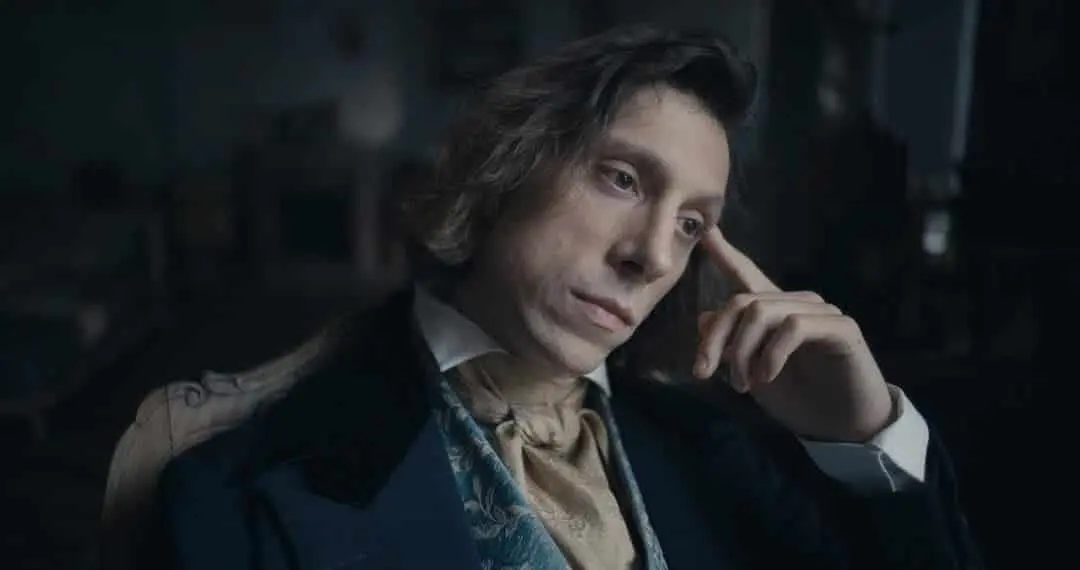
Screened out of competition at the 46th Cairo International Film Festival, in the “Special Screenings” section, Michał Kwieciński’s Chopin, Chopin! is a period film of striking visual beauty — but never decorative. Its sumptuousness is not there to seduce, but to expose the exhaustion of an era. Through the figure of the Polish composer, Kwieciński captures a society on the brink of collapse: the waning world of Parisian salons, aristocratic rituals, and a social order about to crumble.
Far from a traditional biopic, Chopin, Chopin! abandons linear storytelling for a structure made of fragments — fleeting moments of intimacy, glimmers of public glory, and suspended silences. The narrative unfolds like a sonata in itself: a dialogue between creation and decay. Eryk Kulm plays Chopin with an extraordinary restraint, embodying a man who is both present and already fading, aware that his music will soon outlive him. Every breath, every hesitation in his movement carries meaning, while the film deliberately avoids the melodramatic excesses often associated with the Romantic myth.
Set in 19th-century Paris, the film paints Chopin as the darling of Parisian nights — the talk of the town, the most romantic figure of his time. But when his lungs begin to bleed, he knows his days are numbered. Music becomes both a refuge and a rebellion, even as the glittering society around him continues to waltz in denial.
The visual reconstruction, crafted by leading Polish artisans, is one of the film’s major achievements. The attention to detail — sets, costumes, instruments, the glow of candlelight — evokes a tangible sense of lived-in authenticity. Yet the light is never celebratory. It reveals fatigue, fading faces, and the long shadows that creep across the walls. The brilliance of the salons, the grand soirées, the concert halls only heightens the encroaching darkness — of illness, solitude, and the end of an age.
This is, above all, a film about the end of a world. France, after the Revolution, clings desperately to appearances of past grandeur. History looms in the background — not as an event to recount, but as a silent threat, an unspoken inevitability. The French Revolution is never shown, yet it hangs over the story like an invisible weight, reminding us that this glittering world is already dying, even as it dances and applauds.
Kwieciński avoids grand statements. He lets meaning emerge through detail — a glance, a cough, a note that trembles. His refusal of spectacle may unsettle some viewers, but it’s precisely where the film’s power lies. Chopin, Chopin! tells of the fall of a civilization through the slow extinction of one man — and, in turn, the death of the artist becomes a metaphor for the passing of a world.
The director approaches the balance between genius and frailty with remarkable subtlety. Chopin is never deified; he is shown as a man at war with his body and time itself. This acute awareness of the end shapes every aspect of the film, especially its reflection on creation and legacy.
Throughout the story, Kwieciński returns to the theme of the secret compositions — bold, avant-garde works that Chopin discusses with Franz Liszt, who admires them but fears they won’t be understood. Near the end, bedridden, Chopin asks that these manuscripts be burned. The flames consume them without pathos, filmed as a quiet gesture of lucidity rather than pride. It is the artist’s final act of authorship — choosing erasure over distortion.
That single moment encapsulates the entire film: a meditation on memory, on what remains and what must be lost. Aware that posterity distorts, Chopin chooses silence as his truest legacy.

Music, of course, is the heartbeat of Chopin, Chopin! — not as background, but as narrative structure. The nocturnes, mazurkas, and preludes don’t merely accompany the story; they are the story. The camera lingers on fingers trembling over the keys, on the pauses between notes, on the labor of breathing. The illness becomes rhythm. The pianist and the filmmaker turn exhaustion into movement, fragility into form.
But Kwieciński also situates Chopin within the crumbling society around him — a theatre of appearances where people clap without listening. Beneath the glitter lies decay. The salons, the conversations, the wit — all are rituals performed to deny the inevitable. Chopin is not just a dying man; he’s the silent witness of a civilization that cannot face its own end.
Visually, the film unfolds like a chiaroscuro painting — at times recalling Rembrandt or Caravaggio. The light flickers as if filtered through illness itself, trembling with each breath. The cinematography mirrors Chopin’s fading pulse; the image exhales with him. Kwieciński, known for his meticulous productions, reaches here a rare harmony between form and emotion.
The film may divide audiences, precisely because it resists grandeur. Kwieciński refuses pathos, rejecting the cliché of the suffering Romantic genius. Instead, he opts for a discreet, almost ascetic mise-en-scène that makes Chopin deeply human. The emotional restraint is not detachment — it is the film’s very purpose: to show an artist facing disappearance, suspended between the fragility of the body and the permanence of music.
Chopin, Chopin! is less a narrative than a meditation — on creation, mortality, and the vanishing of worlds. It asks what it means to “leave a trace,” and whether art can truly outlast its creator. As the composer fades while the world around him clings to illusion, Kwieciński crafts a film not of resurrection but of reckoning — an exploration of how beauty dies, and how, in dying, it endures.
When the final notes fall silent, the silence itself feels musical — not an absence, but a continuation. One last surge of light fills the frame before dimming. Not an ending, but a suspension. As if the film, like the composer it portrays, were holding its breath — and, in doing so, achieving a strange kind of immortality.
Neïla Driss