

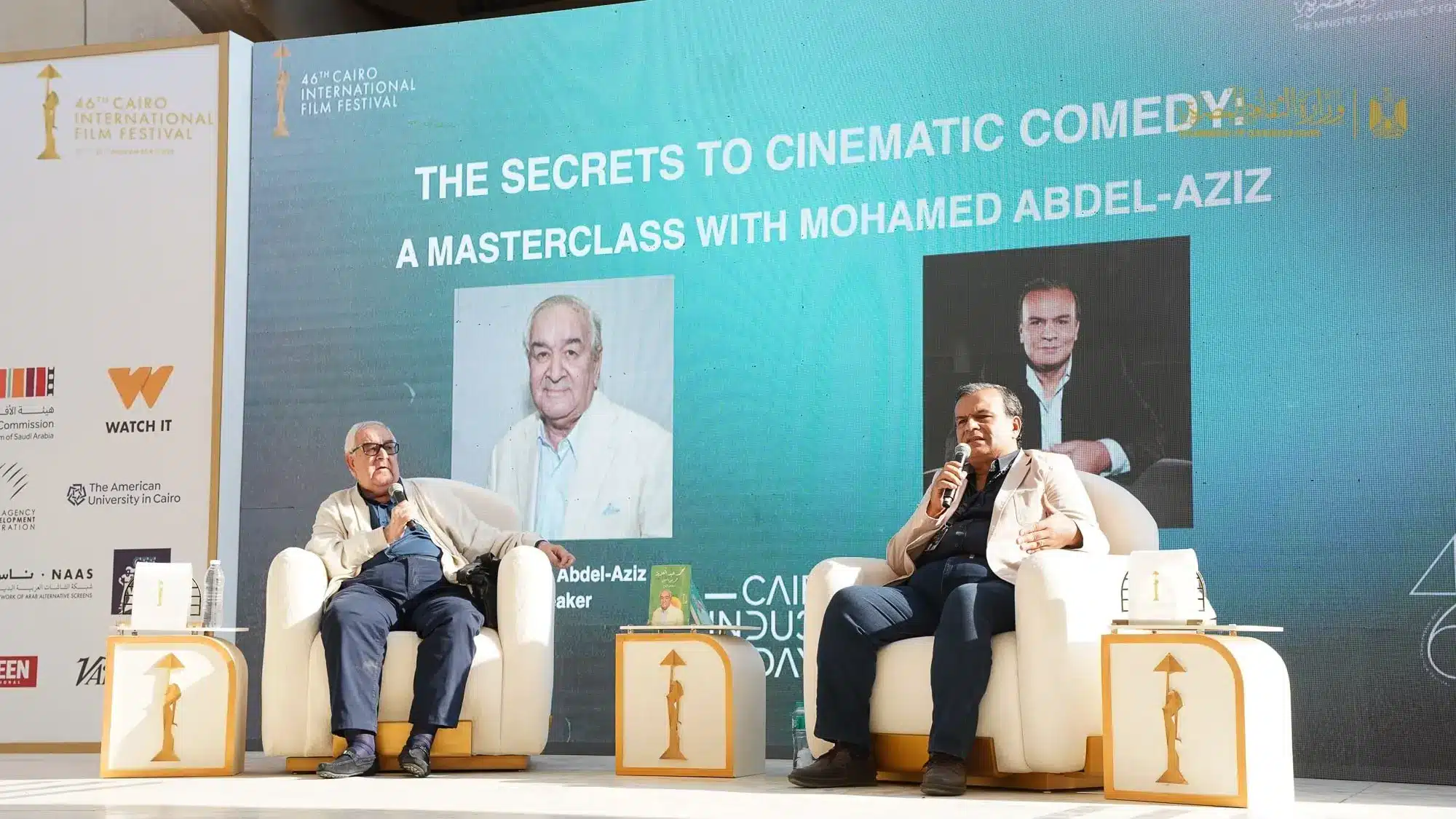
For more than five decades, Mohamed Abdelaziz has stood at the heart of Egyptian cinema, shaping an art form that blends humor with social clarity. Since the 1970s, he has forged a body of work that is both immensely popular and artistically demanding, becoming one of the few filmmakers capable of uniting box-office success, social responsibility, and a resolute ethical vision of the craft. His unusual longevity—nourished by a profound understanding of successive generations of filmmakers—makes him one of the essential witnesses to the evolution of modern Egyptian cinema.
During the 46th edition of the Cairo International Film Festival (CIFF), held from November 12 to 21, 2025, the festival honored him at the opening ceremony with the Golden Pyramid for Lifetime Achievement. The following day, the festival hosted an in-depth conversation with him, moderated by critic Osama Abdel Fattah, before a large audience and several artists who came to pay tribute to his life’s work. The encounter unfolded like a living archive of Egyptian cinema, revealing—through Abdelaziz’s own words—the foundations of an art rooted in discipline, social critique, and a deep respect for audiences.
An emotional tribute: a crowd he did not expect
Abdelaziz began by recalling the moment he learned from CIFF president Hussein Fahmy that he would receive the Golden Pyramid. He has known Fahmy for decades; they have worked together on numerous films, some of them major commercial hits. Hearing the news felt to him like “pure happiness.”
But what moved him even more was the audience’s reception during the opening ceremony. He admits he was “frightened” by the unexpected warmth:
“I never imagined I deserved such an honor,” he said.
That reaction made him feel that his decades of work—67 films, 20 television series, several stage productions including three in the private sector—“had not been in vain.” He also underlined something that has guided him throughout his career: the duty to transmit the legacy he inherited from the great masters who trained him. At this edition, CIFF also published a commemorative book about his career, distributed to festival guests.
A life devoted to cinema, theatre, and teaching
Since 1964, Abdelaziz has worked simultaneously in cinema, theatre, and teaching. Moderator Osama Abdel Fattah noted that he is considered one of the oldest active film instructors in the world, having taught generations of directors—from Daoud Abdel Sayed and Khairy Beshara to today’s young filmmakers.
Abdelaziz confirmed this continuity and recalled his years at the Higher Institute of Cinema in Cairo, where he and Hussein Fahmy studied together and where, as he says, “our professors instilled in us a love for cinema.”
Laughing, Fahmy intervened briefly to say he had taught for about twelve years before stopping “because I didn’t have the patience,” whereas Abdelaziz never left teaching.
For Abdelaziz, teaching is a creative form in itself. Passing on knowledge, watching students grow, seeing them succeed—these experiences gave him a lasting sense of joy. He added one regret: “Students make a comedy film as a graduation project only once every twenty years,” he said. For him, comedy requires a specific set of skills and a courage that too few young filmmakers attempt to embrace.
Early years: tragedy before comedy
Before becoming a major figure of social comedy, Abdelaziz began his career in tragedy. A graduate of the Higher Institute of Cinema, trained by masters like Salah Abu Seif and Hussein Kamal, he directed his first two films in a dramatic register: Forbidden Images (1972) and A Woman from Cairo (1973).
After these films, he found himself without work for two years. Then his former professor, Dr. Hatchman, brought him a comedy script—ironically, the same professor who had predicted during his student years that he would one day turn to comedy. Abdelaziz accepted. The film, Fil Seef Lazem Neheb (1974), turned out to be a massive commercial and critical success, with many saying he would become the heir to the legendary Fatin Abdel Wahab.
This success marked his formal entry into the world of comedy, although he insists: “I didn’t go to comedy. Comedy came to me.”
Tragedy and comedy: two different philosophies
Abdelaziz took time to explain the distinction that shaped his approach to filmmaking. Tragedy, he says, focuses on the particular. It tells the story of a character who commits a single mistake—just one—that defines his destiny forever. It is an intimate art centered on individual choices.
Comedy, by contrast, is about the entire society. It exposes collective behaviors, social distortions, and everyday contradictions. It ridicules harmful habits and reveals what people prefer not to discuss openly.
“Comedy deals with serious issues,” he said. It addresses social problems, bad habits, moral shortcomings. And because it attracts far larger audiences than tragic films, its influence is far deeper. For Abdelaziz, this makes comedy—not tragedy—the most serious and demanding genre.
Absolute rigor: no cheap gags, no improvisation
His motto is clear: “If you want to make comedy, you must not joke.”
He explained how he set strict rules on his sets. Laughter is not the goal: it is a by-product. A comedy must be carefully built—structured scene by scene, with no shortcuts.
He illustrated this with the example of Abdel Monem Madbouly, the legendary stage actor, who suggested wearing his jacket inside-out to provoke a quick laugh. Abdelaziz refused immediately: “That’s not what makes people laugh,” he told him.
He recalls repeating the same principle: he never directs a film with the intention of making people laugh.
“I don’t make films to make people laugh,” he told Madbouly, who was stunned.
This decision defined his method. Comedy must emerge from situations, not gimmicks. Improvisation could distort the message, so he forbade it—whether from theatre-trained actors, stars or newcomers. He monitored his performers closely, even in stage productions, standing backstage every night to ensure scenes were not altered.
“If you loosen the reins even a little, you lose control of the film,” he said. Comedy, for him, is “a complex architectural operation.”
Intabihu Ayuha Al-Sada: a critique of liberalism and moral collapse
Among his most important films, Abdelaziz cites Intabihu Ayuha Al-Sada (1978), a sharp critique of Egypt’s “infitah”—economic liberalization—and the corrosive power of money over moral values.
He recounted the true story that inspired the film: a respectable neighbor whose daughter, a law graduate, was forced to marry her cousin—a man without formal education but wealthy due to his mechanical workshop. The husband, deeply insecure, behaved atrociously.
With his team, Abdelaziz adapted the story into a confrontation between a university professor and a garbage collector, showing how material power can dominate ethics. The film, shot on a small budget and partly financed from his own pocket, achieved great commercial success and won several awards—including for Abdelaziz himself and for Hussein Fahmy, who played one of the two leading roles alongside Mahmoud Yassine. The film’s dialogue, while humorous, was built around a precise critique of society.
With Adel Imam: discipline, trust, and eighteen films
A major portion of the conversation focused on his relationship with Adel Imam. Their first encounter dates back to Abdelaziz’s early years as an assistant to Med Salem on a television film starring Fouad El Mohandes—Adel Imam’s first time before a cinema camera.
Later, when Abdelaziz directed Dakkat Qalbi (1976), a comedy starring actors known for tragedy such as Mahmoud Yassine, Adel Imam called him: “Why didn’t you ask me to join?” He eventually did, the following year, in Juns Naeim (1977). Their collaboration began there.
They worked on eighteen films together, sometimes three or four in a single year. Coming from theatre, Imam was used to carving out space for improvisation, but Abdelaziz imposed strict rules. They would read the script scene by scene, each offering suggestions, and once they agreed, nothing could be changed—not even a single word. Imam respected these rules with discipline.
Abdelaziz also recalled the exhausting rhythm they shared: Imam would finish his stage performance at three in the morning, then meet him to work on the script. At nine, Abdelaziz taught at the institute, and at two in the afternoon, he was on set. Grueling, but exhilarating.
When Adel Imam refused: the legendary “Al Baa’d Yazhab lel Maa’zoun Marratayn”
This story, told with humor, was one of the highlights of the conversation.
Abdelaziz sent the script of Al Baa’d Yazhab lel Maa’zoun Marratayn (1978) to Adel Imam, who read it and rejected it outright: “This film will fail.”
Abdelaziz considered other actors, but none seemed right—he wanted Imam. When he learned that Imam was performing in Alexandria, he made an unexpected decision: he moved the entire shoot to Alexandria.
One evening, after the play, he went to see Imam in his dressing room. At that moment, an assistant walked in and handed Imam the shooting schedule for the next day. Imam stared at him:
“I refused this film!”
“The shoot starts tomorrow,” Abdelaziz replied calmly.
Imam eventually showed up. By the third day, he complained again: “The film will fail.”
But once released, the film became a hit. One evening, they slipped into a 6 p.m. screening. The audience laughed nonstop.
“You see?” Abdelaziz told him.
Imam shrugged and joked:
“This isn’t the script you gave me!”
The line became famous, symbolizing both their affection and their creative chemistry.
Words of gratitude from two actresses
When Abdelaziz finished speaking, two actresses shared their memories.
Lebleba recalled that from their very first meeting, he told her she would become a star. Working with him, she learned the precision required in comedy: how to hold her head, where to place her gaze, how to act naturally. She spoke about playing the role of a woman constantly pregnant to keep her husband in Al Baa’d Yazhab lel Maa’zoun Marratayn, and about Khally Balak Men Giranak (1979), for which she was cast at the last minute after another actress withdrew. The film ran for thirty-four weeks and marked a turning point in her career.
Elham Chahine spoke of the deep personal and professional bond she shares with him. She recalled the moment he sent her a script for a comedy play with four major musical numbers—at a time when she was known mostly for dramatic roles. The play ran for five years and toured widely across the Arab world, revealing to audiences and directors an unexpected side of her talent. Thanks to him, she began receiving comedy roles and even musical roles she had never imagined herself playing.
A filmmaker who believes in comedy as a form of social action
Listening to Abdelaziz recount his memories, his principles, and the backstage processes of his films, one understands that his career has never been a mere sequence of works—it has been a way of thinking about society and engaging with it. Every anecdote he shared illuminated a cinema where comedy is never just entertainment: it becomes a form of activism, discreet but profound, aimed at imagining a better world.
For him, laughter is not an escape; it is a strategy. He repeated throughout the conversation a belief that seems to guide all his films: people think far more deeply when they laugh than when they are lectured. A direct or serious discourse risks alienating the audience; comedy opens a space where difficult topics can be tackled gently, where contradictions appear clearly, and where behaviors can be questioned without accusation.
By the end of the conversation, what emerged most strongly was the coherence of his trajectory. The director who refuses cheap gags, who imposes unwavering discipline, who moves an entire shoot to convince an actor, is the same man who continues to teach, to pass on, and to remind young filmmakers that comedy is essential to understanding society—and helping it evolve.
And one can’t help imagining what Egyptian comedy could become if a new generation embraced this vision: a cinema capable not only of making people laugh, but of illuminating, questioning, and transforming the world around it.
A cinema that, in the spirit of Mohamed Abdelaziz, uses laughter as a tool for clarity—and for change.
Neïla Driss