

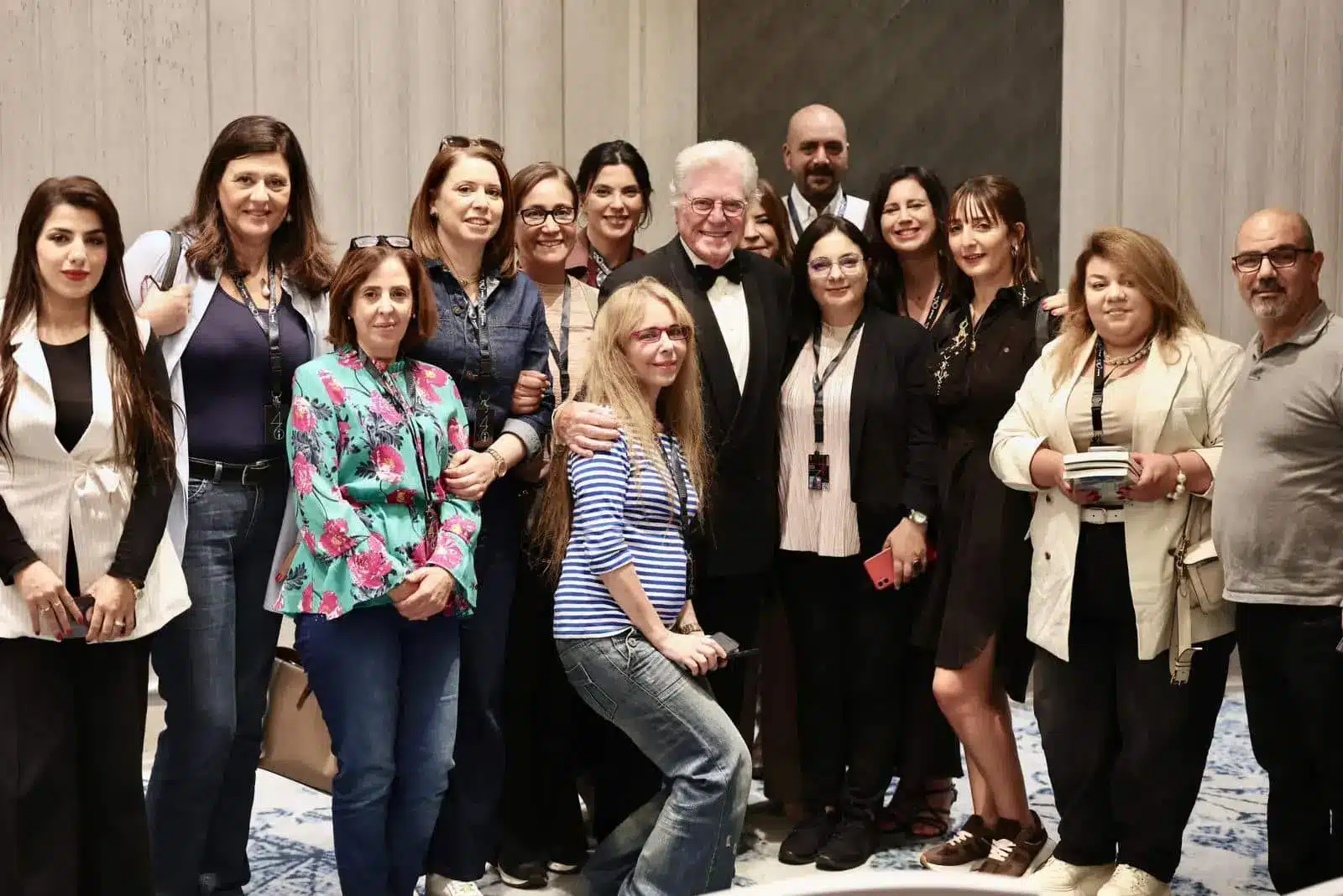
During the 46th Cairo International Film Festival (CIFF), held from 12 to 21 November 2025, festival president Hussein Fahmy met with Arab journalists to reflect on the major themes shaping this edition, to share his vision of Egyptian cinema, and to explain how he sees his role at the head of an event he considers one of the most important in the Arab world and on the African continent.
The CIFF’s role and the question of legacy
From the very start of the conversation, Hussein Fahmy expressed his hope that this edition would surpass the previous ones. The idea of moving forward, enriching the festival, and strengthening its identity returned frequently in his remarks. For him, the CIFF derives its strength from its roots: Egypt, its long cinematic tradition, and “its status as the region’s oldest and most important festival, founded in 1972. (He nevertheless overlooks one historical detail: the Carthage Film Days, created in 1966, are in fact older. Their initially biennial format, however, explains why they are only now holding their 36th edition — a nuance worth recalling.)
When asked about the festival’s future, Hussein Fahmy remained optimistic. Despite the multiplication of film festivals across the Arab world, he does not see this as a threat, but as a dynamic environment that stimulates creativity. “Competition drives creativity,” he said, emphasizing that the CIFF’s forty-seven years of history form a solid institutional foundation. What he hopes to leave behind is a stronger, more enduring festival capable of carrying Arab cinema forward.
A personal commitment to restoring Egypt’s film heritage
Film restoration has become one of the central pillars of his presidency, a commitment tied directly to his own artistic upbringing. Hussein Fahmy learned his craft with the first generation of Egyptian filmmakers and worked closely with figures such as Hassan El Imam and Youssef Chahine. Being shaped by these masters — and particularly by the aesthetics of black-and-white cinema — forged not only his artistic sensibility, but also his sense of responsibility toward this heritage. His determination to restore films springs naturally from this early formation and from the conviction that he carries part of this legacy.
When he became CIFF president, he was appointed to the board of a company that owns 1,400 films and several cinemas. He then initiated an extensive restoration project with cinematographer Mahmoud Abdel Samie, who has been closely involved in the effort. Several films have already been restored, subtitles have been added, and the work continues. Countries such as China and Germany have provided valuable support.
For him, restoration only makes sense if the films are screened. Beyond programming them at CIFF, he is considering making them available on streaming platforms to reach wider audiences. He also noted that many of these works once circulated widely — in the USSR, Brazil, China — and that the addition of subtitles now allows them to travel again.
This year, he came up with the idea of printing posters of restored films on festival tote bags. The reaction was immediate: audiences began requesting specific bags, a gesture that he sees as proof of their attachment to these works.
The following day, still in the spirit of celebrating Egypt’s cinematic heritage, Hussein Fahmy gathered the press around a massive vintage Studio Misr camera installed in the gardens of the Cairo Opera House. He explained how the machine worked, its mechanisms and particularities, and revealed that advanced discussions with Italian experts are underway to finally establish a cinema museum in Egypt. The location has not yet been decided, but the project is part of a broader vision of cultural preservation.
Balancing the CIFF with an active acting career
Asked how he manages his acting career while presiding over a festival of this scale, Hussein Fahmy explained that he does not need to spend long hours at the office every day. His role, he said, is to define the festival’s strategy, set its general orientations, make key decisions, and resolve problems when they arise. Day-to-day operations are handled by his team of qualified professionals.
Last year, he was filming during the festival. This year, immediately after the closing ceremony, he will travel to the Marrakech International Film Festival in Morocco, where he will be honoured, before returning to Egypt to begin a new shoot. He has also just celebrated fifty years in the industry, during which he has explored every genre — tragedy, comedy, theatre, cinema — always striving, he said, not to repeat himself. Artistically, he considers that he has achieved everything he aimed for.
Difficult decisions, political context and cultural responsibility
Reflecting on his three years as CIFF president, Hussein Fahmy mentioned that replacing certain members of the festival’s previous team was one of the most difficult decisions he had to make.
He also spoke about the challenges of the 2024 edition. After the massacre that followed the events of 7 October, the festival felt compelled to highlight Gaza and take a clear position. He recalled the decision to bar the State of Israel from participating in the CIFF — a stance that drew criticism when he was serving as a UN goodwill ambassador. He said he fully assumed this decision, even returning his diplomatic passport: “They cannot silence us,” he stated.
This year, the context is different, shaped by what he calls a “pseudo-peace”. At the same time, Egypt is experiencing a significant cultural moment, with major developments such as the inauguration of the Grand Egyptian Museum, contributing to a sense of renewed cultural dynamism. The festival unfolds within this broader context while remaining attentive to the situations in Palestine, Sudan and Lebanon.
The film selection and the question of Egypt’s new generation of actors
Regarding the selection of films for the 46th edition, Hussein Fahmy described a multi-step process: a committee views the films and submits reports to him. He personally watches certain titles he considers important, but the opening and closing films are chosen exclusively by him. This year, he selected the Brazilian film The Journeys of Tereza to open the festival and The Voice of Hend Rajab, directed by Kaouther Ben Hania, to close it. He insisted that no external or financial pressure plays a role in these choices.
Asked whether Egypt can still produce artists on the scale of Ahmed Zaki, Nour Sherif, Hussein Fahmy himself, Nagla Fathy or Shadia, he replied that it certainly can. While such exceptional talents are rare, he sees in the younger generation many excellent actors.
Artificial intelligence: a tool, never a substitute for the human element
On the subject of artificial intelligence, Hussein Fahmy expressed caution. AI can be useful in specific cases, he said, but must never replace human creativity. It tends to make things superficial, creates distance between viewers and characters, and risks stripping cinema of its emotional depth. Excessive use, he fears, could erode the human dimension that lies at the heart of the art form.
Neïla Driss