


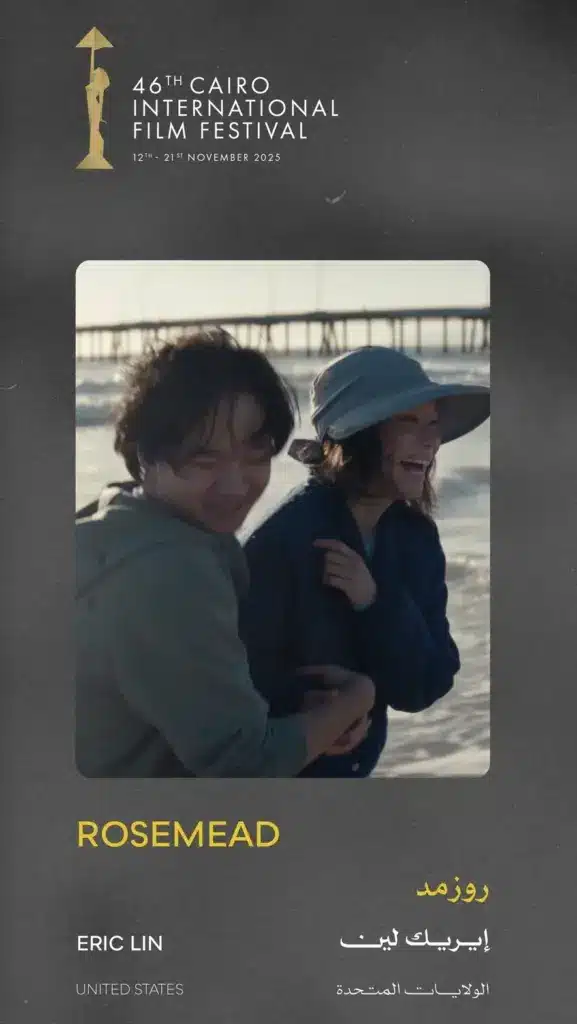
Screening in the Special Screenings section of the 46th Cairo International Film Festival, Eric Lin’s Rosemead continues a journey already marked by major festival appearances. After its world premiere at the Tribeca Film Festival in June 2025, the film went on to win the UBS Audience Award at Locarno.
Inspired by Frank Shyong’s 2017 Los Angeles Times article, the film stars Lucy Liu as Irene Chao, an American woman of Chinese descent diagnosed with terminal cancer, and Lawrence Shou as her teenage son Joe, who struggles with schizophrenia. Written by Marilyn Fu and based on true events, Rosemead unfolds in the San Gabriel Valley near Los Angeles, where illness, shame, and fear intertwine with tenderness and exhaustion.
A Story Born of Silence
Irene runs a small printing shop she took over after her husband’s death. Her son Joe, once a bright student and promising swimmer, begins to withdraw. He neglects school, isolates himself, fills his notebooks with drawings of spiders and corpses, and develops a fixation on mass shootings. What begins as concern turns into fear as his behavior grows increasingly volatile.
Before fear, though, comes denial. Irene refuses to see what is happening to her son. The thought that he might suffer from a mental illness is unbearable. She convinces herself it’s temporary, hides the evidence, avoids the doctor’s calls, and clings to the illusion that life will return to normal. Lin translates this denial into everyday gestures: Irene cleans, cooks, and works with obsessive precision, as if order could keep chaos away.
Shame is both cultural and personal. As an American of Chinese origin, Irene fears gossip, judgment, and stigma. In her largely Chinese-American community, discretion is a core value, and mental illness remains unspoken. The film portrays this milieu without stereotype — through dinners, polite exchanges, and silences that reveal unspoken codes and inherited restraint. Silence here is collective before it becomes individual.
Eric Lin captures the weight of this silence through subdued lighting, half-lit faces, and muted sounds inside a house where words no longer circulate. Within this enclosed world, illness becomes a quiet, corrosive presence that isolates and binds at once.
When Fear Takes Hold
The turning point comes when denial collapses. Joe’s gestures become alarming, his silences menacing. Irene realizes she has lost control. She begins to fear that her son could harm himself — or someone else. And as her own illness worsens, she grows weaker, more fragile.
This realization anchors the entire film. It marks the end of illusion and the beginning of a fear that can no longer be contained. Knowing her time is limited, Irene faces two ticking clocks — her own and her son’s. Mother and child move on parallel paths, each mirroring the other, bound by love and dread.
Lin films this progression with patience and restraint. There are no musical cues, no dramatic climaxes — only breathing, ambient sounds, the click of printing machines, the rustle of paper. Fear emerges not through spectacle but through accumulation, the quiet dread of what might come next.
A Mother Between Shame and Love
Lucy Liu delivers an understated, deeply grounded performance as Irene — a woman who carries everything alone, without complaint. Her stillness, her silence, her brief flashes of anger and compassion convey exhaustion and devotion in equal measure.
As Joe, Lawrence Shou portrays a teenager on the edge of comprehension, torn between fear and confusion. The film never turns him into a threat or a symbol; he remains painfully human, trapped inside his own perception of the world. The tension between mother and son — built on gestures and pauses rather than dialogue — becomes the film’s emotional core.
English and Mandarin flow naturally through their conversations, as in many Chinese-American families. The bilingual dialogue is not about separation but continuity: two languages coexisting, one for everyday life, the other for intimacy and prayer. This linguistic duality roots the story in its cultural truth without ever calling attention to itself.
An Aesthetic of the Unspoken
With his background in cinematography, Eric Lin crafts each image to express what words cannot. The light, soft and diffuse, caresses faces without beautifying them. Interiors — the home, the workshop, Joe’s room — feel like psychological spaces, both shelters and traps. Every object seems to carry emotional weight: paper, dust, tools, fluorescent light.
Violence never explodes onscreen, yet it is unmistakably present. The film shows weapons, knives, an axe — and blood. These images appear with matter-of-fact simplicity, stripped of sensationalism. That ordinariness is what unsettles. Every object holds potential danger; every silence feels heavy with consequence.
Rosemead unfolds through fragments and ellipses, as if reality itself were slipping from Irene’s grasp. This quiet, fragmented structure draws the viewer closer to her confusion and fear, inviting empathy rather than distance.
A Drama of Responsibility and Loss
Beyond its subjects of illness and impending death, Rosemead explores responsibility — that of a mother facing her son’s fragility and her own mortality, and that of a child unable to understand the scope of his own danger. The film doesn’t moralize or resolve. It observes, patiently, the gestures of survival, the decisions left unspoken.
Love and fear shape every scene. Irene loves her son but fears him. She wants to save him yet knows she cannot. This tension gives the film its gravity. Rosemead isn’t about heroism; it’s about endurance — the emotional fatigue of loving someone you no longer recognize.
A Reflection on America and Its Silences
The story unfolds against a distinctly American backdrop. Joe’s obsession with school shootings evokes the nation’s everyday proximity to violence — the ease of access to weapons, the isolation of families, the quiet dread beneath ordinary life. Yet Lin resists polemic. The danger hovers, visible but never shouted.
Through this lens, Lin and screenwriter Marilyn Fu also address the unspoken burden within Asian-American families: the shame of vulnerability, the fear of being seen as weak, the difficulty of seeking help. The film portrays these silences without commentary, through gestures and pauses that speak more clearly than dialogue ever could.
A Measured, Intimate First Feature
For his first feature, Eric Lin favors precision over spectacle. His direction relies on stillness, duration, and a meticulous attention to framing. The film’s quiet tone gives weight to the smallest details — the pressure of a hand, a glance that doesn’t meet another.
Lucy Liu carries the film with quiet strength. She embodies a woman whose resilience lies not in action but in persistence. Rosemead grounds itself in this truth: that emotion can exist within restraint, that courage sometimes means continuing to look.
The Courage to See
Rosemead is not a film about madness so much as one about lucidity — about seeing what one has long refused to see. It speaks of fear: the fear of knowing, of recognizing danger, of passing pain from one generation to the next.
After its success at Locarno and Tribeca, Rosemead arrives at the Cairo International Film Festival as a work of quiet observation — a film that listens rather than proclaims. It deals with shame, fear, love, and solitude, and reminds us that sometimes, silence is the strongest form of truth.
Neïla Driss